Are You Really Prepared To Fully Commit to Navy SEAL Training? Everyone Says 'Yes,' Yet Most Ring The Brass Bell Sooner Than Later.
Before you sign up for BUD/S, ask yourself:
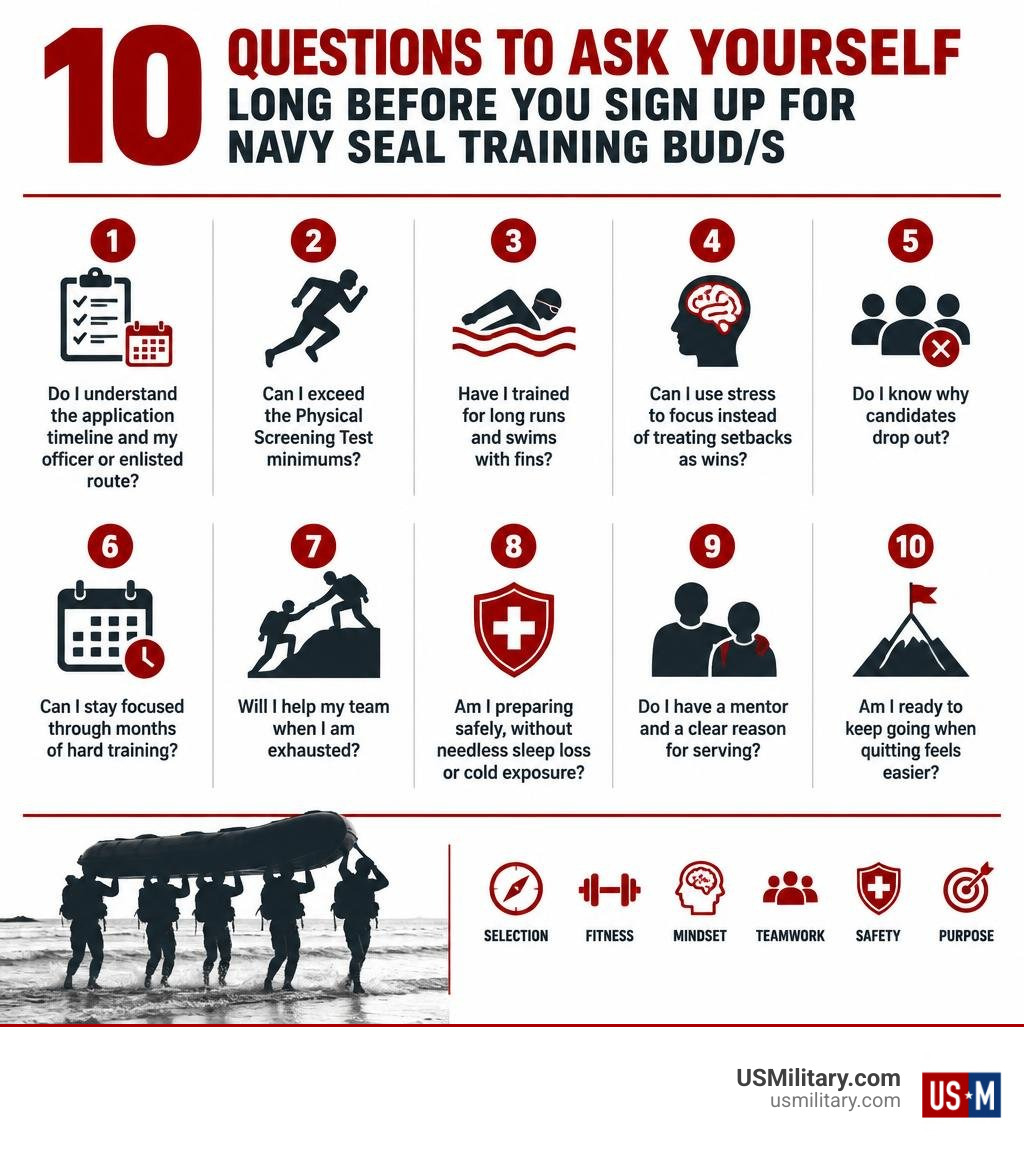
- Do I understand the application timeline and my officer or enlisted route?
- Can I exceed the Physical Screening Test minimums?
- Have I trained for long runs and finned swims?
- Can I use stress to focus instead of treating setbacks as wins?
- Do I know why candidates drop out?
- Can I stay focused through months of hard training?
- Will I help my team when I am exhausted?
- Am I preparing safely, without needless sleep loss or cold exposure?
- Do I have a mentor and a clear reason for serving?
- Am I ready to keep going when quitting feels easier?
These questions matter because getting into BUD/S is not the same as finishing it. In one study of 174 candidates, only 25 completed First Phase.
I'm Larry Fowler, a BUD/S graduate from Class 89 and the publisher of NavySeal.com and USMilitary.com, where I've covered military careers and recruiting decisions since 2007. My guide, 10 Questions To Ask Yourself Long Before You Sign Up For Navy SEAL Training BUD/S, helps you make an informed choice before you commit.
10 Questions To Ask Yourself Long Before You Sign Up For Navy SEAL Training BUD/S definitions:
- Navy SEALs BUD/S Training Requirements
- What is Navy SEAL Training 3 Phases And Why is it so tough
- 7 Big-Time Questions Every Navy SEAL Prospect Should Ask Before Signing Up For BUD/S
10 Questions To Ask Yourself Long Before You Sign Up For Navy SEAL Training BUD/S
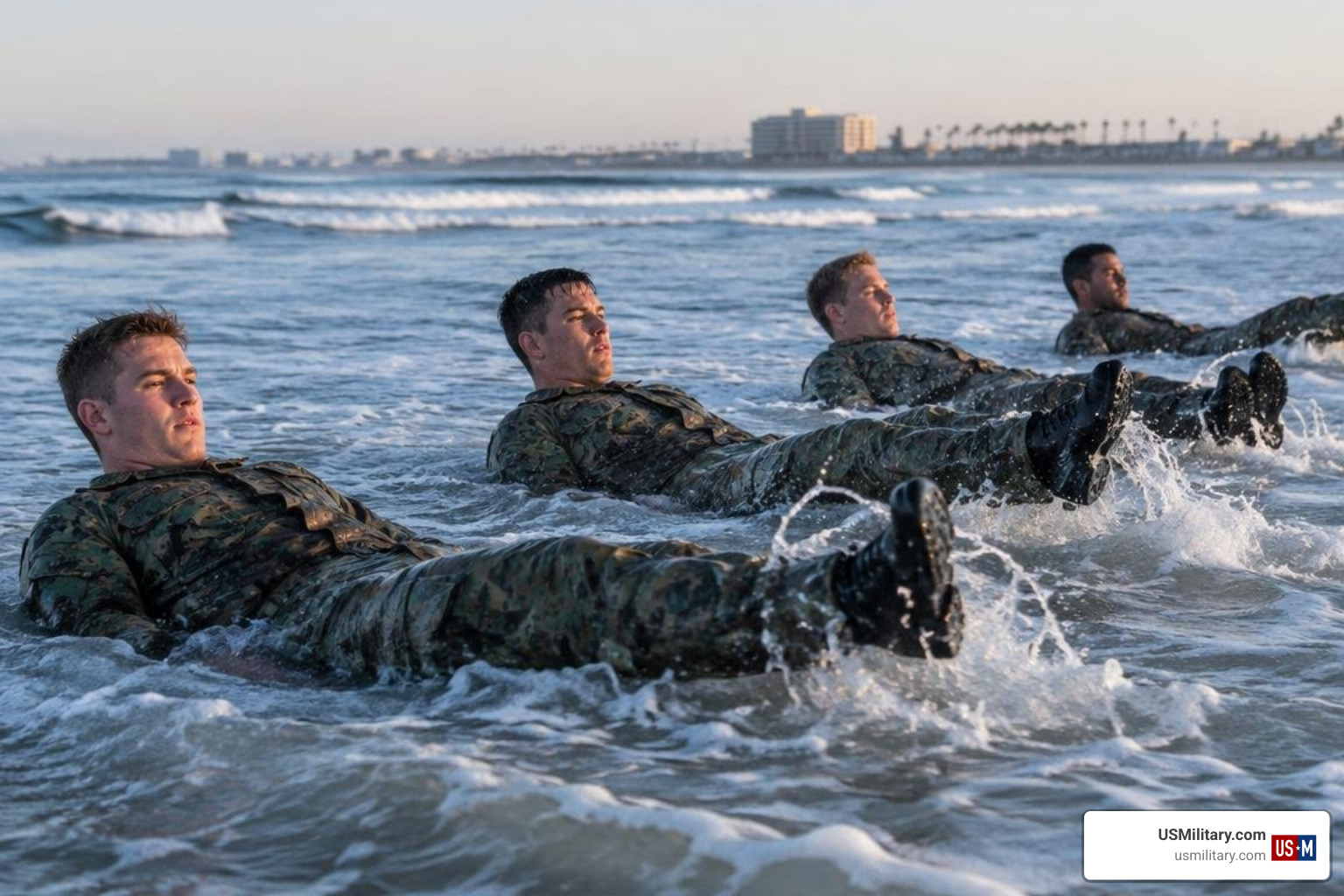
Basic Underwater Demolition/SEAL (BUD/S) training is widely considered one of the world's most grueling military selection pipelines. Historically, only 7% to 20% of candidates who step onto the grinder at the Naval Special Warfare Center in Coronado, California, make it through First Phase. In a documented cohort of 174 candidates, only 45 reached Hell Week, and only 25 ultimately completed the phase.
Surviving this crucible requires honest self-reflection long before you walk into a recruiter's office. Working through these 10 questions before you sign up for Navy SEAL training (BUD/S) will help you decide whether you have the mental, physical, and psychological stamina required for the journey.
| Physical Assessment Event | Minimum Navy PST Standard | Competitive BUD/S Prep Target |
|---|---|---|
| 500-Yard Swim | 12:30 (Breast/CSS) | Sub-9:00 (Combat Side Stroke) |
| Push-Ups (2 Minutes) | 50 reps | 100+ reps |
| Sit-Ups (2 Minutes) | 50 reps | 100+ reps |
| Pull-Ups (No Time Limit) | 10 reps (dead hang) | 20+ continuous reps |
| 1.5-Mile Timed Run | 10:30 (PT gear) | Sub-9:00 (Boots and utilities) |
| 4-Mile Timed Run | N/A (Standard BUD/S test) | Sub-28:00 (In boots on soft sand) |
10 Questions To Ask Yourself Long Before You Sign Up For Navy SEAL Training BUD/S: Timeline and Selection Routes
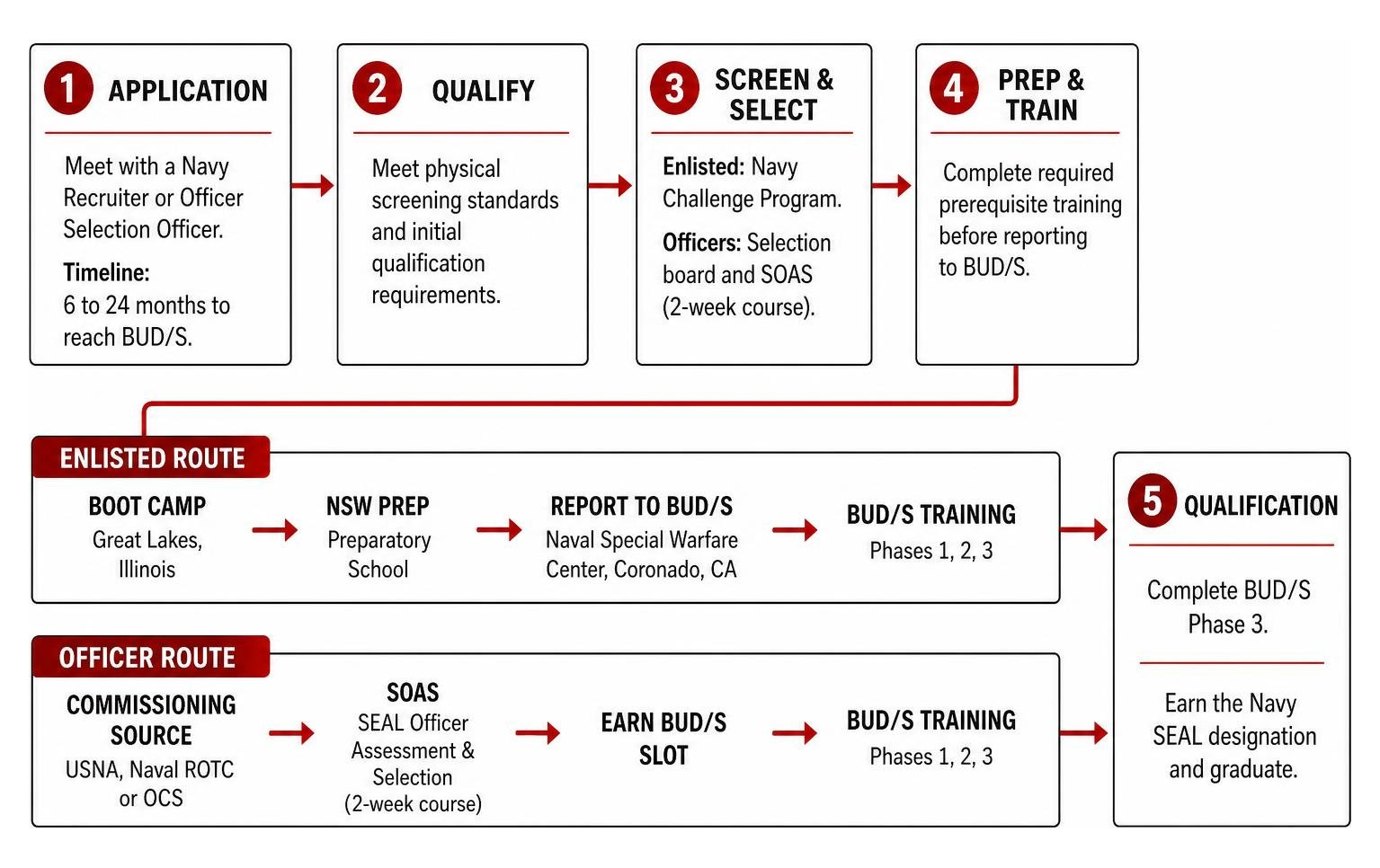
Do you understand how long the pipeline takes and which commission path fits your background? The timeline from your first meeting with a Navy recruiter or Officer Selection Officer to your first official day at BUD/S typically spans 6 to 24 months.
The path splits significantly based on whether you enlist or pursue a commission:
- Enlisted Route: Enlisted candidates secure a Special Warfare Operator (SO) contract via the Navy Challenge Program. The Navy allocates 700-800 enlisted BUD/S billets per year. Candidates complete Navy Recruit Training Command (Boot Camp) in Great Lakes, Illinois, followed by Naval Special Warfare Preparatory School (NSW Prep) before reporting to Coronado.
- Officer Route: Officer accession is fiercely competitive, with only 70 to 80 billets available nationwide each year across the United States Naval Academy (USNA), Naval ROTC, and Officer Candidate School (OCS). Prospective officers must pass rigorous selection boards and attend the two-week SEAL Officer Assessment and Selection (SOAS) course in Coronado before earning a BUD/S training slot.
To understand the broader operational framework and application procedures, read our guide to navigating the Navy SEAL path, along with the historical details outlined in the official Navy SEAL selection and training pipeline.
10 Questions To Ask Yourself Long Before You Sign Up For Navy SEAL Training BUD/S: Physical Standards and Fin Swimming
Can you comfortably crush the Physical Screening Test (PST) and maintain high volume in specialized gear? Simply meeting the Navy's baseline minimums almost guarantees you will struggle during Phase 1.
Competitive candidates arrive able to swim 500 yards in under 9 minutes using the Combat Side Stroke (CSS), do 100+ push-ups and sit-ups in two-minute blocks, and complete 20+ dead-hang pull-ups.
Furthermore, real BUD/S conditioning differs from traditional gym workouts:
- Fin Swimming: You will complete two-mile ocean swims each week wearing stiff Rocket Fins or UDT fins. Preparing your ankles, hips, and calves 3 to 4 months in advance prevents debilitating tendonitis.
- Boot Runs: Timed four-mile beach runs must be finished in under 28 minutes while wearing utility trousers and military boots.
- High-Volume Calisthenics: Expect sets of 100 to 1,000 flutter kicks while wet and sandy on the grinder.
Review our comprehensive Navy SEAL BUD/S requirements guide to audit your physical metrics before setting a ship date.

10 Life-Time Benefits of Becoming a Navy SEAL Officer: A Survival Guide
Question 3: Have You Developed a Stress-Is-Enhancing Mindset Over a Failure-Is-Enhancing Outlook?
How do you view acute stress under duress? Modern performance psychology shows that viewing physiological stress as an asset—a stress-is-enhancing mindset—significantly improves performance. Research shows that candidates who view stress as an evolutionary tool to sharpen cognitive focus complete obstacle courses 4.2% faster (roughly 27 seconds quicker) and persist 12% longer in selection pipelines compared to those who view stress as toxic or harmful.
Critically, you must avoid confusing this with a "failure-is-enhancing" outlook. Learning from mistakes is necessary, but romanticizing failure during selection is dangerous. In BUD/S, failure to meet standards results in remediation, rollbacks, or administrative drops. Reframe rapid heart rates, shivering, and muscle burn as your body preparing you to perform at your absolute peak.
Question 4: Do You Understand the Top Reasons Candidates Drop Out and Ring the Bell?
Are you prepared for the non-fitness obstacles that eliminate the majority of trainees? Over 70% to 80% of candidates fail to graduate. Trainees drop out for distinct, predictable reasons:
- Drop on Request (DOR): Voluntarily quitting by ringing the brass bell three times. This is almost always caused by mental fatigue and the inability to tolerate prolonged discomfort.
- Cold-Water Immersion and Hypothermia: Continuous exposure to 50-to-60-degree Pacific Ocean temperatures drains core heat and breaks mental resolve faster than physical fatigue.
- Medical Attrition: Overuse injuries, including tibial stress fractures, shoulder impingements, cellulitis, and Swimming-Induced Pulmonary Edema (SAPE).
- Phobias and Water Competency: Inability to overcome underwater pool evolutions, dark night swims, or fear of heights on the obstacle course.
Explore our breakdown of why the three phases of SEAL training are so tough to understand, and how each training segment tests your physiological thresholds.
Question 5: Is Your Mental Toughness Ready for a Six-Month Psychological Marathon?
Can you sustain unbroken focus across a six-month selection course? BUD/S is not a short sprint; it is an endurance marathon composed of:
- Three weeks of Indoctrination / Orientation
- Seven weeks of First Phase (Physical Conditioning & Hell Week)
- Seven weeks of Second Phase (Combat Diving & Pool Competency)
- Seven weeks of Third Phase (Demolitions, Reconnaissance, and Land Warfare on San Clemente Island)
Succeeding across this duration requires breaking the day into manageable micro-goals. Instead of worrying about surviving until Friday, focus on surviving until breakfast, then lunch, then dinner. For real-world mindset strategies, read these BUD/S lessons on courage and self-confidence.
Teamwork, Evaluations, and Surviving Hell Week Realities

Question 6: Can You Excel in Peer and Instructor Evaluations Without Self-Serving Ego?
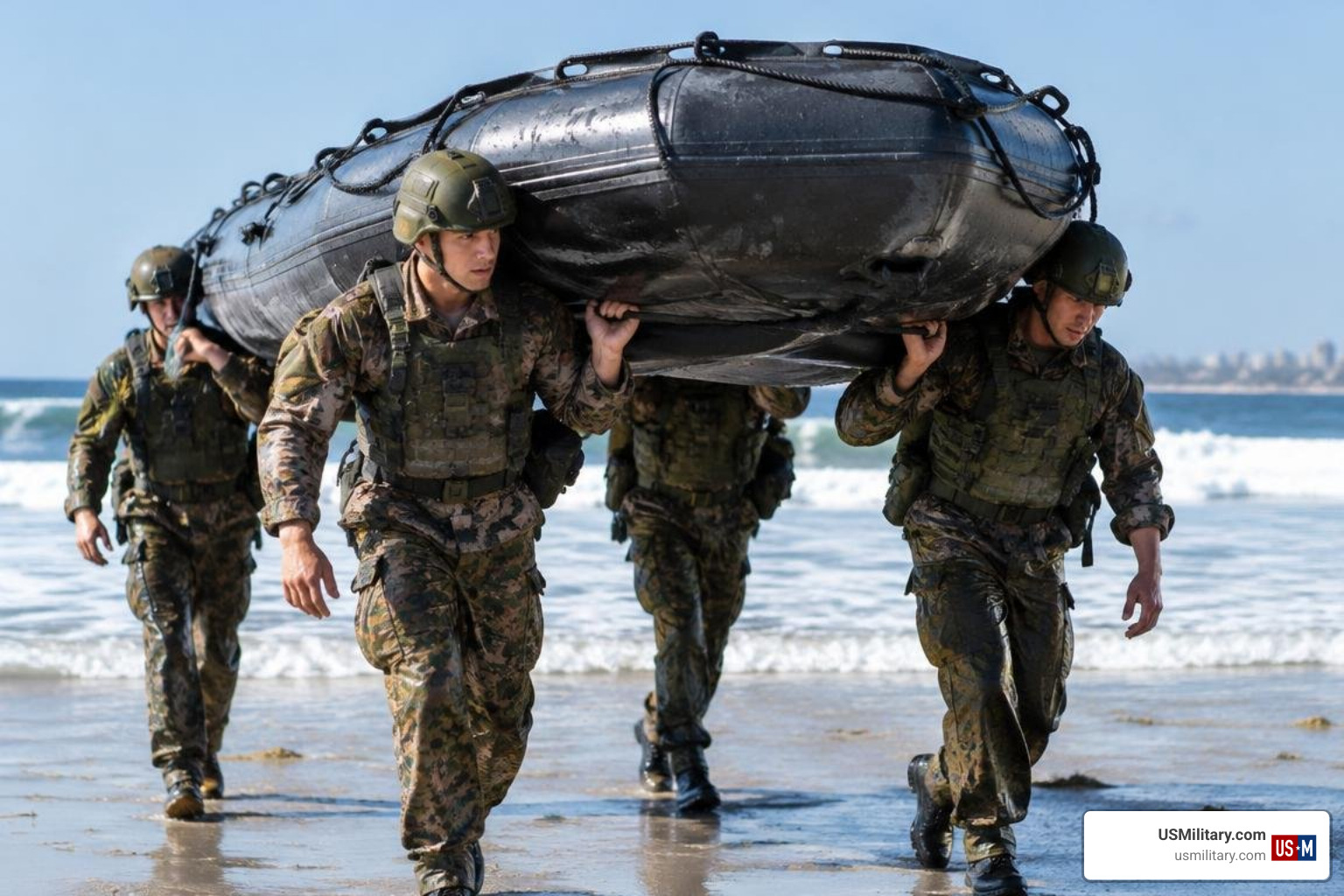
Can you put your teammates ahead of yourself when you are cold, starving, and sleep-deprived? BUD/S is fundamentally a team-selection course disguised as an individual endurance test. Throughout training, candidates are organized into seven-man boat crews assigned to carry a 200-pound Inflatable Boat Small (IBS) and a 300-pound log.
- Peer Evaluations: Instructors regularly conduct peer evaluations where class members rank each other anonymously. The training cadre quickly identifies and removes selfish performers who shirk their share of log or boat weight.
- Instructor Evaluations: Instructors constantly assess humility, coachability, and composure. Arrogance will rapidly bring unwanted attention to the grinder.
Question 7: How Effectively Are You Simulating Cold Exposure, Sleep Deprivation, and Rucking?
Have you conditioned your body and mind for environmental friction without risking pre-training burnout? Hell Week involves 5.5 days of continuous operations with fewer than four hours of total sleep, requiring extreme grit.
Safe ways to build resilience before arriving include:
- End daily workouts with cold-water immersion or cold showers to build cold tolerance.
- Conducting long-distance endurance rucks with progressive loads (35–50 lbs) across variable terrain to build spinal and ankle durability.
- Train in rain, wind, or early-morning cold without complaint.
- Avoid dangerous extreme pre-BUD/S sleep deprivation stunts on your own; focus instead on functional recovery and durable physical capacity.
Review these essential questions to ask before BUD/S for additional pre-training preparation benchmarks.
Question 8: Have You Built an Unshakable Support Network and Found a Qualified Mentor?
Do you have experienced professionals guiding your development? Preparing for Naval Special Warfare in isolation increases your risk of overtraining injuries or following outdated fitness advice.
Seek out former NSW operators, certified tactical strength coaches, or military mentors who can offer realistic guidance regarding pool training, gear selection, and mental discipline. Make sure your family and support network understand the physical demands and time commitment required during the training pipeline.

Preparing for BUDS: Ready to deal with cold water, long runs, then hell week.
Question 9: Is Your Personal "Why" Deep Enough to Survive the Darkest Hours?
Why do you want to become a Navy SEAL? If your answer is rooted in Hollywood glamor, personal vanity, or financial bonuses, you will likely quit during Hell Week's Sunday night breakout or during continuous surf immersion.
Your "why" must be an intrinsic, unbreakable commitment to serving your country, protecting your teammates, and testing your deepest personal limits. When your body is shivering violently at 0200 on Coronado beach, only a deep sense of purpose will keep you standing. Read about personal growth through BUD/S adversity to see how operational purpose develops through hardship.
Question 10: Are You Ready to Accept That Quitting Is a Voluntary Choice, Not an Accident?
Have you accepted that no one accidentally rings the bell? Quitting BUD/S is an active, voluntary choice. The brass bell hangs beside the grinder at all times. Rings occur when a candidate decides that immediate physical relief is worth surrendering their long-term dream.
Recognizing that every evolution ends—and that every meal is just a few hours away—lets you control your internal dialogue. To see what awaits those who refuse to quit, explore the daily operational reality of Navy SEAL operators.
Strategic Pre-BUD/S Preparation: Physical Conditioning and Mindset Drills
Preparing for BUD/S requires balancing functional strength, cardiovascular endurance, and durability:
- Calisthenics Conditioning: Emphasize high-volume push-ups, dips, pull-ups, and core work to build muscular endurance without adding unnecessary body mass.
- Aerobic Base: Build a strong engine through progressive running and swimming mileage, alternating between interval work and long, slow distance (LSD) sessions.
- Injury Prevention: Prioritize rotator cuff stability, hip mobility, and lower-back health to handle the structural loads of log physical training and boat carries.
| Feature | Enlisted Path (SO Rating) | Officer Path (1130 Designator) |
|---|---|---|
| Annual Billets | ~700–800 candidates | ~70–80 candidates |
| Entry Routes | Navy Boot Camp + NSW Prep | USNA, NROTC, OCS + SOAS |
| Primary Focus | Tactical execution, weapons, field craft | Tactical leadership, mission planning, command |
| Selection Gate | Enlistment Contract + PST standard | SOAS evaluation board + Community interview |
For detailed information on special operations career structures, consult the official special operations career pathways and read our complete guide to Navy SEAL service and career milestones.
Frequently Asked Questions About Preparing for BUD/S
What running and swimming pace do you need to avoid the goon squad at BUD/S?
The "goon squad" is the remedial conditioning group formed for candidates who finish near the back of timed runs and swims. To safely avoid remedial training, maintain a sub-28-minute pace on your weekly four-mile boot runs (a sub-7:00 per-mile pace on soft and hard sand) and complete your weekly two-mile ocean fin swims in under 70 to 75 minutes.
How does the officer selection process differ from the enlisted pipeline?
The officer pipeline is exceptionally selective, accepting only 70 to 80 officers annually compared to roughly 700 to 800 enlisted slots. Officers are evaluated on their leadership potential, character, and academic performance through the SEAL Officer Assessment and Selection (SOAS) program. At BUD/S, officers are expected to lead boat crews, maintain organizational standards, and set the standard for physical endurance.
Can heavy powerlifting replace calisthenics and endurance work for BUD/S prep?
No. Excessive muscle mass increases oxygen demand during long swims and adds dead weight during high-mileage runs and obstacle-course evolutions. While baseline functional strength is essential for handling logs and boats, your training should emphasize calisthenics volume, cardiovascular endurance, grip strength, and durable bodyweight movement efficiency over maximal heavy lifts.
Conclusion: Mastering the Mind Before Stepping on the Coronado Grinder
At USMilitary.com, our mission is to provide service members, veterans, and prospective recruits with clear, practical guidance across all military branches. Earning the Navy SEAL Trident is one of the most demanding journeys in the armed forces. It requires exceptional physical conditioning, emotional maturity, humility, and an unbreakable mindset.
By asking yourself these ten questions today, you can address your weak points, build a resilient foundation, and step onto the grinder fully prepared to succeed. Explore our Navy SEAL complete guide and preparation resources to begin your journey toward military special operations.