How to Avoid the 10 Most Common VA Disability Scams in 2026

The 10 Most Common VA Disability Scams in 2026 include unaccredited claim sharks, pension poaching, PACT Act phishing, fake benefit postcards, VA overpayment demands, direct-deposit hijacking, fake VSO representatives, VA home-loan schemes, bogus job or grant offers, and romance scams.
The fastest way to protect yourself is simple: do not pay someone to file an initial VA claim, never share VA.gov, Login.gov, or ID.me credentials, and verify any benefit offer through VA.gov or an official VA phone number. Real VA staff will not demand gift cards, cryptocurrency, wire transfers, or an immediate payment to keep your benefits.
Veterans and military families reported $584 million in fraud losses in 2024, according to the FTC. Scammers often use urgent language, official-looking logos, and promises of a higher disability rating or faster approval to make a bad offer seem trustworthy.
I am Larry Fowler, publisher of the USMilitary.com Network, which has helped military audiences understand VA benefits and service-related decisions since 2007. In this guide to the 10 Most Common VA Disability Scams in 2026, I will show you what these schemes look like and how to respond before money or benefits are lost.
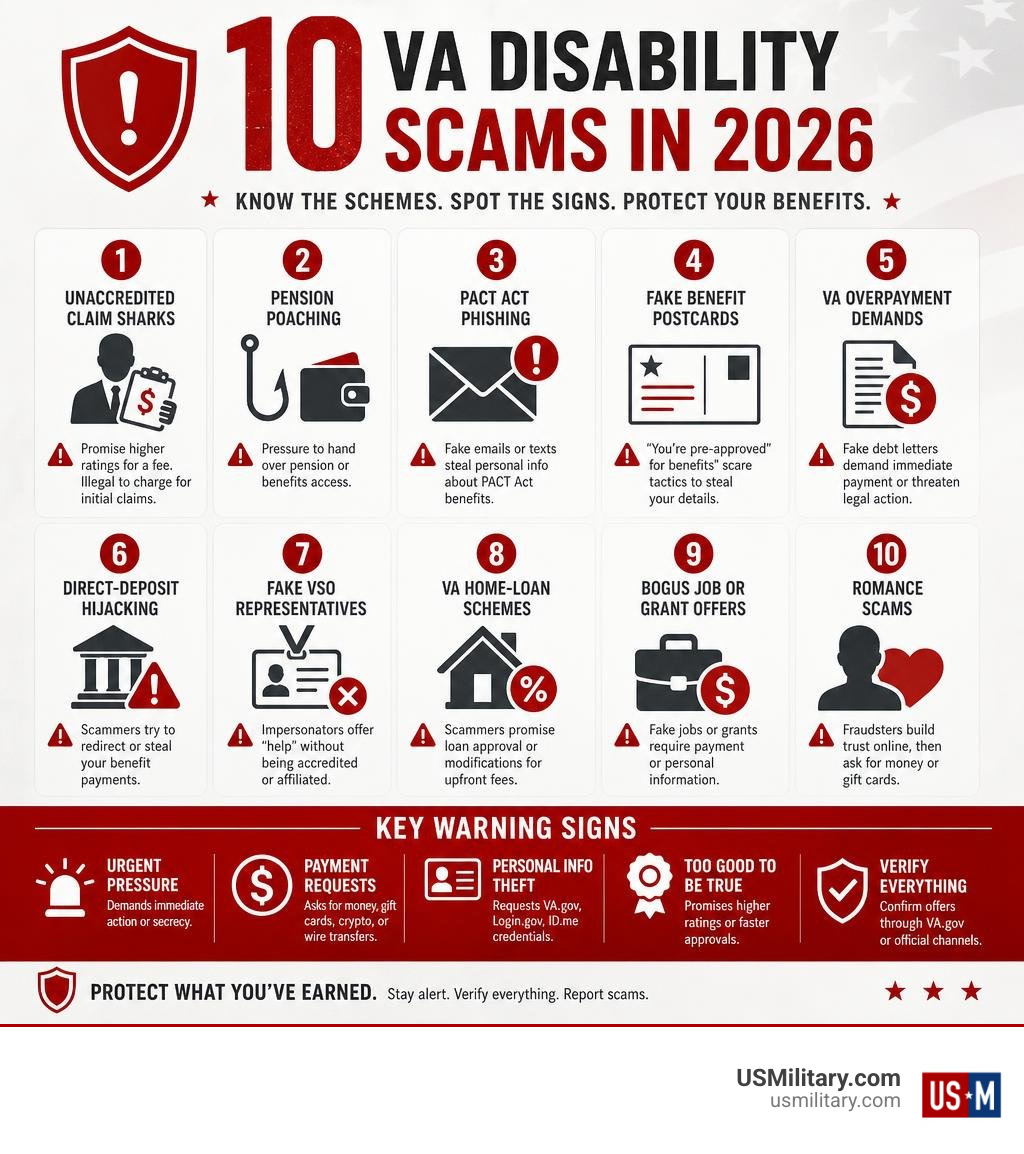
The 10 Most Common VA Disability Scams in 2026
With the Department of Veterans Affairs compensating roughly 6 million veterans in 2026 and allocating over $190 billion annually to disability programs, bad actors see military compensation as a massive target. As highlighted by VA OIG warnings on claims predators, fraudulent outfits rely on complex paperwork, digital confusion, and aggressive sales scripts to siphon off earned military compensation.
Understanding how these schemes operate is your first line of defense. Below is an exhaustive breakdown of the ten most prevalent schemes targeting the veteran community today.
Talk With An Expert About Your VA Disability Rating. You May Be Qualified For Higher Pay. Click Here For A Free Call To Discuss Your Disability Rating.
Unaccredited Claim Sharks: #1 Among the 10 Most Common VA Disability Scams in 2026
Unaccredited claims consulting companies—widely referred to as "claim sharks"—represent the most widespread threat to veterans filing for disability benefits. These operations promise guaranteed rating increases, "secret" medical lines, or faster turnarounds. In exchange, they demand illegal upfront fees or lock veterans into contracts requiring them to surrender five to six times the monthly increase of their award.
Federal law strictly regulates who can assist veterans with their claims. Only VA-accredited attorneys, claims agents, and recognized Veterans Service Organization (VSO) representatives may provide claim preparation representation. Furthermore, it is illegal under federal statute to charge fees for assistance with an initial claim.
To bypass state fee caps (such as Florida’s $12,500 limit under the Veterans Right to Choose Act), some claim sharks employ a deceptive "backpay-and-financing trick." They tell the veteran that there is "no fee from your backpay," only to issue a separate, third-party loan agreement charging steep interest rates. Understanding how to do the VA claim process the right way ensures you partner with verified advocates who operate entirely within the law.
Pension Poaching and Asset Traps in the 10 Most Common VA Disability Scams in 2026
Pension poaching specifically preys upon elderly veterans and surviving spouses seeking the VA's Non-Service-Connected Pension and Aid and Attendance benefits. Unscrupulous financial planners, insurance salesmen, and bogus eldercare consultants convince seniors to artificially transfer their wealth, buy high-commission deferred annuities, or place assets in irrevocable trusts to skirt the VA's net-worth limits.
As documented in a comprehensive senior veteran scam protection report, these asset-shifting maneuvers carry catastrophic financial consequences. Moving assets can trigger severe Medicaid look-back penalties, leaving veterans completely ineligible for nursing home coverage when they need it most. Never pay for assistance completing VA Form 21P-527EZ or 21P-534EZ; accredited VSOs complete these applications at zero cost.
PACT Act Phishing and Deceptive Postcard Hoaxes
The historic passage of the PACT Act expanded healthcare and benefits for millions of veterans exposed to burn pits, Agent Orange, and other toxic substances. Unfortunately, it also triggered an unprecedented surge of phishing and postal mail fraud.
Scammers send out glossy postcards and mass text messages branded under names like the "Veterans Savings Program." These mailers offer non-existent perks, such as a "$185 monthly payout" or "guaranteed free comprehensive dental coverage." When a veteran scans the QR code or dials the number on the card, an imposter attempts to collect Social Security numbers, dates of birth, and service histories under the guise of "locking in your PACT Act entitlement before the deadline." Remember: the VA does not send mass promotional postcards promising cash for dental work, nor does PACT Act eligibility expire.
VA Overpayment and Fake Debt Demands
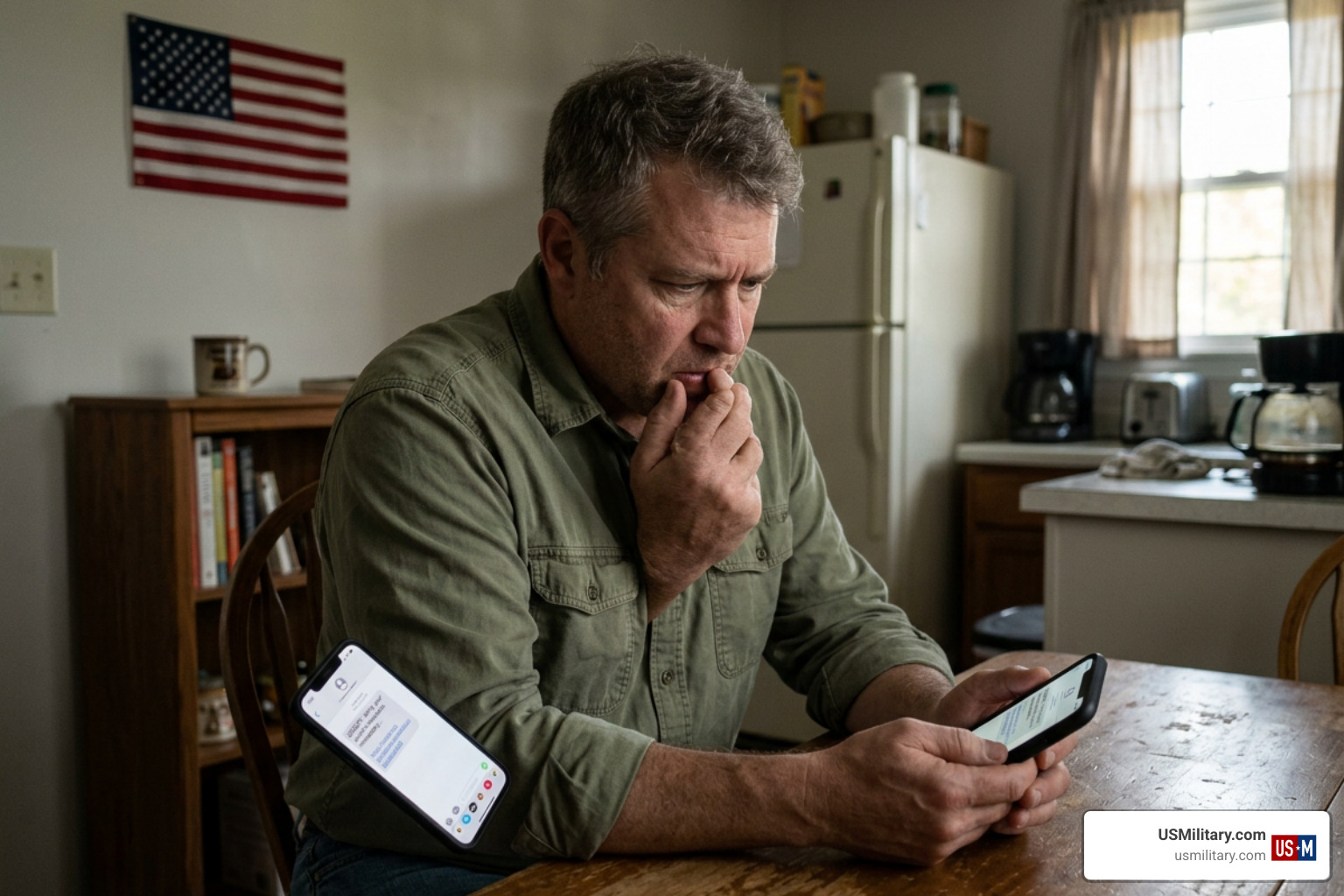
One of the most intimidating tactics hitting veterans involves fake notifications from the "VA Debt Management Center." Fraudsters send urgent emails or text messages claiming an audit revealed an administrative overpayment of thousands of dollars. The message threatens an immediate suspension of monthly disability payments, wage garnishment, or legal action unless the "debt" is settled right away.
An in-depth analysis of the VA overpayment scam reveals that criminals demand settlement through untraceable payment methods, including prepaid debit cards, wire transfers, cryptocurrency, or gift cards (such as Apple or Google Play).
The real VA never collects debts via text message, never demands payment through gift cards or crypto, and always provides written notice by postal mail with formal dispute and waiver procedures.
Benefit Redirect and Direct Deposit Hijacking
Direct deposit tampering is a silent, devastating cybercrime. Rather than tricking you into sending them money, criminals break into your existing account infrastructure to steal your monthly compensation payments before you even realize they are gone.
Perpetrators deploy lookalike phishing websites mimicking Login.gov, ID.me, or VA.gov. Once an unsuspecting service member enters their username, password, and multi-factor authentication (MFA) code on a spoofed portal, the scammer logs into the authentic VA profile and changes the routing and checking account details to an offshore or prepaid account. The veteran only discovers the breach when their expected direct deposit fails to post at the beginning of the month.
Fake VSO Impersonation and Bogus Advocates
Imposters frequently design slick websites, print official-looking business cards, and display patriotic logos resembling the American Legion, VFW, or DAV to deceive veterans. They present themselves as "Certified VA Claims Coordinators" or "Veteran Service Advocates."
Once trust is established, these unaccredited representatives abuse VA Form 21-0845 (Authorization to Disclose Personal Information) to gain unrestricted access to medical records, private financial information, and military discharge documents. Following the complete guide to VA disability claims allows you to avoid unvetted third parties and ensure your representative holds valid credentials with the VA Office of General Counsel (OGC).
Predatory VA Home Loan Refinancing and Churning
VA home loan benefits are among the greatest advantages earned through military service, making veteran homeowners prime targets for predatory mortgage lenders. Unscrupulous lenders use aggressive direct-mail campaigns offering unrealistically low interest rates, "skipped mortgage payments," and large cash-out sums.
Through a practice known as loan churning, these lenders repeatedly convince veterans to refinance their mortgages. While the lower rate appears attractive on the surface, the lender rolls tens of thousands of dollars in hidden processing fees, discount points, and funding fees directly into the loan balance. This drains home equity, increases total long-term debt, and leaves the homeowner worse off financially.
Bogus Veteran Employment and Grant Scams
Transitioning service members and disabled veterans seeking civilian employment frequently encounter fake government job listings and phony "military hardship grant" programs. Scammers post attractive, work-from-home administrative positions on non-government job boards, claiming exclusive preference for disabled veterans.
Once an applicant applies, they are told they got the job—but must first wire money for "certified home-office security hardware," background screening, or federal onboarding software. In other variations, scammers offer "unclaimed federal veteran grants" that require an upfront "processing fee" before the grant funds can be disbursed. Genuine federal jobs are posted exclusively on USAJOBS.gov, and no legitimate employer or grant program requires you to pay for hiring or application processing.
Military Romance and Friendship Impersonation Schemes
Military romance scams exploit both the general public and fellow veterans. According to FBI Internet Crime Complaint Center (IC3) records, tens of thousands of romance fraud reports generate hundreds of millions of dollars in losses each year.
Scammers scrape public social media profiles and military tributes to steal photographs of real active-duty service members and decorated veterans. Posing as deployed troops, military doctors, or lonely widows of combat veterans, they build intense emotional bonds over weeks or months. Eventually, a manufactured crisis occurs: they need money for emergency medical treatment, an unexpected leave request fee, military transit insurance, or a secure communication line. In reality, the U.S. military provides medical care, transportation, and official leave at zero expense to service members.
Bogus DBQ Mills and Fraudulent Medical Evidence
A rapidly growing scam involves private medical mills offering to complete Disability Benefits Questionnaires (DBQs) and nexus letters for a guaranteed rating outcome. These operations charge anywhere from $1,500 to $10,000, connecting veterans with telehealth doctors who write glowing medical opinions after a five-minute phone interview—or without ever speaking to the patient at all.
While reviewing what conditions qualify for veteran disability benefits is essential for building a valid claim, relying on fabricated evidence can be catastrophic. Recent investigations into fraudulent disability claims have prompted the VA to deploy advanced data-driven fraud detection analytics. This tool flags questionable DBQ submission patterns and suspicious medical providers. Submitting improper medical evidence can result in claim denials, reduction of existing ratings, and potential federal fraud investigations.
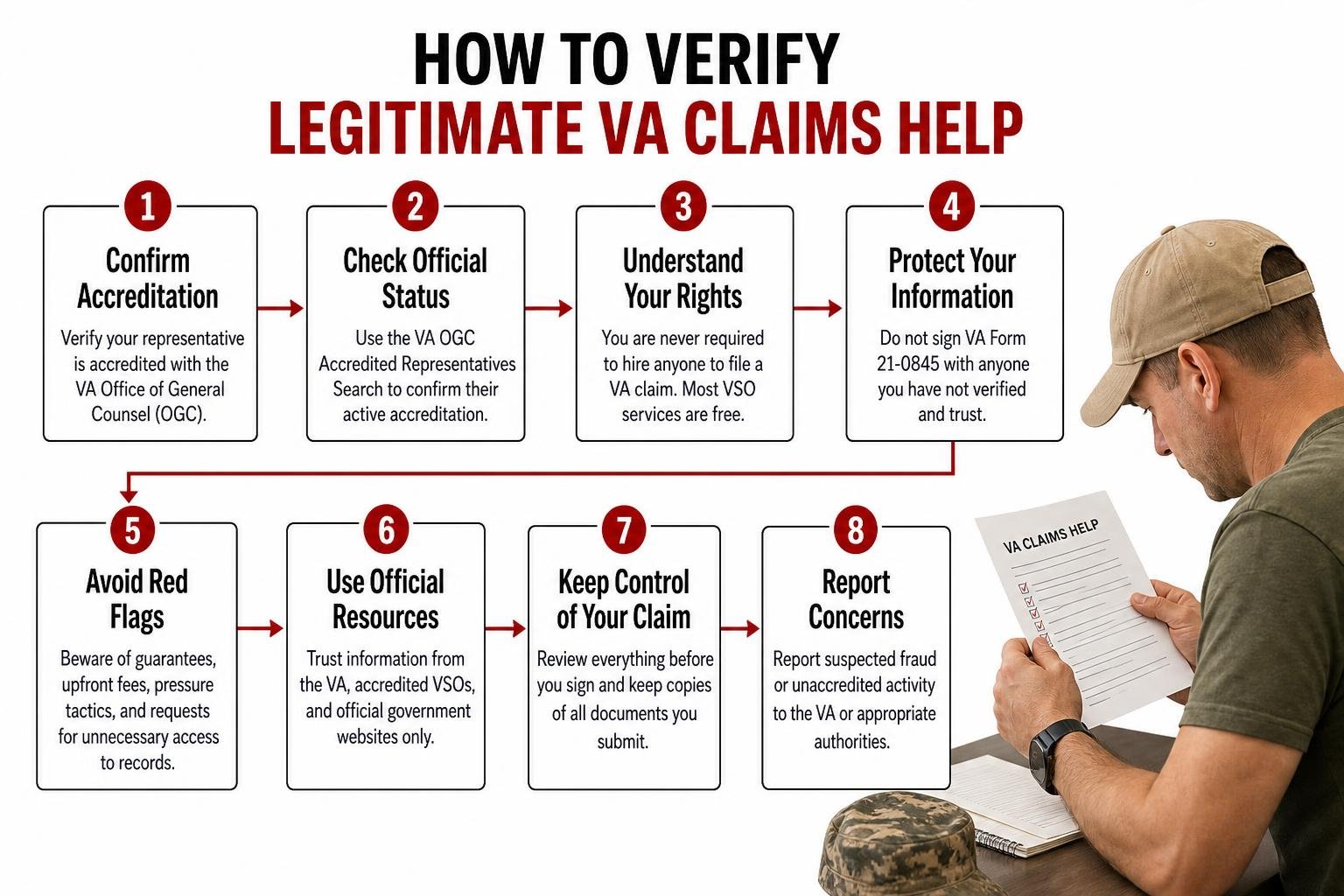
Red Flags Checklist: How to Spot VA Fraud and Predatory Tactics
Knowing the common warning signs helps you identify a predator before sharing sensitive records or signing a binding contract.
- Guarantees of Specific Ratings: No private company, accredited attorney, or VSO can guarantee a 100% rating or any specific disability percentage. The VA rating board alone determines compensation levels based on Title 38 of the Code of Federal Regulations.
- Charging for Initial Claims: Legitimate advocates never charge a penny to assist with an original disability application.
- Demands for Personal Login Credentials: An ethical representative will never ask for your Login.gov, ID.me, eBenefits, or VA.gov passwords.
- High-Pressure Deadlines: Scammers use artificial countdowns, claiming your benefits will be revoked or that special legislative windows are closing.
- Payment via Non-Standard Methods: Legitimate organizations never request gift cards, wire transfers, or cryptocurrency.
- Refusal to Provide VA Accreditation Numbers: Unaccredited entities will claim they are "consultants" or "coaches" to explain away their lack of official VA credentials.
To see how legitimate assistance differs from predatory services, review our comparison below:
| Feature | Legitimate Accredited Representative | Predatory Claim Shark |
|---|---|---|
| VA Accreditation | Formally accredited by VA Office of General Counsel | Unaccredited; operates in legal gray zones |
| Initial Claim Assistance | 100% Free of charge | Charges illegal upfront fees or future percentages |
| Appeals & Supplemental Fees | Capped by law (generally 20% to 33.3% of back pay only) | Demands 5x–6x monthly benefit increase |
| Access to VA Systems | Accesses files securely via official VA representative portals | Demands personal Login.gov or ID.me passwords |
| Medical Evidence | Coordinates legitimate clinical documentation | Operates questionable DBQ mills and nexus mills |
| Contract Transparency | Uses standard VA Form 21-22 or approved fee agreements | Uses complex, aggressive debt and financing contracts |
If you need professional legal representation for complex appeals, our top 10 veteran disability lawyers guide details how to locate accredited attorneys who adhere strictly to federal fee standards.
Action Plan: What to Do If You Have Been Targeted or Compromised

If you suspect your information has been compromised, your login credentials stolen, or your benefits redirected, take immediate action:
- Secure Your Digital Accounts: Log into VA.gov immediately and change your password. Ensure Multi-Factor Authentication (MFA) is enabled and set to your primary mobile device. If you cannot log in, contact the VA technical help desk immediately.
- Halt Direct Deposit Redirections: Call the VA Benefits Hotline at 1-800-827-1000 to lock your direct deposit profile and verify that your monthly payments are routing to your actual bank account.
- Notify Your Financial Institution: If you shared banking details or sent money, call your bank's fraud department. Request an immediate stop payment, close compromised accounts, and establish security challenge questions.
- Place a Credit Freeze: Contact the three major credit bureaus (Equifax, Experian, and TransUnion) to freeze your credit files. This prevents identity thieves from opening loans or credit lines in your name.
- Report the Fraud to Federal Agencies:
- VSAFE Fraud Hotline: Call 1-833-388-7233 or visit VSAFE.gov for coordinated veteran fraud support.
- VA Office of Inspector General (OIG): Submit an online report at va.gov/oig/hotline.
- Federal Trade Commission (FTC): File a report at ReportFraud.ftc.gov to help law enforcement track scam networks.
- FBI Internet Crime Complaint Center (IC3): File cyber fraud complaints at ic3.gov.
Frequently Asked Questions About VA Disability Scams
Understanding your rights and how benefits are structured is essential. For a complete look at monthly payouts, view your ratings your rewards a comprehensive look at VA benefits by disability percentage to ensure you know what you are legally entitled to receive.
Can a company legally charge a fee to file my initial VA disability claim?
No. Federal statute (38 U.S.C. § 5901) strictly prohibits any individual or organization from charging a fee to assist a veteran with filing an initial claim for VA disability benefits. Accredited attorneys and claims agents are only permitted to charge reasonable fees (typically capped between 20% and 33.3%) on past-due benefits (back pay) resulting from successful appeals or supplemental claim reviews. Anyone asking for payment before a claim is decided is violating federal rules.
How does the VA actually notify veterans if they owe an overpayment debt?
The VA notifies veterans of authentic debt exclusively through official written correspondence sent via the U.S. Postal Service from the VA Debt Management Center (DMC). This documentation details the reason for the overpayment, exact amounts, and comprehensive instructions on how to request a waiver, dispute the finding, or set up an interest-free payment plan. The VA will never send an unsolicited text message demanding immediate settlement via gift cards, wire transfers, or crypto. You can always check valid debt records online by logging into your account at VA.gov.
What should I do if a scammer obtained my Login.gov or ID.me credentials?
If an unaccredited company or scammer obtains your Login.gov or ID.me credentials, immediately log in and change your password, update your account recovery email, and revoke all unfamiliar active sessions. Next, contact the VA Benefits Hotline at 1-800-827-1000 to verify that your direct deposit routing numbers, contact address, and pending claim documents have not been altered. You should also report the breach at IdentityTheft.gov and monitor your credit reports for unauthorized activity.
Conclusion: Protecting Your Hard-Earned Military Benefits
Your military disability compensation represents an earned benefit for the sacrifices you made in service to our nation. Fraudsters, predatory claims companies, and unaccredited operators will continue refining their tactics, but vigilance remains your greatest safeguard.
Never let a high-pressure salesperson rush you into signing away months of back pay, and never surrender control of your secure digital identity. Always verify credentials through the official VA Office of General Counsel directory, partner with recognized VSOs, and consult our military VA disability pay tables for accurate, up-to-date compensation rates.
By remaining informed, recognizing the warning signs, and sharing this knowledge with fellow service members, we can collectively shut down predatory operations and ensure every veteran receives the full, untainted benefits they rightfully deserve.