What VA Benefits Navy SEALs May Be Missing?

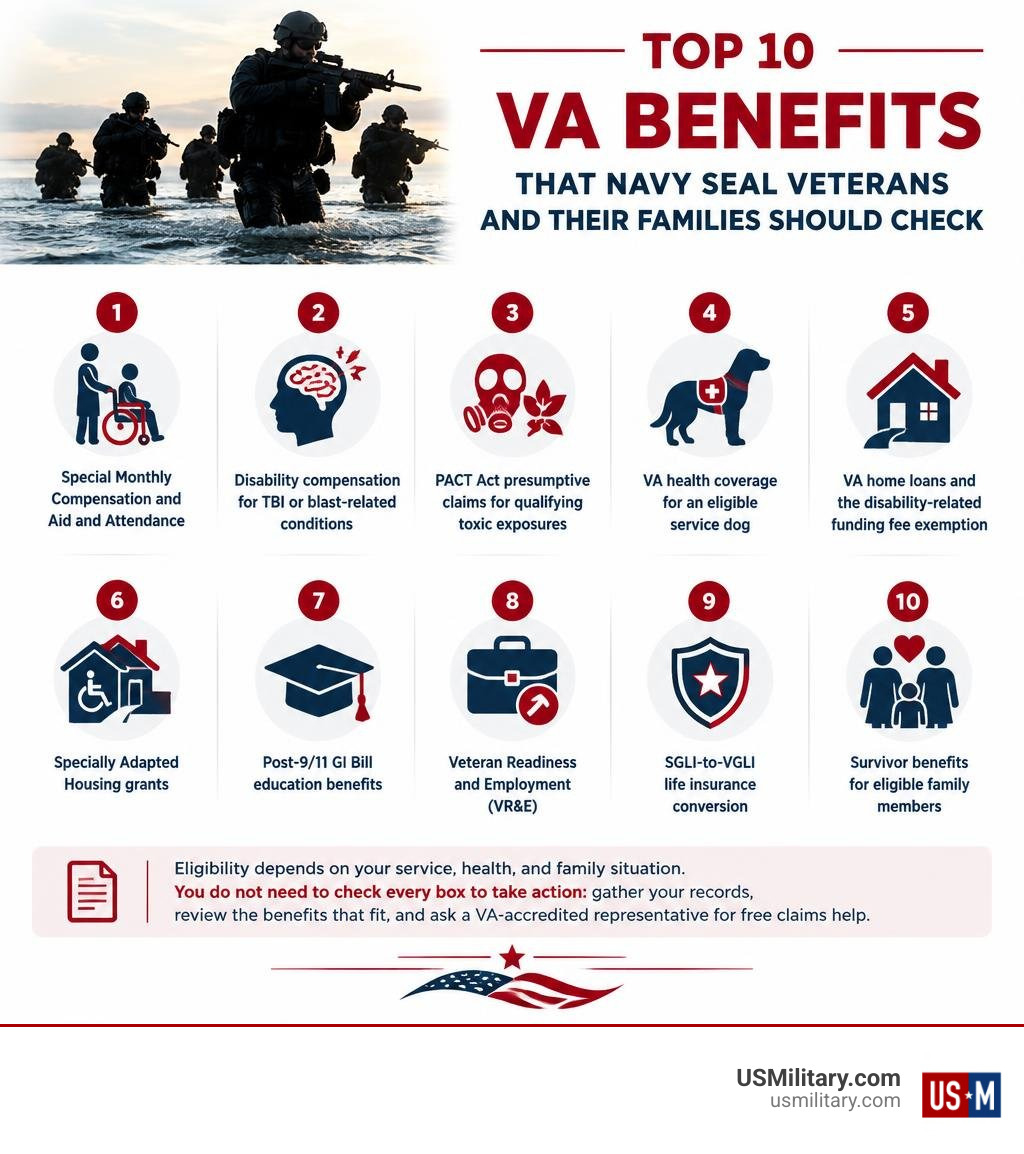
Start with these 10 benefits worth checking:
- Special Monthly Compensation and Aid and Attendance
- Disability compensation for TBI or blast-related conditions
- PACT Act presumptive claims for qualifying toxic exposures
- VA health coverage for an eligible service dog
- VA home loans and the disability-related funding fee exemption
- Specially Adapted Housing grants
- Post-9/11 GI Bill education benefits
- Veteran Readiness and Employment (VR&E)
- SGLI-to-VGLI life insurance conversion
- Survivor benefits for eligible family members
Eligibility depends on your service, health, and family situation. You do not need to check every box to take action: gather your records, review the benefits that fit, and ask a VA-accredited representative for free claims help.
I'm Larry Fowler. I graduated BUD/S Class 89 and have published NavySeal.com and USMilitary.com since 2007, where I've covered VA benefits, Aid and Attendance, and disability trends. I wrote this guide, Top 10 VA Benefits That Navy SEALs Often Forget And Do Not Claim, to help you decide what to review next.
Simple Top 10 VA Benefits That Navy SEALs Often Forget And Do Not Claim glossary:
- The Complete List of Top 15 Forgotten VA Benefits
- VA TDIU Explained: Eligibility, Rates, & How To File in 2026
- Unlock Your Entitlements: A Step-by-Step Guide to Benefit Applications
Top 10 VA Benefits That Navy SEALs Often Forget And Do Not Claim
Naval Special Warfare personnel are trained to operate under extreme conditions, push through pain, and focus on mission completion. While that mindset builds unmatched battlefield performance, it often becomes a major obstacle during the transition to civilian life. Special Operators routinely downplay musculoskeletal injuries, dismiss concussive blast symptoms, and avoid filing administrative paperwork.

Reviewing 10 VA Disability Benefits That Veterans Often Don't Claim But Many Can demonstrates how specific operational exposures create secondary conditions that significantly boost compensation.
| Benefit Category | Key Eligibility Trigger | Monthly / Financial Impact | Often Overlooked Reason |
|---|---|---|---|
| Special Monthly Compensation (SMC) | Loss of use of limb, creative organ, severe TBI | Adds hundreds to thousands over standard 100% rate | SEALs assume standard 100% rating is the statutory ceiling |
| VA Aid and Attendance | Inability to perform 2+ daily living activities | Additional monthly cash assistance | Believed to be strictly for elderly, bedridden veterans |
| Service Dog Veterinary Benefit | Clinically prescribed mobility or psychiatric dog | Up to $2,000/year for authorized medical care | Operators pay out of pocket, unaware VA covers vet care |
| VA Loan Funding Fee Waiver | Service-connected disability rating of 10% or higher | Saves 1.25% to 3.3% of total loan amount up front | Overlooked when purchasing prior to final VA rating decision |
| Specially Adapted Housing (SAH) | Severe loss of mobility, loss of limbs, blindness | Large lifetime grants for home remodeling | Believed to apply only to paralyzed wheelchair users |
| VGLI No-Medical-Exam Conversion | Apply within 240 days post-discharge | Up to $500,000 in term life insurance | Missed window forces stringent civilian medical underwriting |
| PACT Act Toxic Presumptions | Deployment to Southwest Asia / airborne hazards | Direct service-connection without nexus proof | Chronic sinus or pulmonary issues brushed off as minor |
| VR&E (Chapter 31) | 10%+ rating with employment handicap | Full tuition, supplies, retrofitted housing allowance | Mistakenly viewed as an inferior alternative to the GI Bill |
| VA Priority Group 1 Enrollment | Disability rating of 50% or higher | 100% free care, parallel specialty prescriptions | Belief that private insurance or TRICARE is sufficient |
| Survivor Entitlements (DIC / DEA) | Service-connected death or rated 100% P&T | Monthly tax-free stipend & college tuition | Failure to establish primary ratings before passing |
1. Special Monthly Compensation and Health Perks: Top 10 VA Benefits That Navy SEALs Often Forget And Do Not Claim
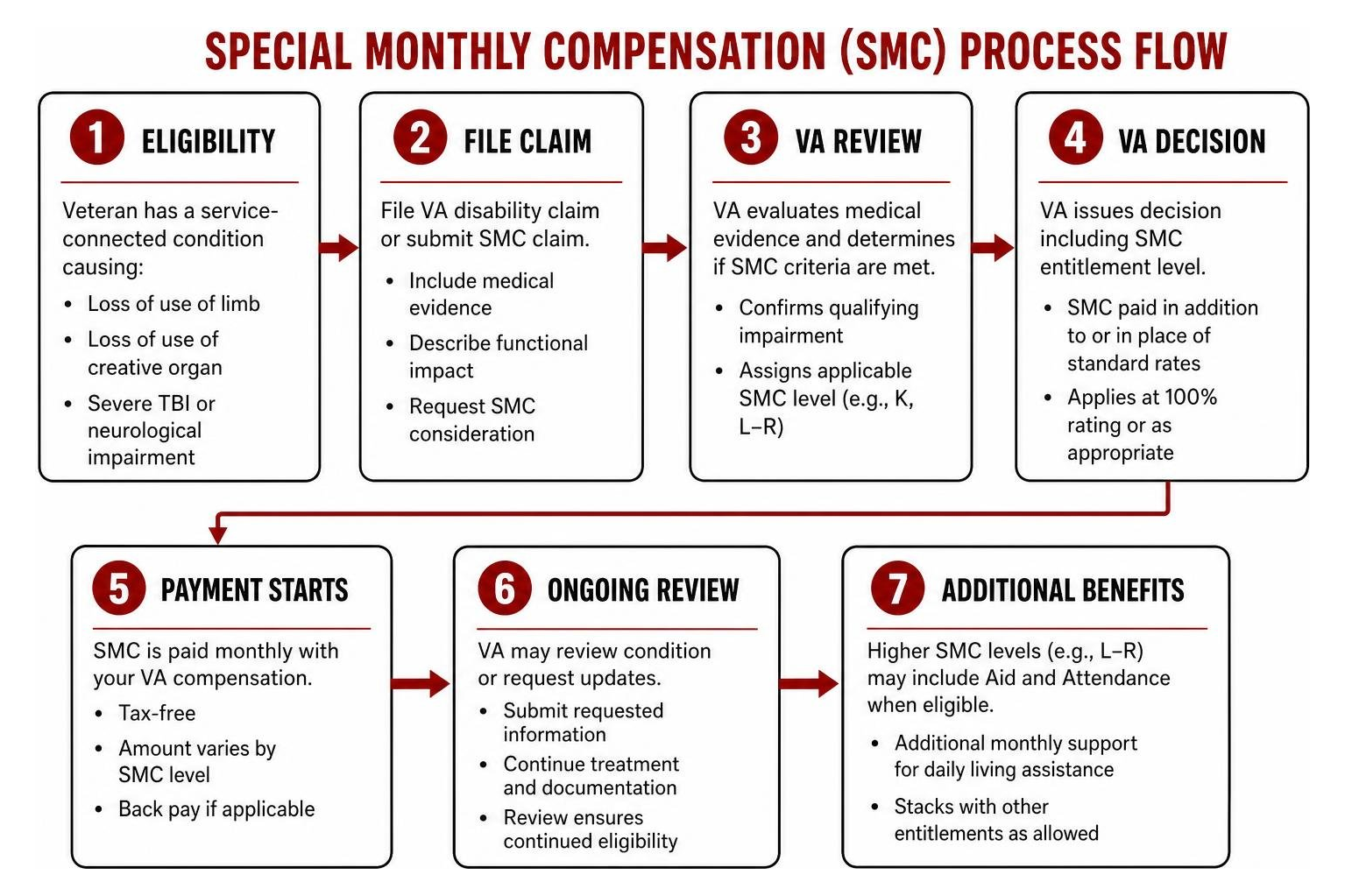
The statutory maximum 100% disability rating is not the upper limit of VA financial support. For veterans who suffer specific physical impairments, the VA provides Special Monthly Compensation (SMC).
SMC is paid in addition to or in place of standard disability rates. Levels like SMC-K provide added monthly sums for the functional loss of an extremity, creative organ, or neurological impairment, which can stack for multiple combat-related injuries. Higher tiers (such as SMC-L through SMC-R) provide critical financial support when catastrophic trauma requires daily assistance.
2. Aid and Attendance (A&A)
Operators suffering from advanced traumatic brain injuries, polytrauma, or severe chronic pain often qualify for Aid and Attendance. This supplemental benefit pays thousands above baseline compensation to cover in-home assistance, helping veterans who struggle with daily living tasks such as dressing, bathing, preparing meals, or managing prosthetics.
3. VA Service Dog Health Insurance Benefit
Many SEAL veterans partner with service dogs to manage severe orthopedic limitations, balance issues, or post-traumatic stress. While the VA does not buy the dog itself, the VA Service Dog Health Insurance Benefit covers veterinary medical bills, routine care, and emergency interventions up to $2,000 annually. You must secure a clinical prescription from a VA provider showing the animal was trained by an accredited organization (such as Assistance Dogs International).
4. Priority Group 1 and Community Care Access
A combined service-connected disability rating of 50% or higher automatically places a veteran in Priority Group 1 for healthcare. This tier completely eliminates copayments for inpatient, outpatient, and prescription care.
Furthermore, if local VA facilities exceed drive-time thresholds (30 minutes for primary care, 60 minutes for specialty care) or wait-time benchmarks (20 days for primary care, 28 days for specialty care), operators can access private, world-class local physicians at zero out-of-pocket cost through the Veterans Community Care Program.
You can consult the Federal Benefits for Veterans and Dep. 2010 manual to see how these healthcare tiers are structured under federal statute.
Financial and Housing Grants: Top 10 VA Benefits That Navy SEALs Often Forget And Do Not Claim
5. VA Home Loan Funding Fee Waiver
The VA Home Loan program is well known for offering zero-down-payment mortgages without private mortgage insurance (PMI). However, many operators forget that receiving a VA service-connected disability rating of 10% or higher completely waives the standard VA funding fee.
On a $600,000 home purchase, this single waiver saves between $7,500 and $19,800 in upfront closing costs. To understand how housing and healthcare benefits integrate into long-term financial security, read our guide From Health to Home: A Veteran's Guide to VA Benefits.
6. Specially Adapted Housing (SAH) and Special Home Adaptation (SHA) Grants
Operators who have sustained severe combat trauma, lost limbs, suffered spinal cord injuries, or experienced major respiratory loss can access substantial home-adaptation grants.
- Specially Adapted Housing (SAH) Grants: Designed to build, purchase, or remodel a barrier-free home with wide entryways, roll-in showers, and custom ramps.
- Special Home Adaptation (SHA) Grants: Aimed at helping veterans with severe anatomical or burn injuries adapt their existing living spaces.
These grants are lifetime allowances that do not have to be repaid, ensuring that your home adapts to your physical needs rather than restricting your daily life.
7. SGLI to VGLI 240-Day Conversion Window
Active-duty operators are automatically insured under Servicemembers' Group Life Insurance (SGLI) up to statutory limits. Upon transition, you have exactly 240 days to convert that policy into Veterans' Group Life Insurance (VGLI) without taking a medical physical, undergoing blood tests, or submitting medical underwriting.
Missing this 240-day window means you must prove good health—a near-impossible hurdle for veterans with documented spinal compressions, blast exposure records, or high disability ratings.
8. Survivor Entitlements: DIC and Chapter 35 Benefits
Taking the time to file your disability claims directly protects your family's future:
- Dependency and Indemnity Compensation (DIC): A tax-free monthly payment awarded to surviving spouses and eligible children if an operator passes away from a service-connected condition or was rated 100% P&T for at least 10 continuous years prior to death.
- Survivors' and Dependents' Educational Assistance (DEA / Chapter 35): Provides monthly education stipends directly to spouses and children attending college or vocational training.
- $100,000 Military Death Gratuity: A rapid-payout tax-free lump sum provided to immediate next of kin following active-duty fatalities.
Navigating Blast Injuries, Wave Slamming, and PACT Act Presumptions
Naval Special Warfare training and tactical insertions subject operators to physical forces rarely seen elsewhere in the military. Scientific impact studies confirm that high-speed combat ocean craft—such as Combatant Craft Medium (CCM) and Special Operations Craft-Riverine (SOC-R)—regularly generate wave-slamming forces exceeding 60 times the force of gravity (60G).

These repetitive mechanical shocks compress the spine, destroy cartilage, and cause microscopic traumatic brain injuries (micro-TBIs). When combined with close-quarters breaching charges, heavy-caliber weapons fire, and rocket blast waves, operators frequently experience subconcussive head trauma that manifests years down the road as:
- Treatment-resistant sleep apnea
- Intractable migraines and vestibular disorders
- Endocrine system disruptions and pituitary damage
- Severe neurocognitive deficits and executive dysfunction
Understanding how the VA rates these conditions is critical. You can track exact compensation tiers using Your Rating Your Rewards: A Comprehensive Look at VA Benefits by Disability Percentage.
9. PACT Act Presumptions for Naval Operators
The passage of the PACT Act created the largest expansion of veteran toxic-exposure benefits in three decades. For SEALs deployed across the Middle East, North Africa, the Horn of Africa, and maritime combat zones, the law removes the burden of proving that specific toxic environments caused their illnesses.
Under the PACT Act, more than 20 respiratory diseases, gastrointestinal issues, and cancers are automatically presumed to be service-connected.
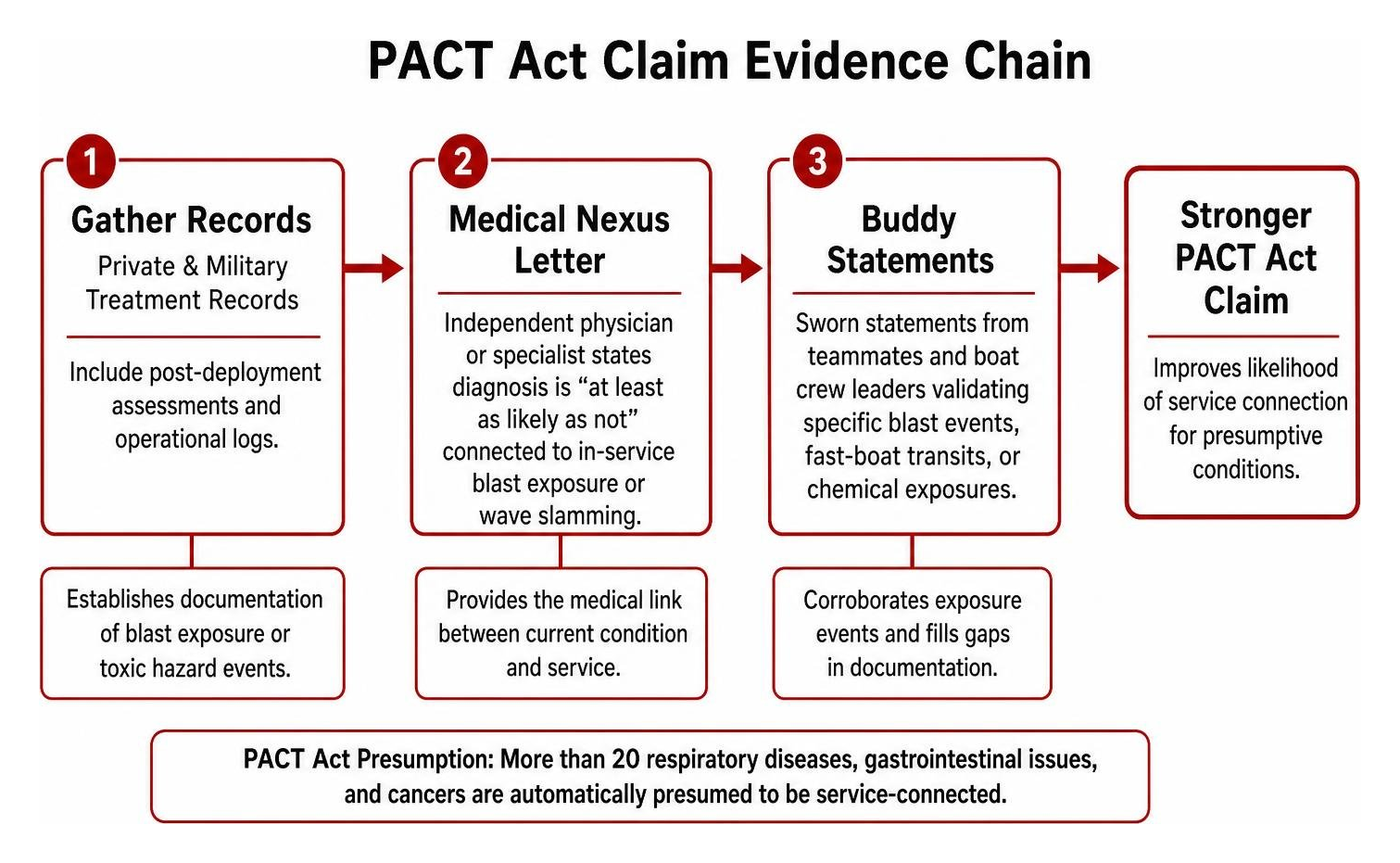
When filing a late claim for blast exposure or toxic hazards:
- Gather Private & Military Treatment Records: Include post-deployment assessments and operational logs.
- Obtain a Medical Nexus Letter: Have an independent physician or specialist write a clear statement establishing that your current diagnosis is "at least as likely as not" connected to in-service blast exposure or wave slamming.
- Submit Buddy Statements: Sworn statements from teammates and boat crew leaders can fill documentation gaps left by classified mission logs by validating specific blast events, fast-boat transits, or chemical exposures.
10. Maximizing Post-Service Education and Employment: VR&E vs. GI Bill
Many SEAL veterans instinctively default to using their Post-9/11 GI Bill (Chapter 33) to pursue college degrees, completely overlooking Veteran Readiness and Employment (VR&E / Chapter 31).
VR&E is a federal employment and career-rehabilitation program for veterans with a service-connected disability rating of at least 10% and an established employment handicap.
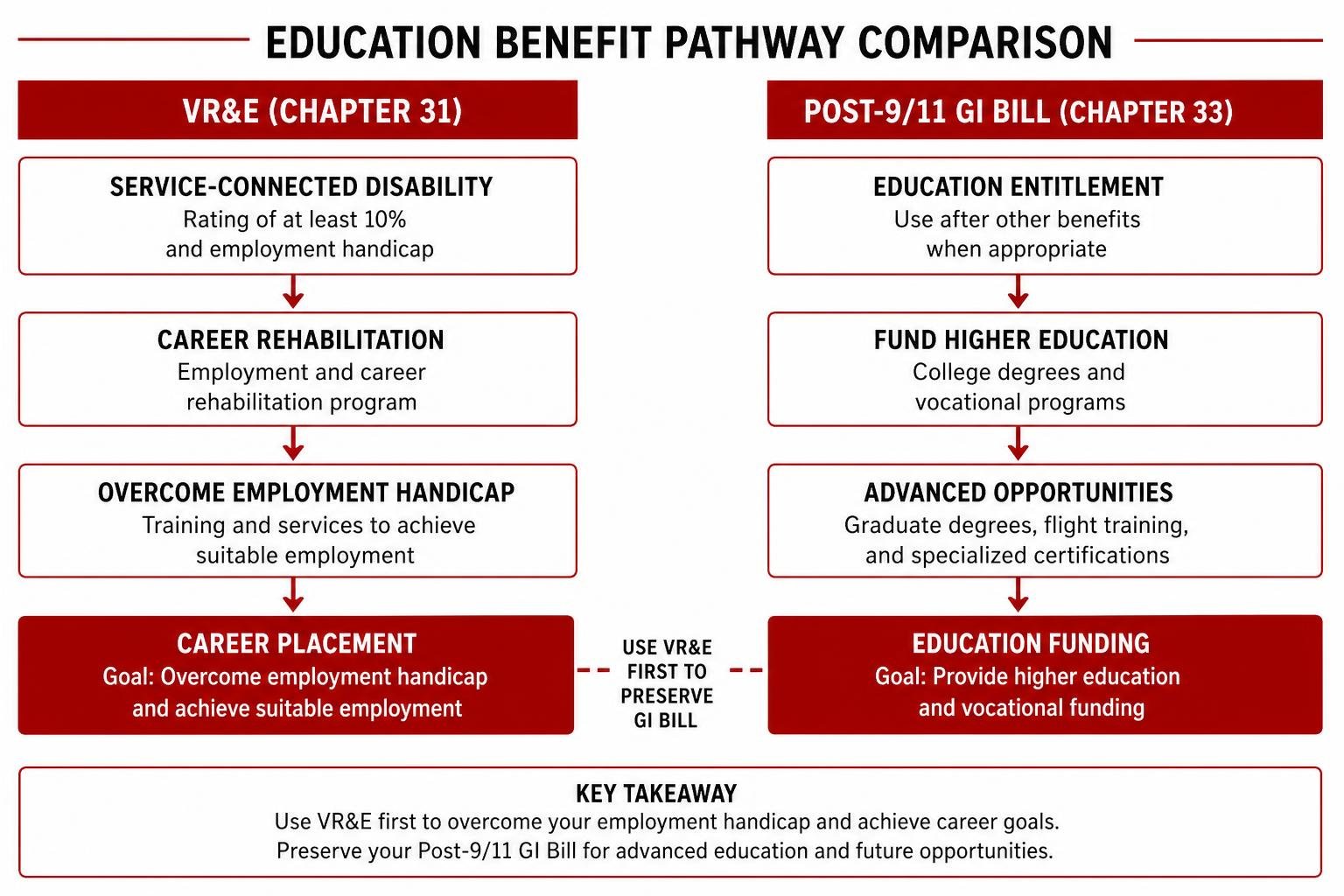
Using VR&E first preserves your GI Bill entitlement, allowing you to fund advanced graduate degrees, flight training, or specialized civilian certifications later on. Reviewing The Veterans Guide to Not Leaving Money on the Table helps ensure you do not exhaust finite education resources prematurely.
| Benefit Feature | VR&E (Chapter 31) | Post-9/11 GI Bill (Chapter 33) |
|---|---|---|
| Primary Goal | Overcome employment handicap; career placement | Provide higher education and vocational funding |
| Eligibility Requirement | 10%+ rating + established employment handicap | 90+ days of qualifying active-duty service |
| Impact on Other Benefits | Preserves your 36 months of Chapter 33 GI Bill | Uses up your allocated 36 months of benefits |
| Housing Allowance (BAH) | Pays equivalent P911 rate (if eligible for Ch 33) | Standard E-5 with dependents MHA based on ZIP |
| Covered Expenses | 100% tuition, books, laptops, ergonomic equipment | Tuition capped at public school in-state rates |
| Expiration Rules | 12-year window (waived for many modern ratings) | Lifetime benefit (Forever GI Bill for post-2013 exits) |
Additionally, transitioning service members can use DoD SkillBridge programs during their final 180 days of active duty, gaining corporate or specialized technical training while receiving full military pay and allowances.
Protecting Your Earned Compensation from Unaccredited Claims Scams
The complexity of navigating VA disability claims has fueled an aggressive, unaccredited consulting industry. According to the Federal Trade Commission, veterans reported losing more than $419 million to scams and deceptive practices in 2024.
By late 2025, at least 29 of 38 companies warned by the Department of Veterans Affairs for potentially unlawful claims consulting practices remained in operation.
Many predatory consulting firms target transitioning Special Operations personnel, offering to manage their claims in exchange for a fee equal to five times their monthly disability increase—charging $10,000 to $20,000 for work accredited representatives do for free.
To learn more about your statutory protections, review Disabled Veteran Benefits What You Need to Know.
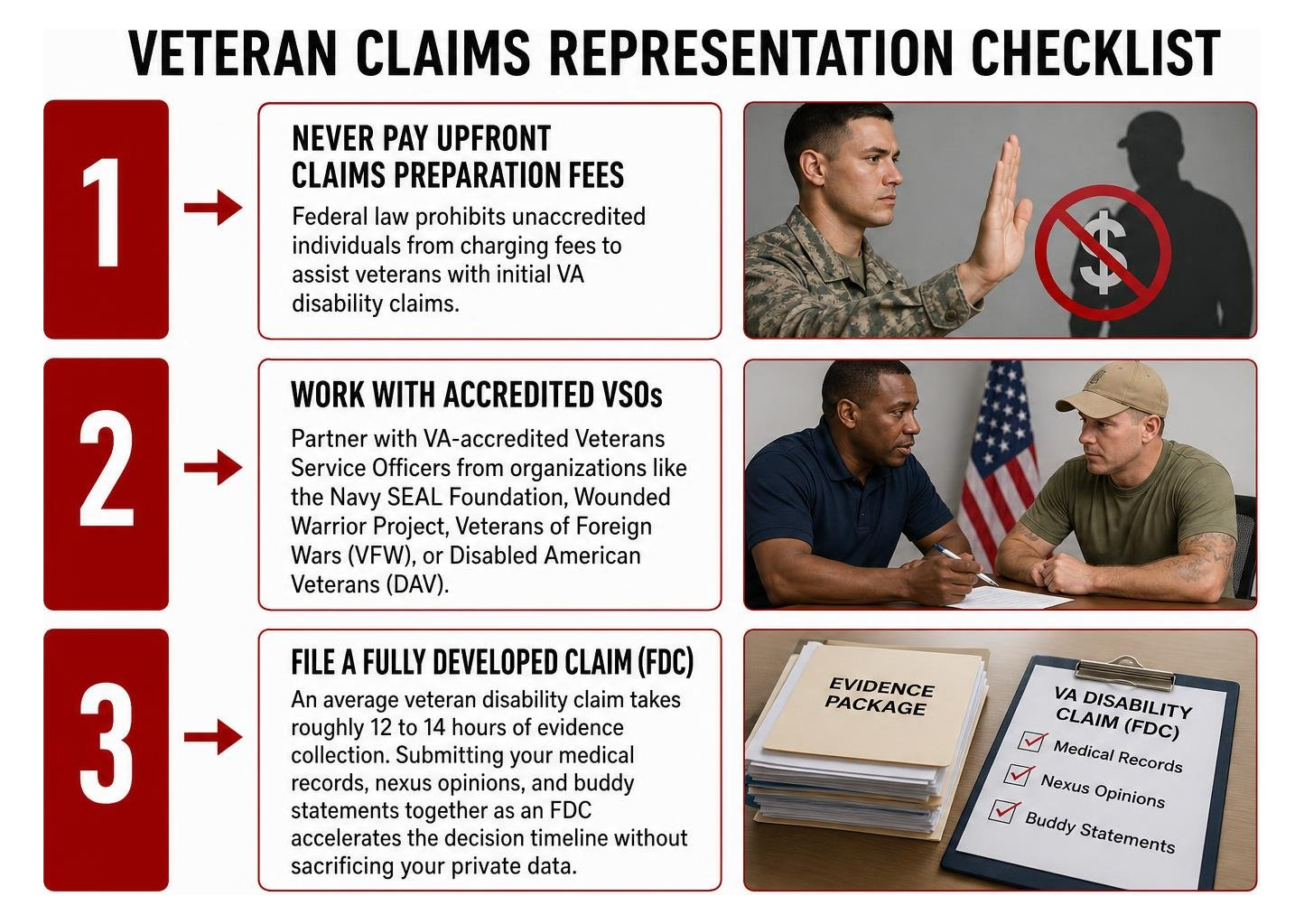
Always protect your personal records and finances by adhering to these guidelines:
- Never Pay Upfront Claims Preparation Fees: Federal law prohibits unaccredited individuals from charging fees to assist veterans with initial VA disability claims.
- Work with Accredited VSOs: Partner with VA-accredited Veterans Service Officers from organizations like the Navy SEAL Foundation, Wounded Warrior Project, Veterans of Foreign Wars (VFW), or Disabled American Veterans (DAV).
- File a Fully Developed Claim (FDC): An average veteran disability claim takes about 12 to 14 hours to collect evidence. Submitting your medical records, nexus opinions, and buddy statements together as an FDC accelerates the decision timeline without sacrificing your private data.
Frequently Asked Questions about Navy SEAL VA Benefits
Can Navy SEALs receive both military retirement pay and full VA disability compensation?
Yes. Under Concurrent Retirement and Disability Pay (CRDP), military retirees who completed 20 or more years of active service and hold a VA service-connected disability rating of 50% or higher receive both their full military retirement pension and full, tax-free VA disability compensation without any offset.
For combat-wounded operators who were medically retired under Chapter 61 with fewer than 20 years of service, Combat-Related Special Compensation (CRSC) restores a tax-free portion of retired pay lost to the standard disability offset. Legislative reforms like the Major Richard Star Act continue to press Congress to permit full concurrent receipt for all medically retired combat veterans.
Why is the 240-day deadline critical for converting SGLI to VGLI?
The 240-day post-discharge window is essential because it lets transitioning SEALs convert their SGLI policy to Veterans' Group Life Insurance (VGLI) with no medical underwriting.
Within this window, coverage is approved automatically regardless of your combat injuries, blast exposure, sleep apnea, or high VA disability ratings. If you apply after day 240 (up to the ultimate 1-year and 120-day cutoff), you must pass strict civilian medical underwriting, which frequently results in denial or unaffordable premiums for combat veterans.
How does blast exposure or wave slamming qualify for presumptive VA disability ratings?
While the VA does not have a single disability code called "wave slamming," the medical consequences of 60G impacts and repetitive low-level blast exposure are rated through primary and secondary service connections.
Operators establish direct service connection for documented orthopedic damage, cervical spine compression, vestibular damage, and traumatic brain injury.
Once your TBI or blast-related condition is service-connected, secondary medical conditions—such as obstructive sleep apnea, clinical depression, vestibular migraines, and bilateral tinnitus—can be linked directly to that primary injury, establishing a comprehensive, highly rated disability package.
Conclusion
The elite operational tempo and silent warrior ethos of Naval Special Warfare should never keep you from securing the healthcare, housing, and financial benefits you earned on the battlefield. Whether you're applying for Special Monthly Compensation, accessing $2,000 in annual veterinary benefits for an approved service dog, waiving thousands in VA home loan fees, or protecting your post-service education with VR&E, these programs were built to support your life beyond the team.
Don't navigate this administrative terrain alone, and don't hand your hard-earned benefits to predatory, unaccredited claims consultants. Connect with an accredited Veterans Service Officer from trusted Special Operations support organizations, gather your medical documentation, and file your claims early.
For authoritative guides on claims filing, military loans, transition planning, and branch comparisons, visit our central portal at USMilitary.com and explore comprehensive military benefits to protect your family's future today.