Why Navy SEAL Benefits Go Beyond Standard Military Perks
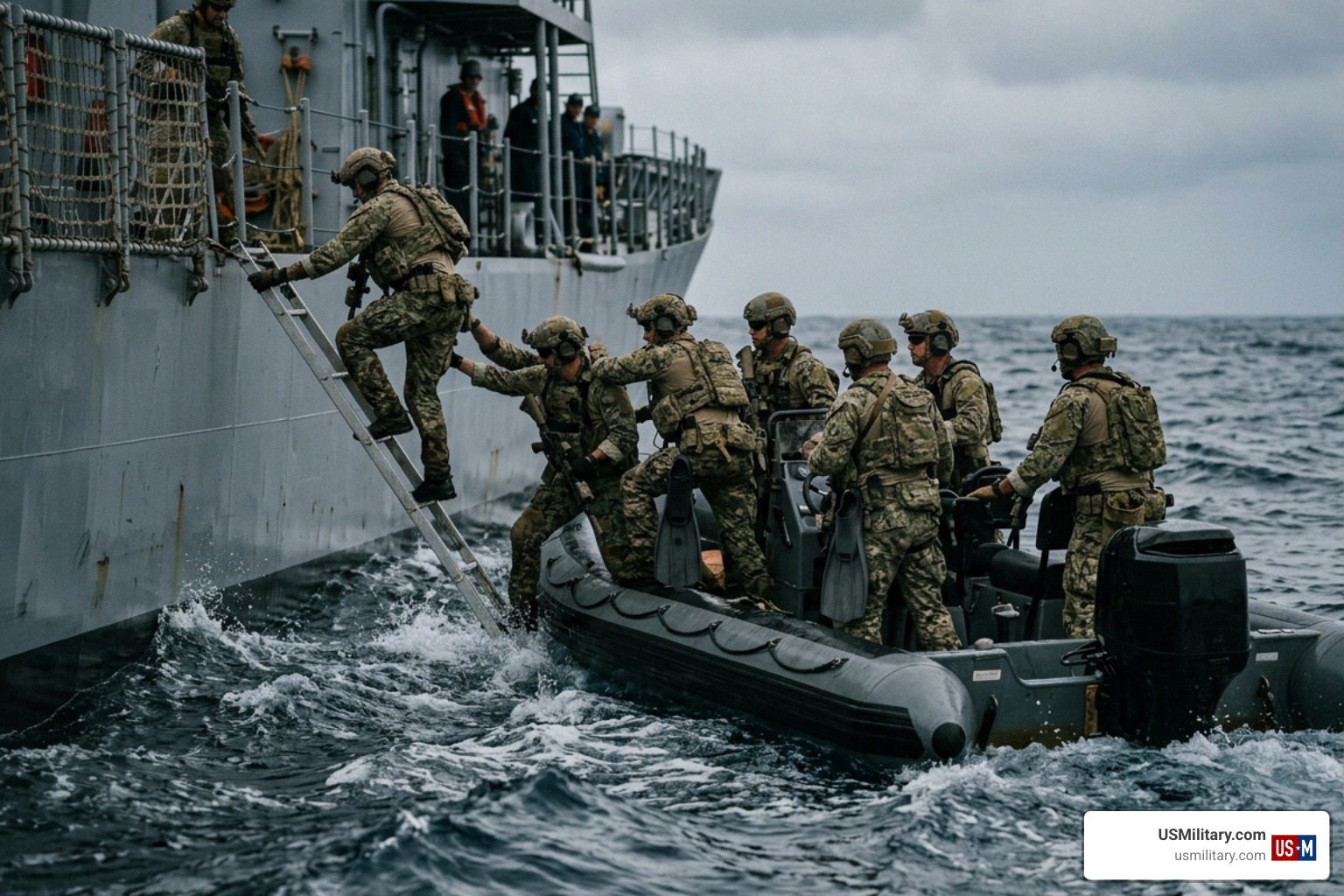
Navy SEALs receive the same core military benefits as other service members, but their high-risk role can also open access to specialized training, mission-specific equipment, incentive pay, and a powerful professional network. The 10 unique benefits offered only to Navy SEALs center on what they are trained and assigned to do:
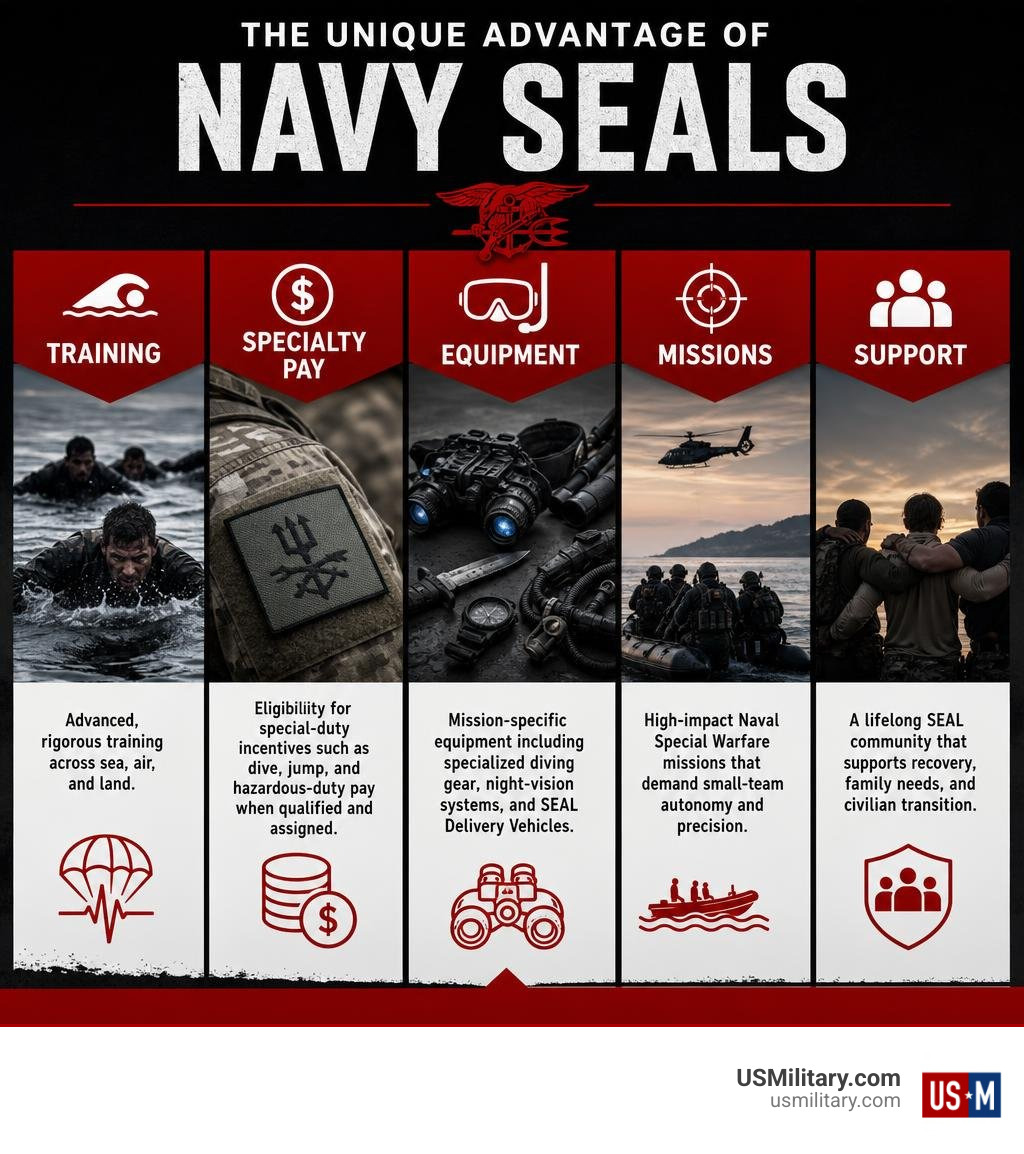
- Advanced special-operations training, from diving and parachuting to medical, language, and sniper courses.
- Mission-specific equipment, including specialized diving gear, night-vision systems, and SEAL Delivery Vehicles.
- Eligibility for certain special-duty incentives, such as dive, jump, and hazardous-duty pay when qualified and assigned.
- High-impact Naval Special Warfare missions that demand small-team autonomy.
- A lifelong SEAL community that can support recovery, family needs, and civilian transition.
These are not shortcuts or immunity from military rules. They are mission-driven resources earned through one of the military's toughest pipelines. BUD/S alone runs for at least 24 weeks, and only about 20% to 25% of candidates typically complete it. The result is an unusually close-knit force built to work at sea, in the air, and on land.
LARRY FOWLER is a graduate of BUD/S Class 89 and is the publisher of NavySeal.com and the USMilitary.com Network, and has served military audiences since 2007 with clear information on military careers, VA benefits, and service-related decisions. His experience helping active-duty members and veterans navigate benefits informs this guide to the 10 Unique Benefits Offered Only To Navy SEALs and the trade-offs behind them.
**10 Unique Benefits Offered Only To Navy SEALs ** terms to learn:
Breakdown of the 10 Unique Benefits Offered Only To Navy SEALs

When people think of the military, they often picture standard uniforms, barracks life, and traditional 9-to-5 base operations. The Naval Special Warfare (NSW) community operates on an entirely different plane. The physical demands are intense, but the rewards—both tangible and intangible—are tailored to match the immense risks these operators shoulder.
Here is an overview comparing general Navy enlistment perks with the specialized benefits offered to active SEAL operators:
| Benefit Category | Standard Navy Enlisted | Navy SEAL Operator |
|---|---|---|
| Specialty Incentive Pay | Specific technical ratings only | Dive pay, jump pay, demo pay, and special duty assignment pay stacked concurrently |
| Initial / Re-enlistment Bonuses | $5,000 – $30,000 based on rating | Up to $100,000+ retention and qualification bonuses |
| Weaponry & Tactical Gear | Standard-issue service rifles (M4/M16) | Custom configurations, HK416 rifles, specialized suppressors, and tailored kit |
| Subsurface Platforms | Standard submarine assignment | Exclusive access and pilot training on SEAL Delivery Vehicles (SDVs) |
| Advanced Schooling | Rating-specific technical schools | Combat Medic, Sniper School, High-Performance Driving, Language Immersion |
| Operational Autonomy | Rigid hierarchy and direct supervision | Broad tactical latitude and small-team commander discretion |
| Physical Rehabilitation | Base clinic and standard physical therapy | Dedicated elite sports medicine, cognitive therapy, and tailored recovery suites |
| Stationing Locations | Global fleet locations, ships, and ports | Concentrated coastal hubs (Coronado, CA and Virginia Beach, VA) |
| Post-Service Non-Profit Network | General military charities | Dedicated multi-million dollar private foundations (e.g., Navy SEAL Foundation) |
| Private Sector Brand Equity | General veteran hiring preferences | Immediate tier-one credibility in executive leadership and security consulting |
Compensation Breakdown and 10 Unique Benefits Offered Only To Navy SEALs
While standard military pay charts set baseline pay according to rank and years of service, a qualified operator's actual earnings look dramatically different. Through various special pays and bonuses, a first-term operator can see a Navy SEAL salary and bonus package reaching total compensation starting at up to $60,000 per year, quickly rising with deployment incentives.
These financial add-ons include:
- Dive Pay: Monthly compensation for maintaining open-circuit and closed-circuit combat diving qualifications.
- Parachute Jump Pay: Additional pay for military freefall (HALO/HAHO) and static-line airborne readiness.
- Demolition Pay: Hazard incentives for handling explosives and breaching materials.
- Special Duty Assignment Pay (SDAP): Monthly specialty stipends granted to operators maintaining active status in tactical teams.
- Tax-Free Combat Zone Pay: Complete federal tax exemptions on earned income while operating inside designated combat zones, combined with standard tax-free basic allowances for housing (BAH) and subsistence (BAS).
To review entry pathways and monetary incentives, prospective candidates can explore the official U.S. Navy SEAL careers portal and the specialized benefits overview on NavySEALs.com.
Operational Advantages in 10 Unique Benefits Offered Only To Navy SEALs
Beyond pay stubs, operational benefits give SEAL teams access to tier-one technology. SEALs do not rely on standard warehouse equipment. Instead, units use the Heckler & Koch HK416 assault rifle, customized suppressed weapon platforms, and advanced panoramic night-vision goggles (GPNVGs).

In the underwater domain, SEALs utilize the SEAL Delivery Vehicle (SDV)—a manned wet submersible designed to insert operators covertly into hostile harbors and coastlines. Other military units rarely receive the budget, maintenance support, or training clearance required to operate these sophisticated sub-surface systems.
These capabilities ensure SEALs receive priority tasking for high-visibility direct action, counter-terrorism, and deep reconnaissance operations worldwide—including legendary national-priority missions like the 2011 raid in Abbottabad.
Advanced Specialized Training and Educational Pipelines
SEAL operators undergo continuous technical instruction across their careers. Following the core comprehensive Navy SEAL training pipeline, team members complete world-class specialty courses that would cost civilian organizations hundreds of thousands of dollars:
- Special Operations Combat Medic (SOCM): Intensive trauma management, field surgical procedures, and emergency pharmacology.
- Special Operations Target Interdiction (Sniper): Advanced marksmanship, ballistic calculation, camouflage, and field craft.
- Defense Language Institute (DLI): Full immersion language courses in strategic regional dialects.
- Tactical Mobility & Driving: High-performance off-road maneuvering, evasive driving, and vehicle combat dynamics.
- Military Freefall Jumpmaster: Advanced skydiving mastery, wind calculations, and high-altitude infiltration tactics.
Forward-looking operators also use educational avenues like the Health Services Collegiate Program (HSCP) and active-duty degree completion tracks. A notable example is Dr. Jonny Kim, who transitioned from an enlisted combat medic and sniper to a Harvard-educated physician and NASA astronaut using Navy education initiatives.
Elite Medical Support, Recovery, and Brotherhood Networks
The physical toll of special warfare demands specialized recovery care. Navy SEALs have direct access to human performance programs equipped with:
- Dedicated physical therapists and orthopedic specialists embedded directly inside the team compounds.
- Advanced cognitive therapies, hyperbaric treatments, and neuro-tracking protocols to manage traumatic brain injuries and combat fatigue.
- Tailored mental health programs designed specifically around special operations operational stress.
Outside the military structure, non-profit institutions like the Navy SEAL Foundation provide millions of dollars in direct assistance annually to active operators, wounded warriors, and Gold Star families. This community solidarity forms a lifelong fraternity unmatched across other career fields.
How Rigorous Selection Unlocks Exclusive Operator Privileges
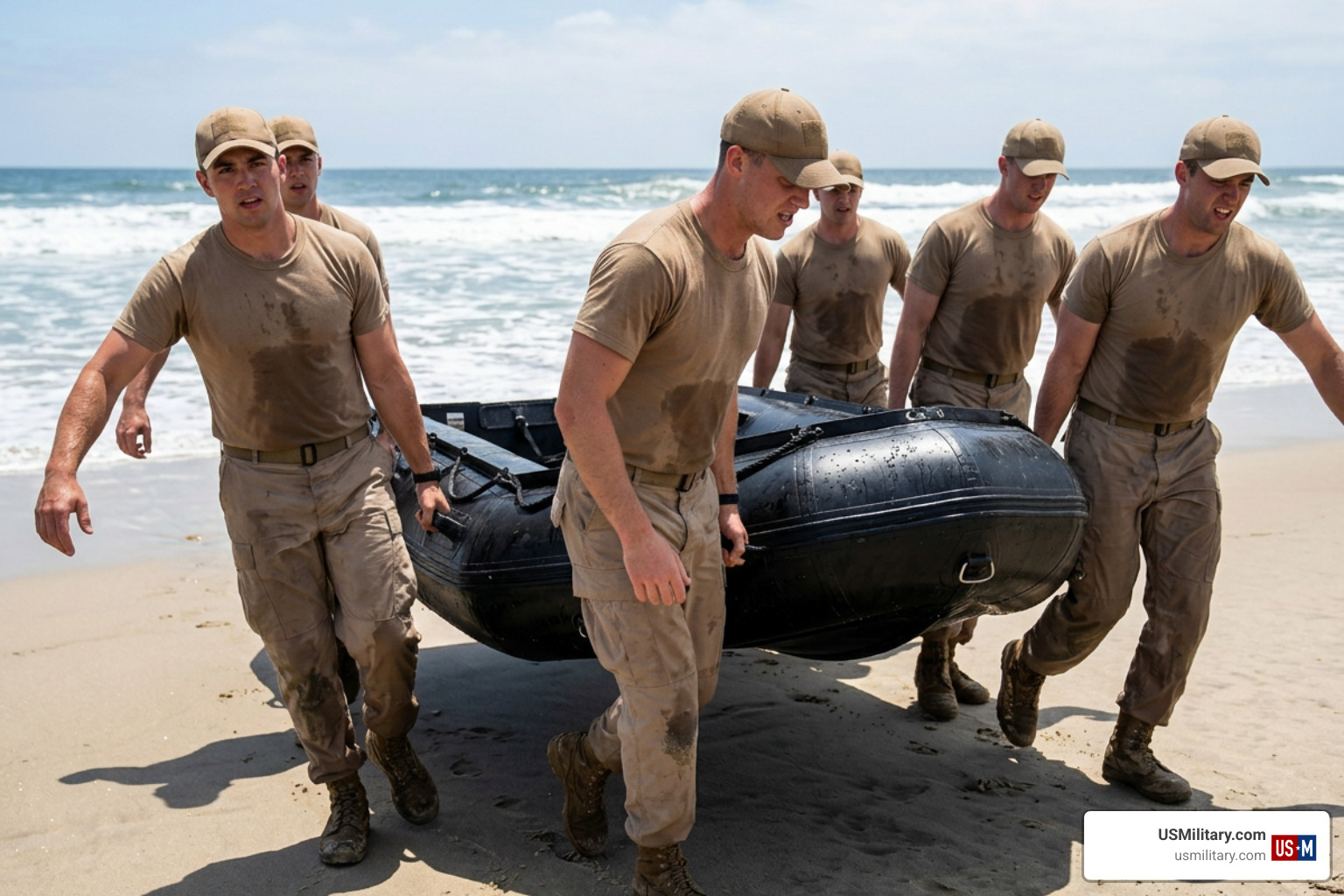
The reason Navy SEALs receive specialized resources comes down to the extreme selectivity of their candidate pipeline. Elite privileges are the functional byproduct of proving one can perform under unmatched psychological and physical pressure.
Candidates start by meeting strict Physical Screening Test standards, which require top-tier swimming, running, and calisthenics performance before securing a contract. From there, trainees enter the 24-week BUD/S training pipeline, which includes the legendary, sleep-deprived, grueling Hell Week.
Only after passing BUD/S, Parachute Training, and SEAL Qualification Training (SQT) does an operator earn the coveted Navy SEAL Trident.
Attrition Realities and Merit-Based Resource Access
The attrition rate at BUD/S typically hovers between 75% and 80%, meaning roughly one out of four candidates finishes the initial phase. Because the military invests millions into selecting and forging each successful graduate, funding advanced gear, customized weapons, and high-level training is an operational necessity. As sailors climb the Naval Special Warfare ranks, their autonomy and leadership responsibilities expand alongside their technical capabilities.

Larry, the amazing and Honor Man Doug Young and awesome Scott Rawding with the BUD/S Class 89 Plaque Still Displayed in BUD/S Compound.
Coastal Stationing and Geographic Lifestyle Perks
While conventional naval personnel may deploy across dozens of inland or remote overseas stations, SEALs are primarily stationed at two coastal hubs:
- Naval Amphibious Base Coronado in San Diego, California.
- Joint Expeditionary Base Little Creek-Fort Story in Virginia Beach, Virginia.
These installations provide year-round coastal climates, direct beach and ocean access for tactical readiness, and top-tier training facilities. For service members raising families, these long-term coastal hubs provide greater community stability compared to constant reassignment across distant bases.
The Ultimate Winner: Which Exclusive SEAL Benefit Matters Most?
When reviewing top compensation, specialized submersibles, elite weapons, and pristine coastal living, what is the single greatest benefit awarded to a Navy SEAL?
The Winner: The Lifelong Brotherhood and Post-Service Brand Equity.
While combat pay and advanced firearms serve immediate operational needs, an operator's post-service network and reputation last a lifetime. Earning the Trident demonstrates undeniable mental resilience, leadership under pressure, and elite teamwork. In the civilian world, former elite Navy SEALs often step directly into executive leadership roles, high-level private security management, entrepreneurial ventures, and public service.
Combined with continuous transition support from philanthropic foundations and an unbreakable alumni brotherhood, this reputation creates enduring career and personal dividends long after hanging up the uniform.
Frequently Asked Questions About Navy SEAL Perks
Do Navy SEALs receive higher basic pay than other service members?
No. Base pay is strictly determined by DoD rank and time-in-service charts common to all military branches. However, SEALs routinely earn significantly higher gross compensation due to stacking dive pay, demolition pay, parachute jump pay, and special duty assignment bonuses.
How does the Navy SEAL Foundation support operators and their families?
The Navy SEAL Foundation delivers comprehensive support across five pillars: warrior support, family resiliency, educational scholarships, tragedy assistance, and legacy preservation. They fund family retreats, specialized healthcare treatments, emergency financial relief, and children's higher-education grants.
Are Navy SEALs exempt from standard military justice and regulations?
No. Navy SEALs are subject to the exact same Uniform Code of Military Justice (UCMJ) rules, regulations, and disciplinary actions as every other service member. While they are granted broad tactical latitude on the battlefield, their conduct is held to strict legal and ethical standards.
Conclusion
The perks and specialized equipment given to Navy SEALs reflect the demands of their missions. From customized weapon systems and advanced combat schools to dedicated medical teams and lucrative qualification pay, every single benefit is engineered to build an agile, self-sufficient warfighter capable of operating in extreme conditions.
If you are considering a career in special warfare or want to explore broader military pathways, loan programs, and education perks, we invite you to review our complete guide to Navy SEAL careers and explore comprehensive service resources on USMilitary.com.