The 5 Types Of People Navy SEALs Despise Being Around

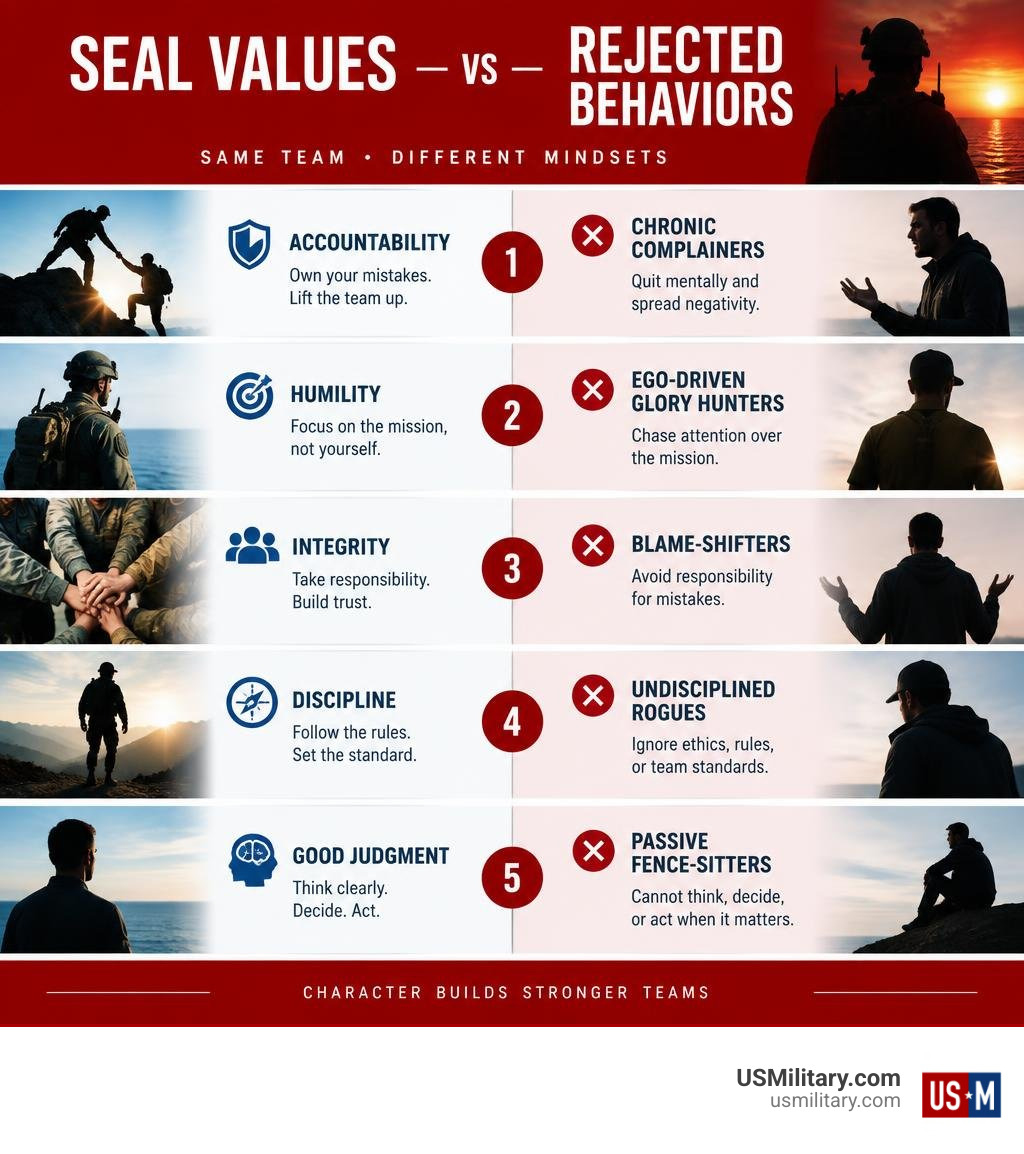
Navy SEALs are not known for disliking people who are simply less experienced, less athletic, or afraid. They tend to reject behaviors that make a team weaker or less trustworthy under pressure:
- Chronic complainers who quit mentally and spread negativity.
- Ego-driven glory hunters who chase attention over the mission.
- Blame-shifters who avoid responsibility for mistakes.
- Undisciplined rogues who ignore ethics, rules, or team standards.
- Passive fence-sitters who cannot think, decide, or act when it matters.
The standard is not mindless aggression. Naval Special Warfare depends on people who are capable, disciplined, and restrained. A teammate does not need to be loud or perfect, but they must own errors, protect the team, and use good judgment. With roughly 75% to 80% of candidates leaving before earning the Trident, BUD/S is built to test far more than fitness. It tests character under sustained stress.
I am LARRY FOWLER, BUD/S Class 89, publisher of NavySeal.com and the USMilitary.com Network since 2007, where I have helped active-duty members, veterans, and future service members make sense of military culture and career decisions. Understanding the 5 Types of People Navy SEALs Despise Being Around can help applicants see why accountability, humility, and disciplined action matter in military teams and civilian life.
Explore more about 5 Types Of People Navy SEALs Despise Being Around:
- 10 Bad Habits of all Navy SEALs confess to
- How Navy SEALs Can Be Perfect Husbands and Amazing Role Models
- What Navy SEAL BUD/S Training Taught Me About Self-Confidence, Courage, & Faith
The Psychology of Elite Selection and Character Filters
To understand what operators dislike, you have to look at the psychological filter that produces them. Basic Underwater Demolition/SEAL (BUD/S) training is deliberately engineered to break down physical ego and test raw character. While thousands of candidates arrive with stellar athletic resumes, between 75% and 80% drop out before ever earning the coveted Trident pin. In some historically grueling classes, such as BUD/S Class 264, attrition reached 94%, graduating just 16 out of 256 men.
Psychological evaluations like the NEO Personality Inventory (NEO-PI) show that active-duty SEALs score exceptionally low in neuroticism and high in conscientiousness. They possess high emotional stability, an innate drive for excitement, and lower agreeableness—meaning they are direct, brutally honest, and focused on mission execution rather than social pleasantries.

From the early underwater demolition teams to the modern history of the United States Navy SEALs, selection has always weeded out selfish tendencies. The crucible forces candidates to realize that raw physical muscle is useless without mental fortitude. Learning what the BUD/S training mindset truly requires proves that survival in elite environments is about embracing discomfort and protecting your teammates.
Why the 5 Types Of People Navy SEALs Despise Being Around Ruin Unit Cohesion
Special operations rely entirely on the "swim buddy" principle. In training and on deployment, you are tethered to a partner. If one fails to maintain situational awareness, both can die.
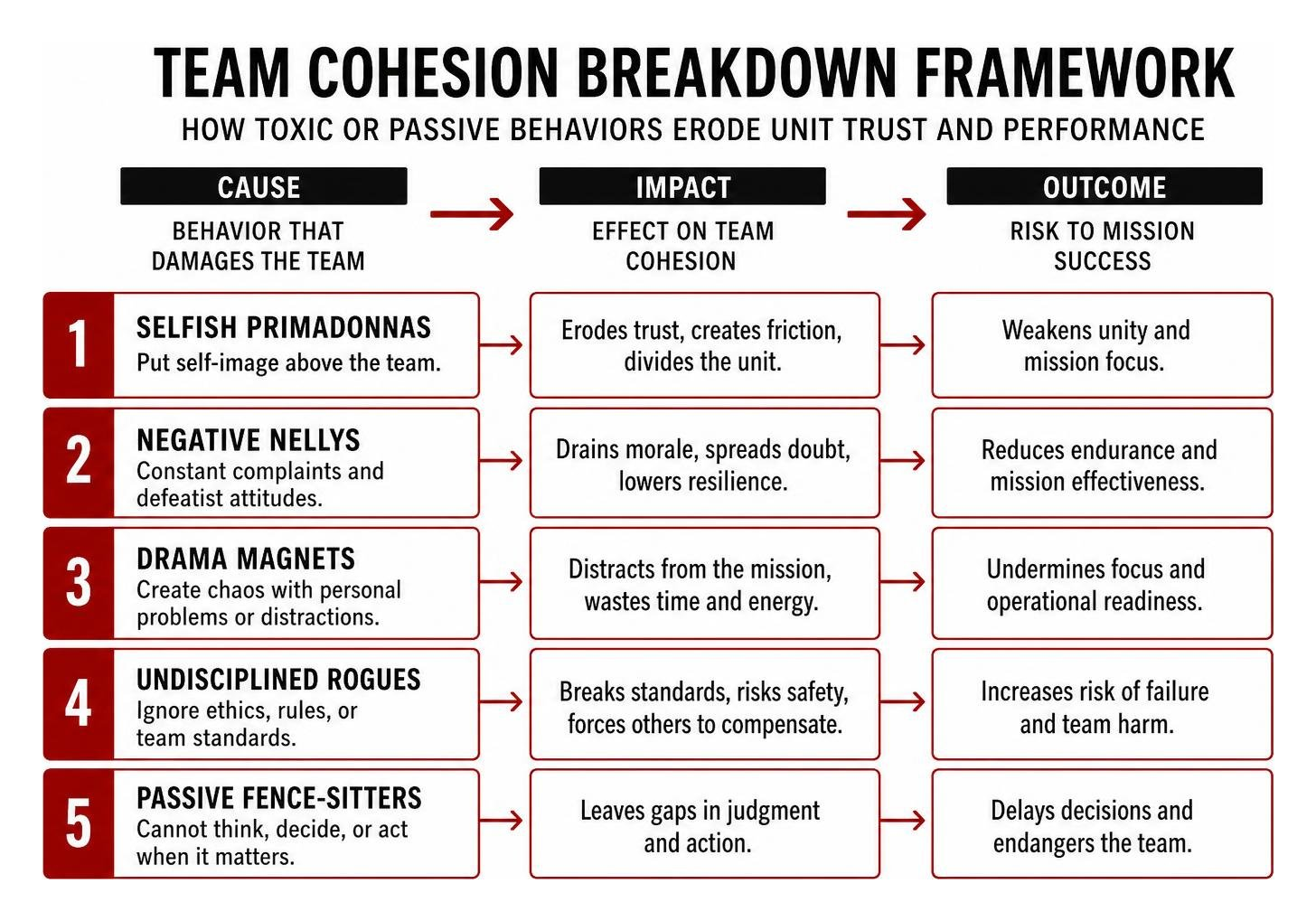
When someone exhibits toxic, selfish, or passive behaviors, they break the mutual trust required to operate in chaotic, high-threat environments. A single unreliable person erodes unit cohesion, drains team energy, and compromises split-second tactical decisions.
The 5 Types Of People Navy SEALs Despise Being Around
Whether comparing SEAL and Army Ranger training standards or looking at corporate boardrooms, elite performance hinges on specific personal standards. Below are the five distinct archetypes that elite operators actively avoid.
1. The Chronic Complainer and Quitter Mindset
Few things destroy a unit faster than a victim mentality. When conditions become miserable—freezing surf at 3:00 AM, heavy boat carries, or endless miles under a rucksack—chronic complainers vocalize their misery, infecting everyone nearby.
SEAL culture values what ultra-endurance athlete and retired SEAL David Goggins demonstrated when he shed 106 pounds in under three months to qualify for training: total refusal to quit. Operators live by the "40% Rule," which suggests that when your brain tells you that you are completely exhausted, you have only tapped into roughly 40% of your actual physical capacity.
People who constantly moan, look for an easy way out, or focus on why a mission cannot be done represent the mindset that leads trainees to ring the brass bell at BUD/S. In combat or business, negativity is a liability nobody has time to carry.
2. The Ego-Driven Glory Hunter
Hollywood movies often depict elite operators as swaggering, loudmouthed commandos. In reality, the community operates on the ethos of the "Quiet Professional." Operators are expected to perform extraordinary deeds without seeking applause or public adulation.
Glory hunters care more about their image, confirmed kills, and post-service book deals than the welfare of the team. During intense combat deployments, individuals who exaggerate their accomplishments or chase personal accolades create dangerous friction. Self-aggrandizement directly violates the humility required to learn from mistakes and put the platoon's safety above individual fame.
3. The Unaccountable Blame-Shifter
In Naval Special Warfare, the highest leadership law is Extreme Ownership. When a mission fails or a detail gets missed, elite operators do not point fingers, make excuses, or blame external circumstances. They step forward, accept responsibility, identify what went wrong, and implement solutions.
Blame-shifters do the exact opposite. When caught in a mistake, they deflect fault onto their subordinates, their gear, or poor leadership. During routine military After-Action Reviews (AARs)—where teams spend 90% of their debrief dissecting what went wrong rather than celebrating what went right—an excuse-maker becomes an immediate obstacle to growth. Avoiding accountability is one of the most toxic, unhealthy habits operators must avoid to stay effective.
4. The Undisciplined Rogue and Ethical Liability
There is a vast difference between being a fierce, aggressive warrior and being an undisciplined criminal. SEALs are trained to apply overwhelming, decisive violence, but that capability must always be paired with ironclad moral restraint and strict adherence to the Rules of Engagement (ROE).
Individuals who cross ethical lines—such as engaging non-combatants, committing theft during tactical operations, or abusing substances—disgrace the Trident and endanger their teammates. When operators ignore operational boundaries, they invite strategic disaster, compromise mission integrity, and dismantle the moral standing of the entire armed forces.
5. The Helpless Fence-Sitter and Passive Bystander
The final type of person operators cannot stand is the individual who freezes in dynamic situations, waiting to be spoon-fed instructions. Naval Special Warfare values free-thinking problem solvers capable of making high-stakes decisions with limited guidance.
A passive bystander confuses harmlessness with goodness. When chaos hits, a fence-sitter lacks the initiative to take charge, assess the threat, and act decisively. As detailed in our breakdown of a day in the life of a Navy SEAL operator, operators operate with high operational autonomy. A person who requires constant hand-holding or defaults to blind obedience becomes dead weight when unexpected crises unfold.
Capable Restraint vs. Harmlessness: The True SEAL Standard
Society often mistakes weakness for virtue, assuming that a person who cannot do harm is morally superior. Elite military units view this differently: a person who lacks the capacity for aggression is simply harmless, not virtuous. True virtue lies in developing immense, lethal capability and possessing the character, discipline, and emotional stability to keep it tightly controlled.
| Behavioral Trait | The Harmless / Passive Person | The Disciplined SEAL Operator |
|---|---|---|
| Response to Crisis | Freezes, avoids responsibility, waits for orders | Evaluates threats rapidly, takes decisive initiative |
| Handling of Mistakes | Blames external factors, makes excuses | Practices Extreme Ownership, leads corrective action |
| Aggression Level | Incapable of meaningful force under stress | Capable of decisive violence, governed by strict restraint |
| Team Role | Drains collective energy through complaints | Maintains composure, elevates unit resilience |
| Ethical Conduct | Follows rules only out of fear of punishment | Governed by an internal moral compass and professional code |
Frequently Asked Questions About SEAL Personality Standards
How to Spot the 5 Types Of People Navy SEALs Despise Being Around in the Civilian World?
In everyday workplace settings, you can spot these individuals by observing how they react under pressure and during project failures. Blame-shifters immediately make excuses when deadlines are missed, chronic complainers spread cynicism in team channels, and glory hunters quickly claim credit for collaborative wins. Testing individuals with small, high-autonomy tasks is often the fastest way to reveal their true accountability and problem-solving initiative.
Do Navy SEALs tolerate aggressive personalities if they are competent?
Aggressiveness is accepted only when directed toward mission objectives and tempered with emotional self-control. Raw tactical skill never excuses toxic perfectionism, reckless rule-breaking, or abusive interpersonal conduct. If an operator is technically brilliant but untrustworthy or selfish, they will quickly be cast out by their peers.
What is the difference between a harmless person and a person with capable restraint?
A harmless person lacks the physical ability, mental toughness, or moral courage to protect themselves or others in a confrontation. A person with capable restraint possesses the training, strength, and mindset to deliver decisive force when required, but consciously chooses ethical behavior, patience, and de-escalation until force is absolutely necessary.
Conclusion
The core warrior values cultivated in elite special operations units—uncompromising accountability, humble professionalism, moral discipline, and proactive initiative—are universal standards of excellence. By eliminating toxic habits like complaining, shifting blame, and chasing shallow recognition, any team or individual can build unshakeable trust and resilience.
Whether you are preparing for military service or striving to lead in your community, mastering these principles will set you apart. For those seeking comprehensive information on training pipelines, career opportunities, and transition resources, review our complete Navy SEAL guide to learn more about the standards required to serve among the world's most elite forces.