Why These Navy SEALs Became Household Names

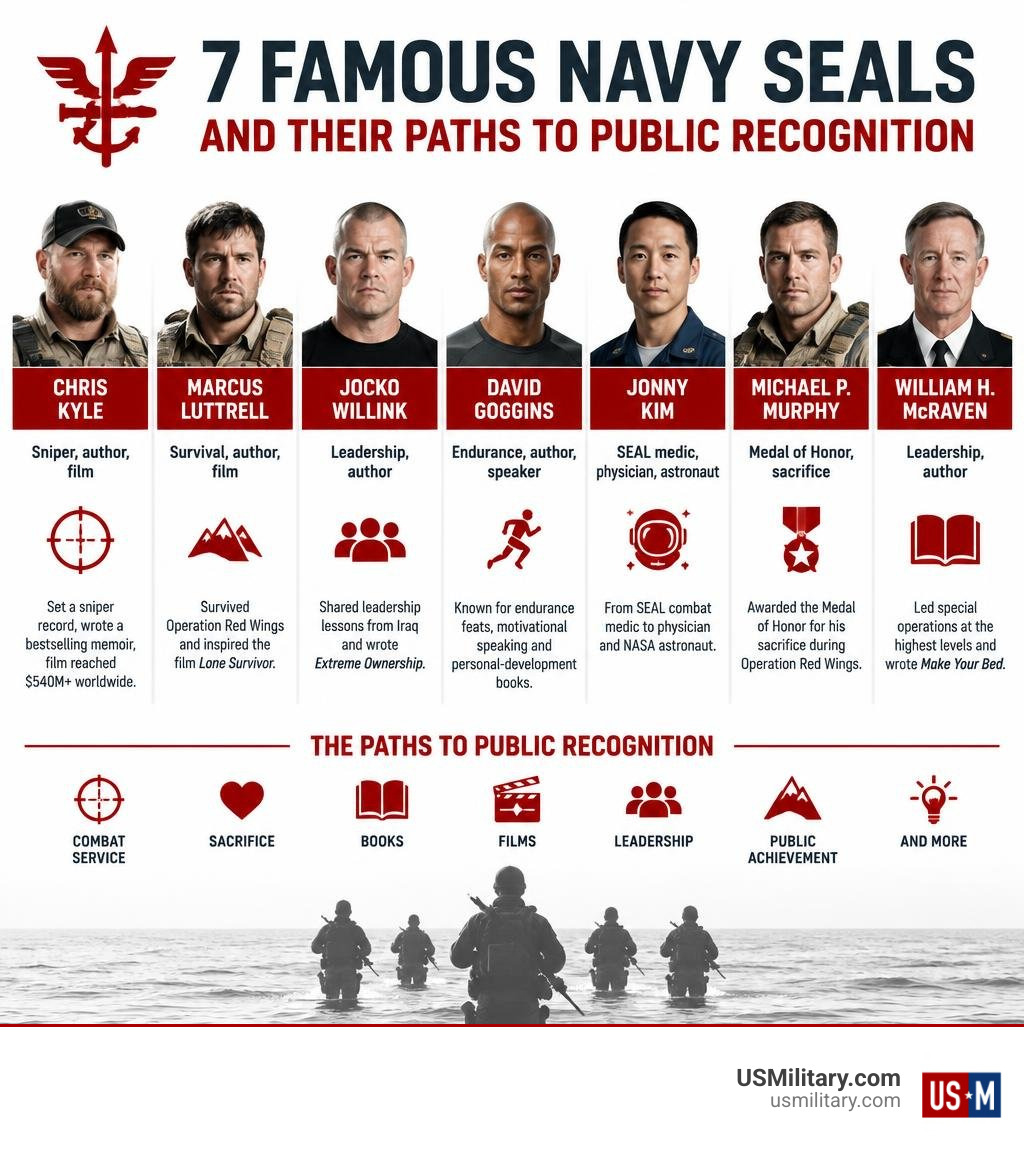
The seven Navy SEALs in this guide became household names through a mix of combat service, sacrifice, books, films, leadership, and public achievement. Chris Kyle is often considered the most famous because American Sniper turned his Iraq War service into a bestselling memoir and a film that grossed more than $540 million worldwide. Others became widely known through survival, Medal of Honor actions, motivational work, science, and national leadership.
More Than 90% Of Clients Have Increased VA Disability Ratings! Why Settle For Less Than You Deserve? Expert Priority Help With Your VA Claim! Free Evaluation Call!
They show that fame after the Teams is not just about a combat record. It can also come from what a veteran does next:
- Chris Kyle: Sniper record, memoir, and Hollywood film
- Marcus Luttrell: Survival in Operation Red Wings and Lone Survivor
- Jocko Willink: Leadership lessons from Iraq and Extreme Ownership
- David Goggins: Endurance feats, speaking, and personal-development books
- Jonny Kim: SEAL combat medic, physician, and NASA astronaut
- Michael P. Murphy: Medal of Honor sacrifice during Operation Red Wings
- William H. McRaven: Senior special operations leadership and Make Your Bed
Their stories can inspire future service members, but they also deserve a clear-eyed view. Public fame can simplify complex missions, and some well-known SEALs have faced questions about claims, awards, or personal accounts. This article separates documented service, cultural impact, and the scrutiny that can follow public attention.
I am LARRY FOWLER, BUD/S Class 89, publisher of NavySeal.com and the USMilitary.com Network since 2007, where I have worked to make military careers, veteran benefits, and service-related decisions easier to understand. In this guide to 7 Famous Navy SEALs And Why They Are Household Names, I focus on the verified achievements and public impact that made these veterans widely recognized.
Explore more about 7 Famous Navy SEALs And Why They Are Household Names:
What Makes a Special Operations Warrior a Pop-Culture Icon?
The transition from silent operator to mainstream icon is a modern phenomenon. Historically, special operators shunned the public eye, adhering strictly to the ethos of the "quiet professional." However, the post-9/11 era fundamentally altered the media landscape, creating an insatiable appetite for authentic stories of battlefield courage, discipline, and operational mastery.
Understanding how the SEALs became the military's premier force requires looking at both their elite, grueling pipeline and their battlefield performance. With Basic Underwater Demolition/SEAL (BUD/S) training maintaining an attrition rate between 65% and 80%, the broader public views anyone wearing the Trident as an individual forged under extraordinary pressure. When these warriors chronicle their experiences in memoirs or transition to high-profile civilian arenas, their military credibility amplifies their public voice.
Criteria Defining 7 Famous Navy SEALs And Why They Are Household Names
To stand out among thousands of elite operators and achieve national recognition, a service member typically checks several distinct boxes:
- Extraordinary Battlefield Valor: Receiving the nation's highest combat decorations, including the Medal of Honor, Navy Cross, or Silver Star.
- Mass-Market Publishing & Film: Translating frontline reality into New York Times bestselling autobiographies and Academy Award-nominated blockbusters.
- Civilian Leadership & Media Presence: Building dominant podcasts, management consulting firms, or delivering viral commencement addresses.
- Extreme Multidisciplinary Achievement: Reaching the pinnacle of demanding fields outside special operations, such as medicine, space exploration, or government governance.
- World-Class Athletic Feats: Conquering world records in endurance sports and reshaping modern fitness philosophies.
Impact of the 7 Famous Navy SEALs And Why They Are Household Names on Modern Culture
The influence of these seven figures reaches far beyond military circles. In modern culture, their mindsets have revolutionized corporate management, popularized high-intensity fitness trends, and fueled veteran entrepreneurship. Concepts like "Extreme Ownership" are taught in business boardrooms, while endurance events raise millions of dollars for military families.
Their public visibility also shapes modern recruiting efforts, giving candidates real-world blueprints of service while providing veterans with models for civilian career transitions.
7 Famous Navy SEALs And Why They Are Household Names
| Navy SEAL | Primary Military Role / Unit | Key Military Honors | Primary Driver of Household Fame | Major Works / Post-Service Milestones |
|---|---|---|---|---|
| Chris Kyle | Sniper, SEAL Team 3 | Silver Star, 4 Bronze Stars w/ Valor | Deadliest sniper record; Hollywood film | American Sniper memoir & $540M+ film |
| Marcus Luttrell | Combat Medic/Sniper, SEAL Team 10 | Navy Cross, Purple Heart | Sole survivor of Operation Red Wings | Lone Survivor book & film; Lone Survivor Foundation |
| Jocko Willink | Commander, Task Unit Bruiser | Silver Star, Bronze Star w/ Valor | Military leadership translated to business | Extreme Ownership; Jocko Podcast; Echelon Front |
| David Goggins | Operator, SEAL Team 5 / TACP | Armed Forces Exemplary Service | "Toughest Man Alive"; extreme endurance | Can't Hurt Me; Guinness World Record pull-ups |
| Jonny Kim | Combat Medic/Sniper, SEAL Team 3 | Silver Star, Bronze Star w/ Valor | Multidisciplinary excellence (SEAL, MD, NASA) | Harvard Medical School M.D.; NASA Astronaut |
| Michael P. Murphy | Officer-in-Charge, SEAL Delivery Vehicle Team 1 | Medal of Honor, Purple Heart | Selfless sacrifice in Operation Red Wings | USS Michael Murphy; "The Murph" Hero WOD |
| William H. McRaven | Commander, USSOCOM (Four-Star Admiral) | Defense Distinguished Service Medal | Architect of the Bin Laden Raid; author | Make Your Bed; UT Austin address; SOCOM leadership |
1. Chris Kyle: The "American Sniper" and Battlefield Legend
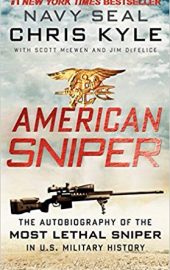
Chris Kyle remains the most famous Navy SEAL in modern history. Serving four combat deployments during the Iraq War—including heavy urban combat in Fallujah, Ramadi, and Sadr City—Kyle officially recorded 160 confirmed kills out of 255 claimed, establishing him as the deadliest sniper in U.S. military history. Insurgents feared him enough to place a bounty on his head, dubbing him the "Devil of Ramadi," while his fellow troops affectionately called him "The Legend."
Kyle's transition to a household name accelerated rapidly with the 2012 release of his autobiography, American Sniper: The Autobiography of the Most Lethal Sniper in U.S. Military History. Following his tragic death in 2013 at a Texas shooting range at the hands of a troubled veteran he was attempting to mentor, Clint Eastwood directed the 2014 cinematic adaptation starring Bradley Cooper. The film grossed more than $540 million worldwide, cementing Kyle's legacy in American pop culture.
Kyle’s public prominence also brought scrutiny. Inquiries into official military personnel files revealed clerical discrepancies in his discharge paperwork regarding his exact medal count, clarifying his verified record as one Silver Star and four Bronze Stars with Valor. Additionally, a defamation lawsuit filed by former governor and UDT veteran Jesse Ventura led to an out-of-court settlement with Kyle’s estate in 2017. Despite these controversies, Kyle’s foundational advocacy for veteran mental health and combat overwatch continues to define his enduring status.
2. Marcus Luttrell: The "Lone Survivor" of Operation Red Wings
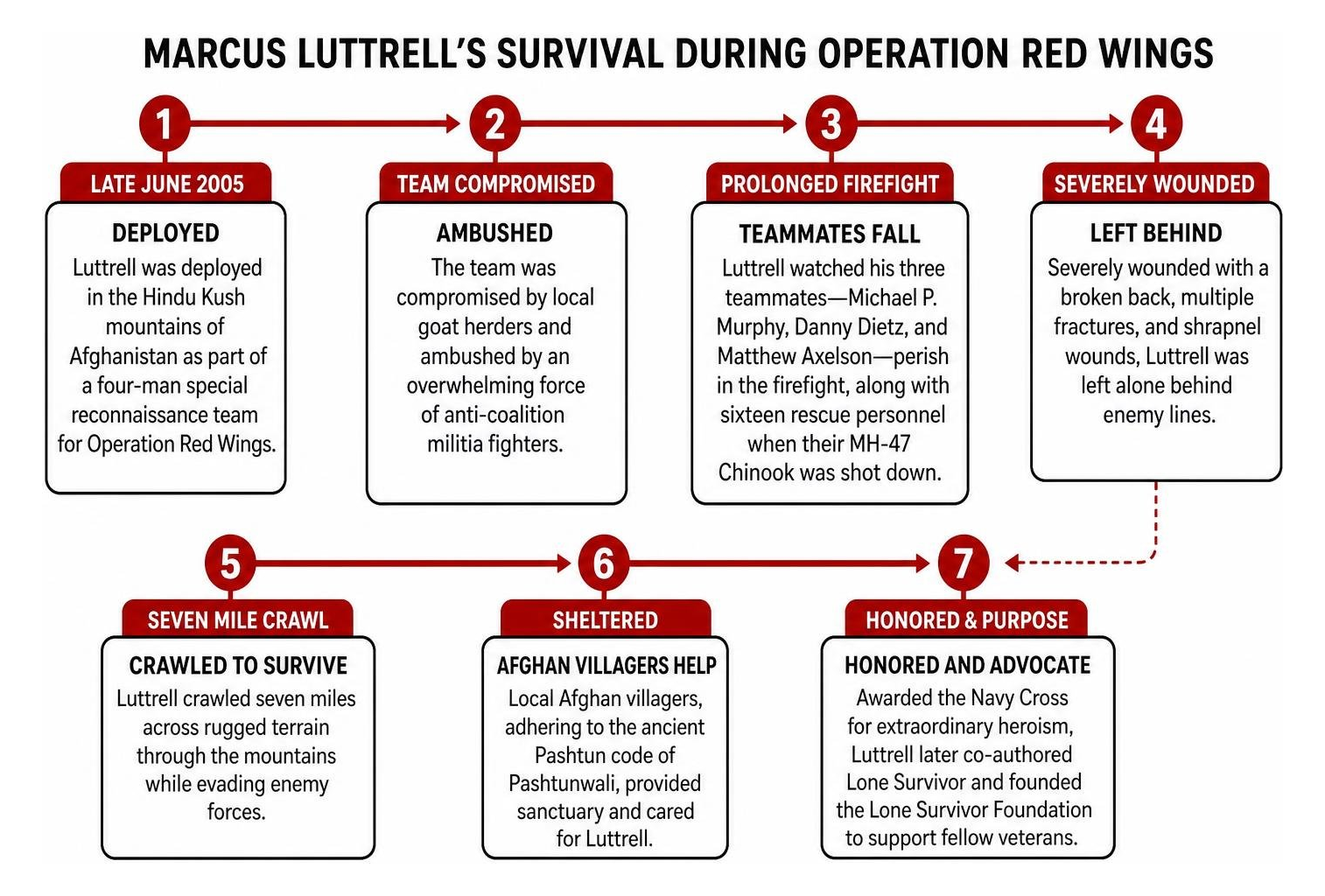
Marcus Luttrell’s fame stems from one of the most harrowing survival stories in modern warfare. In late June 2005, Luttrell was deployed into the Hindu Kush mountains of Afghanistan as part of a four-man special reconnaissance team for Operation Red Wings. After the team was compromised by local goat herders, they were ambushed by an overwhelming force of anti-coalition militia fighters.
Luttrell watched his three teammates—Lieutenant Michael P. Murphy, Danny Dietz, and Matthew Axelson—perish in the prolonged firefight, along with sixteen special operations rescue personnel whose MH-47 Chinook helicopter was shot down. Severely wounded with a broken back, multiple fractures, and shrapnel wounds, Luttrell crawled seven miles across rugged terrain before being sheltered by local Afghan villagers adhering to the ancient Pashtun code of Pashtunwali (providing sanctuary against enemies).
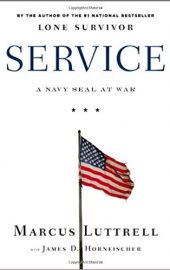
Awarded the Navy Cross for his extraordinary heroism, Luttrell co-authored the 2007 bestselling book Lone Survivor, which was later adapted into a 2013 major motion picture starring Mark Wahlberg. Luttrell leveraged his global platform to launch the Lone Survivor Foundation and establish the nationwide Patriot Tour, providing resources and therapeutic retreats for combat veterans transitioning home.
3. Jocko Willink: Task Unit Bruiser and Extreme Ownership
John Gretton "Jocko" Willink transformed battlefield command principles into a dominant civilian leadership movement. As the commander of Task Unit Bruiser (SEAL Team 3) during the 2006 Battle of Ramadi—an elite unit that included Chris Kyle, Jonny Kim, and Medal of Honor recipient Michael Monsoor—Willink led what became the most highly decorated special operations unit of the Iraq War, earning the Silver Star and Bronze Star with Valor.
Following his retirement after 20 years of active duty, Willink co-founded the global management consulting firm Echelon Front alongside his former subordinate officer, Leif Babin. Their 2015 book, Extreme Ownership: How U.S. Navy SEALs Lead and Win, became a massive New York Times #1 bestseller, fundamentally shifting leadership philosophy across business, athletics, and government by emphasizing complete accountability at every level of command.
Today, Jocko maintains a vast cultural footprint through his popular Jocko Podcast, his early-morning "0430" discipline posts, and his fitness and nutrition enterprises, representing the gold standard of practical leadership drawn from combat experience.
4. David Goggins: The World's Toughest Motivational Machine
David Goggins represents a unique phenomenon in special operations fame: an individual celebrated as much for raw physical and mental transformation as for his service. Overcoming a childhood marked by severe poverty, domestic abuse, and obesity, Goggins famously lost 106 pounds in just three months to qualify for BUD/S, eventually graduating with Class 235 after enduring three Hell Weeks due to medical setbacks.
Goggins is the only member of the U.S. Armed Forces to complete SEAL training, the U.S. Army Ranger School (graduating as Enlisted Top Honor Man), and Air Force Tactical Air Control Party (TACP) training. Following combat deployments with SEAL Team 5, Goggins turned to ultra-endurance racing to raise funds for the Special Operations Warrior Foundation, generating over $2 million for the children of fallen warriors.
Goggins has completed over 70 ultra-marathons, finished 5th in the grueling Badwater 135-mile race, and once held the Guinness World Record for completing 4,030 pull-ups in 17 hours. His memoirs, Can't Hurt Me and Never Finished, have sold millions of copies worldwide, making him a household name for anyone pursuing mental toughness and personal accountability.
5. Dr. Jonny Kim: Combat Medic, Harvard Physician, and NASA Astronaut
Dr. Jonny Kim holds one of the most intellectually and physically demanding résumés in American history. Enlisting in the Navy at age 18, Kim completed BUD/S Class 247 and served as a combat medic, sniper, and point man with SEAL Team 3's Task Unit Bruiser. He completed more than 100 combat missions across two deployments to Iraq, earning both the Silver Star and Bronze Star with Valor for treating wounded comrades under intense enemy fire.
Driven by the loss of teammates on the battlefield, Kim pursued a commission through the Seaman to Admiral-21 program, earning a degree in mathematics from the University of San Diego before earning his medical degree (M.D.) from Harvard Medical School in 2016. While completing his medical residency, Kim was selected by NASA in 2017 out of more than 18,300 applicants to join Astronaut Group 22.
Kim represents the modern pinnacle of multidisciplinary service. As a qualified naval aviator, flight surgeon, and active NASA astronaut assigned to major spaceflight initiatives, Kim has captured the nation's admiration as an emblem of quiet excellence and public service.
6. Michael P. Murphy: Medal of Honor Hero of Operation Red Wings
Lieutenant Michael P. Murphy represents the ultimate expression of battlefield sacrifice. A graduate of Pennsylvania State University who deferred law school to earn his SEAL Trident, Murphy served as the officer-in-charge of the four-man reconnaissance element during Operation Red Wings in June 2005.
Surrounded by a superior enemy force on the steep slopes of the Hindu Kush mountains, Murphy realized his team was cut off from radio communication due to the dense terrain. Knowing it would cost him his life, Murphy deliberately stepped away from protective cover into an open, exposed clearing to establish a satellite call with headquarters. Despite being shot repeatedly, he calmly provided his unit’s coordinates, completed the call, and continued fighting until he was mortally wounded.
For his actions, Murphy was posthumously awarded the Medal of Honor in 2007, becoming the first member of the U.S. Navy to receive the nation’s highest military decoration since the Vietnam War. His legacy is memorialized across the country: the guided-missile destroyer USS Michael Murphy (DDG-112) bears his name, and his preferred physical training regimen—a grueling workout consisting of a 1-mile run, 100 pull-ups, 200 push-ups, 300 squats, and another 1-mile run in a weighted vest—is performed worldwide every Memorial Day as the "Murph" Hero WOD. More historical context on his peers can be found on the historical roster of United States Navy SEALs.
7. William H. McRaven: Special Operations Commander and "Make Your Bed" Author
Admiral William H. McRaven achieved national fame by operating at the highest levels of strategic military command. Over a distinguished 37-year military career, McRaven led special operations at every echelon, culminating in his role as Commander of United States Special Operations Command (USSOCOM), overseeing roughly 69,000 elite operators and support personnel.
McRaven is widely recognized as the strategic architect of Operation Neptune Spear, the high-stakes May 2011 raid executed by SEAL Team Six that eliminated Al-Qaeda leader Osama bin Laden in Abbottabad, Pakistan. His masterful coordination of complex intelligence and tactical precision elevated him to national prominence.
Following his retirement from active service, McRaven served as Chancellor of the University of Texas System. His 2014 University of Texas commencement address, centering on ten life lessons learned during BUD/S training—starting with the discipline of making your bed each morning—went viral worldwide. He adapted the speech into the #1 New York Times bestselling book Make Your Bed: Little Things That Can Change Your Life...And Maybe the World, cementing his place as one of the most respected military authors and thinkers in modern American life.
The Legacy, Ethos, and Scrutiny of Famous SEAL Veterans

The rise of high-profile Navy SEAL veterans has sparked debate within the Naval Special Warfare community. The core ethos of the SEAL Teams has long centered on the principle of the "Quiet Professional"—an operator who does not advertise their service, seek individual recognition, or capitalize commercially on secret operations.
When operators publish books, sign media deals, or step into political spotlights, they sometimes face criticism from peers who feel high-profile publicity undermines operational security and organizational cohesion. Controversies surrounding book releases, conflicting claims regarding historic raids (such as the bin Laden raid), and medal verification reviews emphasize the challenges of public military fame.
Yet, public visibility has also allowed veterans to champion essential causes. High-profile SEALs have raised millions of dollars for fallen-soldier charities, built innovative mental health programs for combat trauma, and inspired thousands of young Americans to pursue service in the Armed Forces. Stories like the extraordinary life of Adam Brown showcase how sharing narratives of resilience and redemption can have a profoundly positive impact on the civilian world.
Frequently Asked Questions About Famous Navy SEALs
Who is considered the most famous Navy SEAL of all time?
Chris Kyle is widely considered the most famous Navy SEAL in history. His reputation as the deadliest sniper in U.S. military history with 160 confirmed kills, combined with his bestselling autobiography American Sniper and Clint Eastwood’s blockbuster film adaptation, created unmatched global name recognition.
How many Navy SEALs have received the Medal of Honor?
Seven Navy SEALs have been awarded the Medal of Honor for conspicuous gallantry above and beyond the call of duty:
- Joseph R. Kerrey (Vietnam War)
- Thomas R. Norris (Vietnam War)
- Michael E. Thornton (Vietnam War)
- Michael P. Murphy (War in Afghanistan – Posthumous)
- Michael A. Monsoor (Iraq War – Posthumous)
- Edward C. Byers Jr. (War in Afghanistan)
- Britt K. Slabinski (War in Afghanistan)
How do former Navy SEALs build successful civilian careers?
Former SEALs leverage the discipline, adaptability, and high-stress decision-making forged during BUD/S and combat deployments. Many build top-tier management consulting firms, author bestselling books on organizational leadership, excel in elite athletic careers, or transition into high-level public service, medicine, and corporate governance.
Conclusion
The enduring fame of these seven Navy SEALs is built upon a foundation of genuine sacrifice and operational excellence. Whether holding defensive lines in the streets of Ramadi, surviving against overwhelming odds in the Hindu Kush, or translating battlefield lessons into actionable life principles for millions of civilians, their legacies continue to shape American culture.
At USMilitary.com, we are committed to honoring this legacy of service by providing active-duty service members, veterans, and military families with transparent, accurate resources—from career planning to VA home loans and disability guidance. To learn more about the requirements, training pipeline, and history of Naval Special Warfare, explore our complete guide to Navy SEAL careers and training.