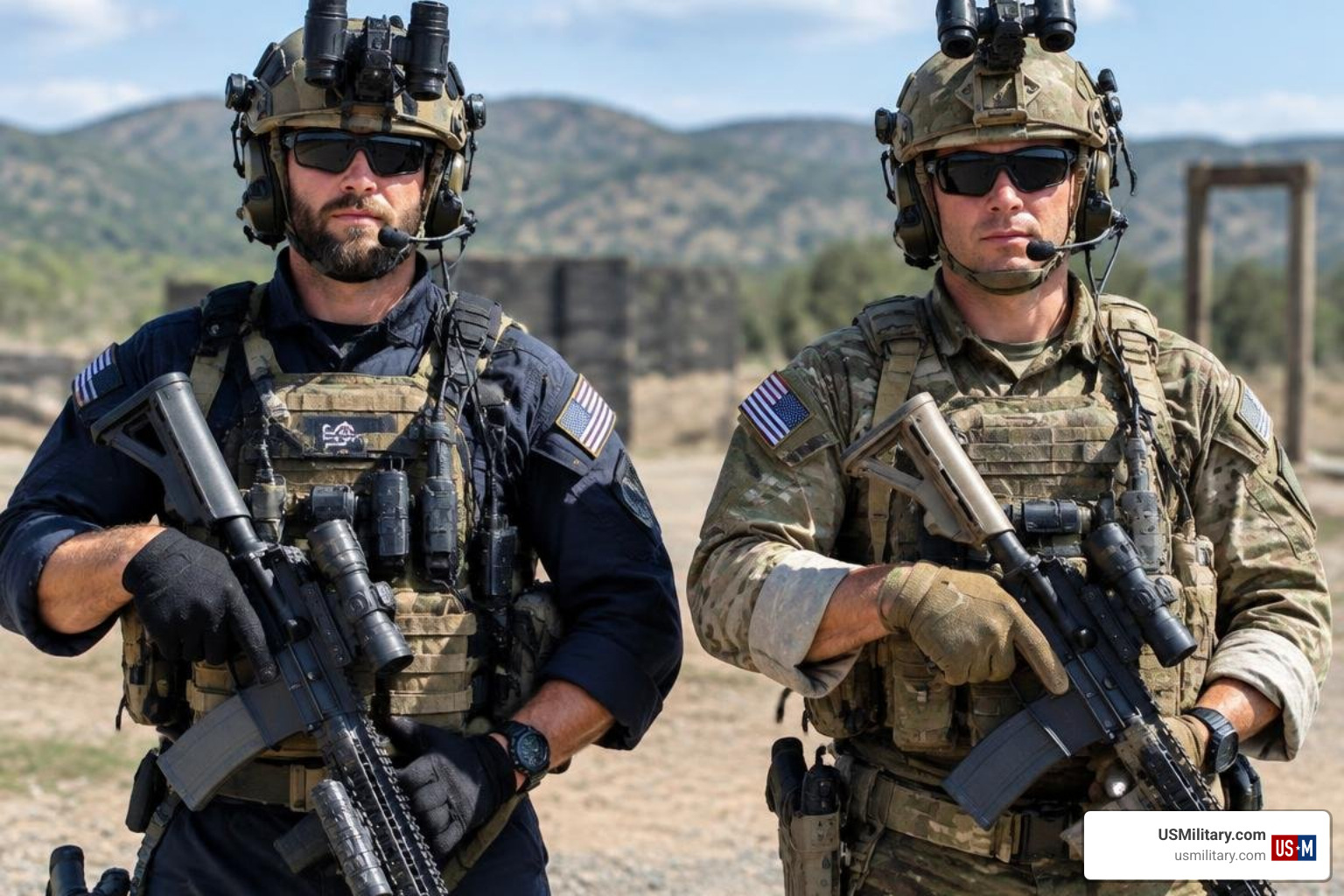
Navy SEALs and Delta Force: Mission Differences That Matter
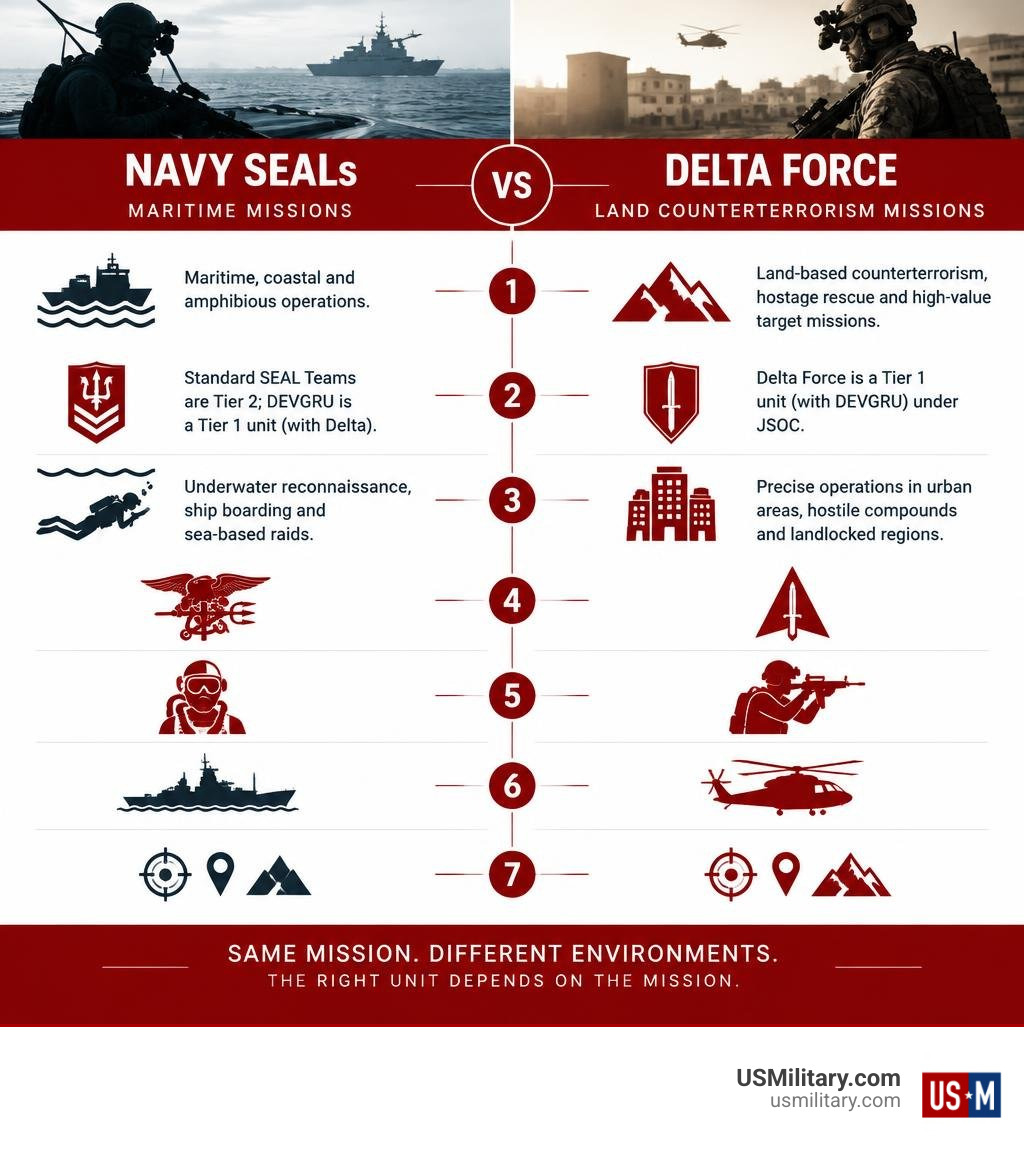
The 7 Major Mission Differences Between Navy SEALs and Army Delta Force come down to mission setting, unit tier, and the skills needed for the target.
- Navy SEALs are built around maritime, coastal, and amphibious operations.
- Delta Force focuses heavily on land-based counterterrorism, hostage rescue, and high-value target missions.
- Standard SEAL Teams are generally considered Tier 2 forces, while DEVGRU is the Navy's Tier 1 special mission unit alongside Delta Force.
- SEALs can conduct underwater reconnaissance, ship boarding, and sea-based raids.
- Delta is strongly associated with precise operations in urban areas, hostile compounds, and landlocked regions.
- DEVGRU and Delta can both conduct direct action and hostage rescue under Joint Special Operations Command (JSOC).
- The best unit is not the "more elite" one. It is the unit whose training, access, intelligence support, and environment fit the mission.
In simple terms, a hijacked vessel or coastal target may favor Naval Special Warfare capabilities. A hostage crisis inside a fortified urban building may call for Delta Force's counterterrorism focus. But real-world tasking is rarely that neat: JSOC can use either unit, or combine forces, based on location, timing, available aircraft, intelligence, and risk.
I am LARRY FOWLER, BUD/S Class 89, publisher of NavySeal.com and the USMilitary.com Network since 2007, serving active-duty personnel, veterans, and people exploring military careers. This guide to the 7 Major Mission Differences Between Navy SEALs and Army Delta Force is designed to help readers look past popular myths and understand how mission requirements shape each unit's role.
7 Major Mission Differences Between Navy SEALs and Army Delta Forces glossary:
- Navy SEAL vs Delta Force: Elite Units Compared
- Pros and Cons Of Army Delta Force vs Navy SEALs
- Should I Train To Become a Navy SEAL or Army Delta Operator?
Understanding the Foundations: Naval Special Warfare vs. 1st SFOD-D
To grasp why these units operate differently, we have to look at how and why they were created. The U.S. Navy SEALs trace their direct lineage back to the World War II Underwater Demolition Teams (UDTs) and Scout & Raider units. Officially commissioned by President John F. Kennedy in 1962, the SEALs (standing for Sea, Air, Land) were designed as an all-environment maritime assault force capable of hydrographic reconnaissance, underwater sabotage, and littoral warfare.
By contrast, the 1st Special Forces Operational Detachment-Delta (1st SFOD-D)—commonly known as Delta Force, Combat Applications Group (CAG), or The Unit—was founded in 1977 by Army Colonel Charles Beckwith. Beckwith served as an exchange officer with the British Special Air Service (SAS) in the 1960s and recognized that the U.S. military lacked a dedicated, surgically precise counterterrorism and hostage rescue organization. You can discover more about their covert history in our deep dive into The Shadow Warriors: Everything You Need to Know About Delta Force.
Tier Classifications: Tier 1 DEVGRU vs. Tier 2 SEAL Teams
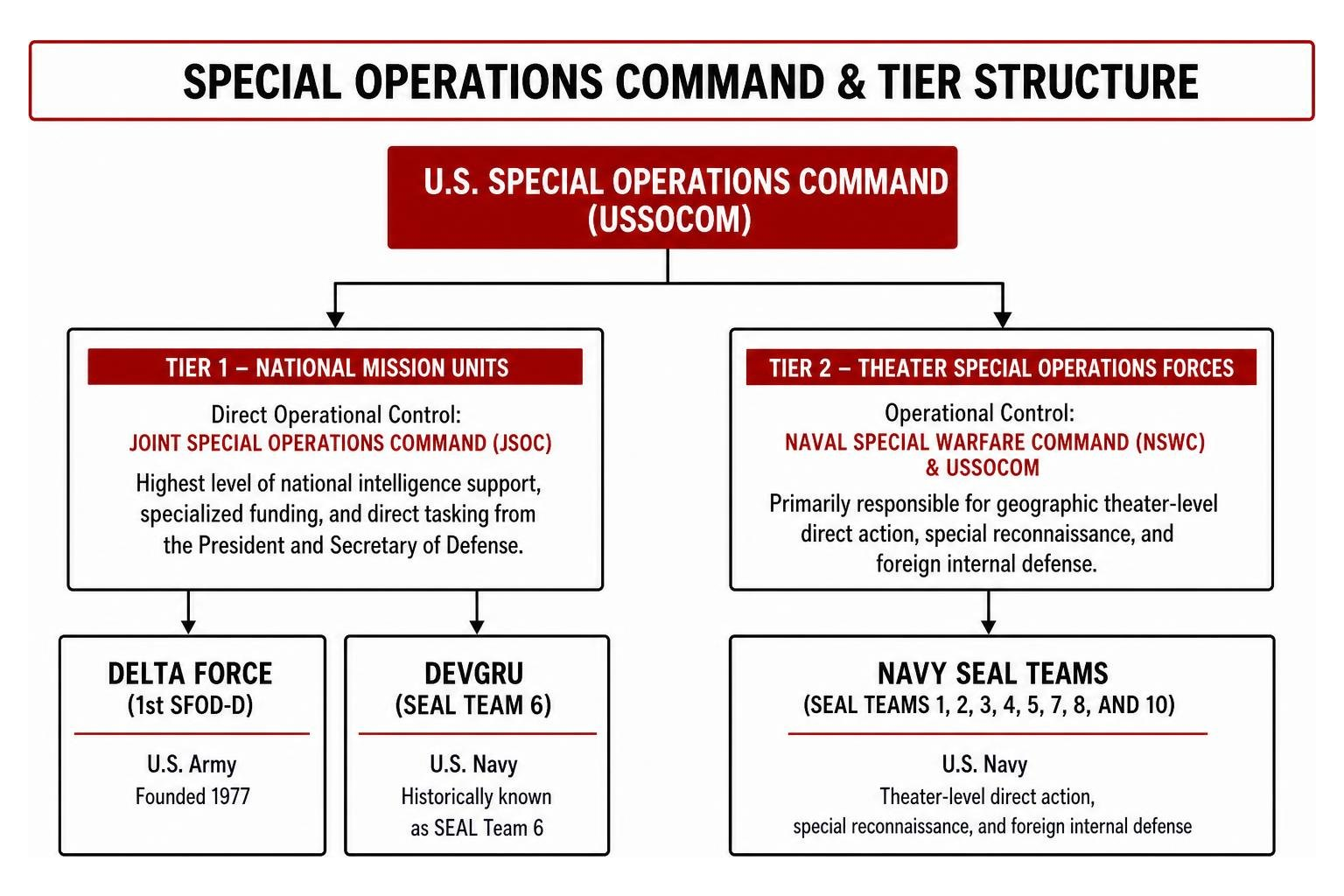
A common point of confusion in special operations discussions is the military "Tier" funding and command structure. In the special operations hierarchy:
- Tier 1 (National Mission Units): Delta Force and Naval Special Warfare Development Group (DEVGRU, historically known as SEAL Team 6) fall under the direct operational control of the Joint Special Operations Command (JSOC). These units receive the highest levels of national intelligence support, specialized funding, and direct taskings from the President and Secretary of Defense. Learn how operators transition to this level in The Path to Tier One: Your Guide to DEVGRU Requirements.
- Tier 2 (Theater Special Operations Forces): Numbered Navy SEAL Teams (such as SEAL Teams 1, 2, 3, 4, 5, 7, 8, and 10) operate under Naval Special Warfare Command (NSWC) and U.S. Special Operations Command (USSOCOM). They primarily handle geographic theater-level direct action, special reconnaissance, and foreign internal defense.
Selection Pipelines and Candidate Demographics
The recruitment pipelines for each force shape their battlefield personalities:
- Navy SEAL Selection: Civilians can enlist directly with a SEAL challenge contract through the Basic Underwater Demolition/SEAL (BUD/S) pipeline. Candidates endure brutal physical conditions, sleep deprivation during Hell Week, and ocean immersion. BUD/S maintains an attrition rate of approximately 75% to 80%. Candidates skew younger (typically 18 to 24 years old). Explore the complete pipeline in our comprehensive guide to the US Navy SEALs.
- Delta Force Selection: Delta does not take direct civilian enlistments. Candidates are seasoned service members—primarily recruited from the 75th Ranger Regiment and Army Special Forces (Green Berets), but open to all military branches including the Coast Guard and Navy. The average candidate is older (24 to 32 years old) with years of combat experience. Delta's selection course boasts an 88% to 90% attrition rate, culminating in "The Long Walk"—a grueling 40-mile solitary land navigation march carrying heavy rucks across rugged mountainous terrain.
7 Major Mission Differences Between Navy SEALs and Army Delta Forces
While both communities field exceptional combat professionals, their tactical mandates diverge across operational environments, infiltration profiles, and command relationships.
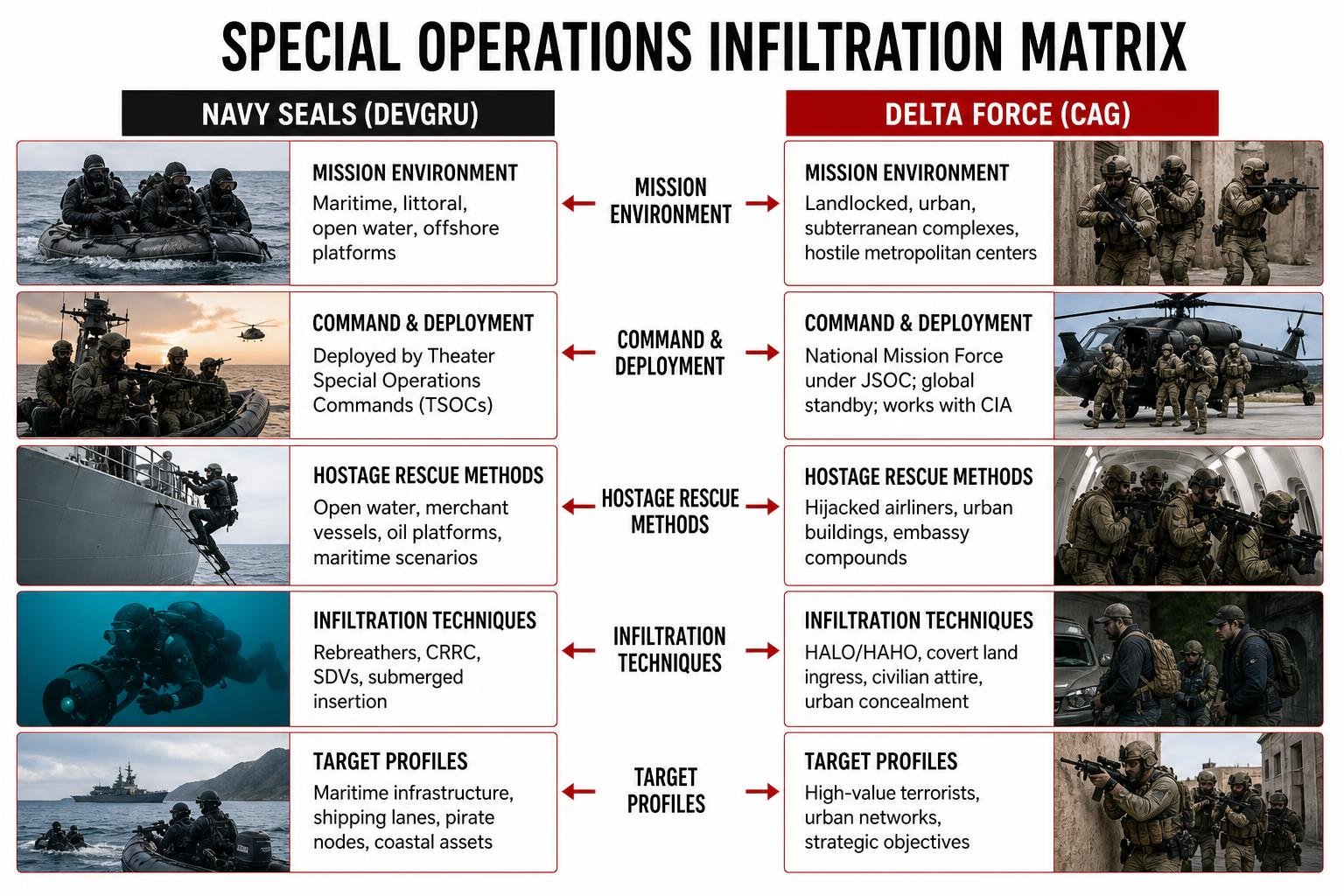
1. Core Operational Environments: Maritime Dominance vs. Landlocked Urban Warfare
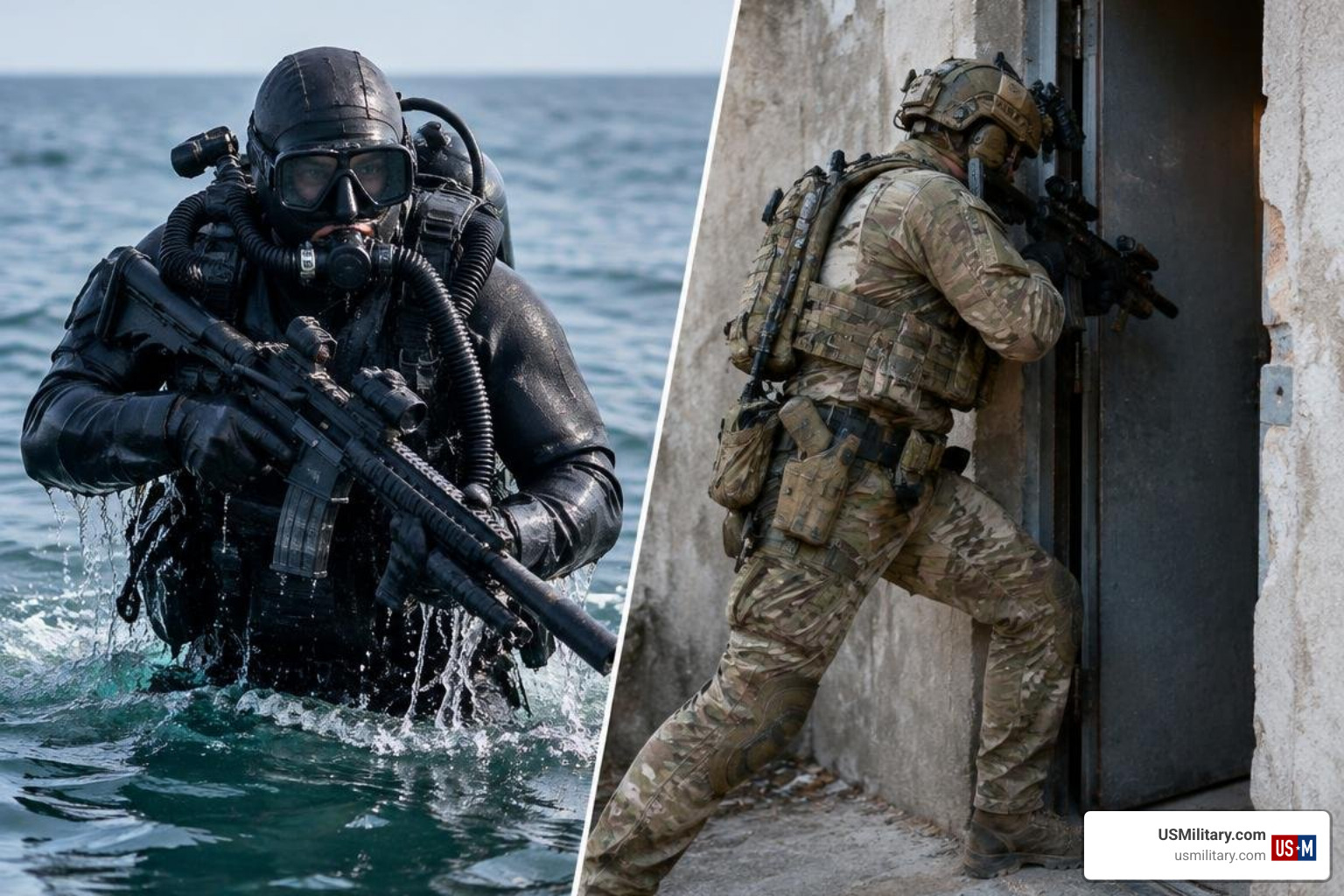
The most defined separation between the two forces is the operating medium. Navy SEALs own the waterline. They specialize in littoral combat, riverine warfare, hydrographic reconnaissance, and Visit, Board, Search, and Seizure (VBSS) operations on non-compliant vessels at sea.
Delta Force is optimized for landlocked combat, dense urban environments, subterranean complexes, and hostile metropolitan centers where collateral damage must be minimized through razor-sharp marksmanship.
2. Command Structure and Deployment: Theater Direct Action vs. National Mission Force
Standard Navy SEAL teams are deployed by Theater Special Operations Commands (TSOCs) to support Geographic Combatant Commanders worldwide. They execute tactical beach clearings, coastal interdiction, and high-stakes direct action operations aligned with maritime theater strategy.
Delta Force functions as a dedicated National Mission Force under JSOC. Delta is permanently on standby to deploy anywhere in the world on a moment's notice to execute high-stakes national strategic objectives, often working in tandem with the CIA Special Activities Center.
3. Hostage Rescue Methodologies: Open Water vs. Fortified Urban Structures
When hostages are taken in open water, on merchant vessels, or offshore oil platforms, DEVGRU takes point. The textbook 2009 rescue of Captain Richard Phillips from Somali pirates off the coast of East Africa demonstrated the Navy's precision sniper capabilities from rolling naval combatants.
When hostages are held inside hijacked airliners, barricaded embassy compounds, or dense urban buildings, Delta Force's Close Quarters Battle (CQB) protocols lead the way. Delta operators spend countless hours perfecting explosive breaching, flashbang entry, and millisecond decision-making inside aircraft fuselages and multi-story structures.
4. Infiltration Techniques: Subsurface Insertion vs. Covert Low-Visibility Land Ingress
How each unit gets to work highlights their distinct toolkits:
- Navy SEAL Infiltration: SEALs master closed-circuit rebreathers (Dräger systems) that produce no surface bubbles, Combat Rubber Raiding Craft (CRRC), and wet combat submersibles known as SEAL Delivery Vehicles (SDVs). They can swim submerged for miles to hit a target undetected.
- Delta Force Infiltration: While Delta maintains High Altitude Low Opening (HALO) and High Altitude High Opening (HAHO) parachuting capabilities, they frequently utilize low-visibility covert vehicle ingress, civilian attire, and specialized urban concealment gear. For an exhaustive breakdown of CAG hardware, view our guide inside Delta Force essential equipment.
5. Target Profiles: Counter-Piracy and Littoral Raids vs. High-Value Terrorist Networks
The target profiles assigned to each force reflect their respective training investments:
- Navy SEAL Targets: Submarine cable infrastructure, coastal air defense batteries, naval shipping lanes, maritime pirate nodes, and coastal weapon storage depots.
- Delta Force Targets: High-value terrorist leadership networks, transnational bomb-making cells, and insurgent command compounds. Delta spearheaded the capture of Saddam Hussein in Operation Red Dawn and executed the daring 2019 raid resulting in the death of ISIS leader Abu Bakr al-Baghdadi.
6. Cross-Branch Interoperability and Joint Task Force Roles
Because Delta Force recruits across the entire Department of Defense—incorporating Army Rangers, Green Berets, Air Force Combat Controllers, and Marine Raiders—its internal structure is inherently joint-service. Delta operators routinely lead multi-agency task forces combining NSA signals intelligence, CIA paramilitary officers, and Army aviation from the 160th Special Operations Aviation Regiment (SOAR).
Navy SEAL teams maintain deep integration with carrier strike groups, amphibious ready groups (ARGs), and surface naval vessels. While DEVGRU seamlessly plugs into JSOC task forces, regular SEAL teams focus on empowering fleet operations and advising foreign allied naval commandos.
7. Operational Secrecy, Unit Culture, and Media Profiles
The cultural posture of the two organizations differs noticeably:
- Delta Force (The "Quiet Professionals"): Delta enforces strict operational security. The Army rarely acknowledges the unit's existence publicly, and operators deliberately avoid public branding, books, or media appearances during and after their service.
- Navy SEALs (The Maritime Brand): Due to historic operational exposure, official Navy recruiting initiatives, and movies like Zero Dark Thirty and Act of Valor, the SEAL community has a prominent public profile. While active operators adhere to strict security, the broader SEAL community enjoys significant brand recognition across civilian culture.
Choosing a Special Operations Career Path
If you are considering a career in elite special operations, your starting point matters:
- Direct Civilian Entry: If you are a civilian wanting immediate access to special operations selection, the Navy's SEAL challenge contract offers a direct path through BUD/S right after recruit training.
- Prior-Service Maturation: If your goal is Delta Force, you cannot enlist directly into the unit. You must enlist in the military (ideally through an Army Option 40 Ranger contract or 18X Special Forces contract), build a multi-year track record of leadership and tactical competence, and then volunteer when Delta recruiters run active screening boards.
Before choosing your track, check our comprehensive guides to training to become a Navy SEAL or Army Delta and review the Navy SEALs vs Delta Force pay and benefits guide.
Frequently Asked Questions About Navy SEALs and Delta Force
Can a Navy SEAL Join Delta Force?
Yes. Because 1st SFOD-D is an all-service unit, active-duty Navy SEALs, Marine Raiders, and Air Force Special Tactics personnel can attend Delta selection. While candidates from other branches must navigate administrative transfer paperwork through their service branch, several Navy SEALs have passed Delta's selection course and served as operators in The Unit.
Which Unit Is Considered More Elite Between Delta Force and SEAL Team 6?
Comparing Delta Force and DEVGRU is like comparing a master neurosurgeon to a master cardiovascular surgeon—each is unequaled in their operational specialty. Both are Tier 1 Special Mission Units under JSOC with identical access to strategic funding, cutting-edge weaponry, and top-secret intelligence. For a head-to-head analysis, read our article exploring which elite unit is more specialized.
How Did SEALs and Delta Force Divide Missions During the Global War on Terror?
During the Global War on Terror (GWOT), JSOC established geographically distinct Joint Special Operations Task Forces to maximize unit strengths:
- Iraq (Task Force 17 / Task Force 77): Delta Force primarily managed high-tempo urban counterterror raids in Baghdad and the Sunni Triangle targeting Al-Qaeda in Iraq.
- Afghanistan: DEVGRU and standard SEAL teams led operations across rugged mountain sectors, coastal interdiction missions in surrounding waters, and targeted strikes against Taliban leadership.
Conclusion
Understanding the operational balance between Navy SEALs and Army Delta Force reveals the brilliance of the U.S. special operations architecture. Rather than duplicating efforts, our military deliberately engineered two distinct organizations: one to project power from the sea onto hostile shores, and the other to surgically dismantle threats hidden in landlocked strongholds.
At USMilitary.com, we provide active-duty service members, veterans, and military families with transparent guides on military careers, education programs, and veteran benefits. If you are preparing for a career in Naval Special Warfare, explore our Navy SEALs complete career and operational guide to launch your military journey.