
Protecting Navy SEAL VA Disability Benefits Starts With Knowing the Red Flags

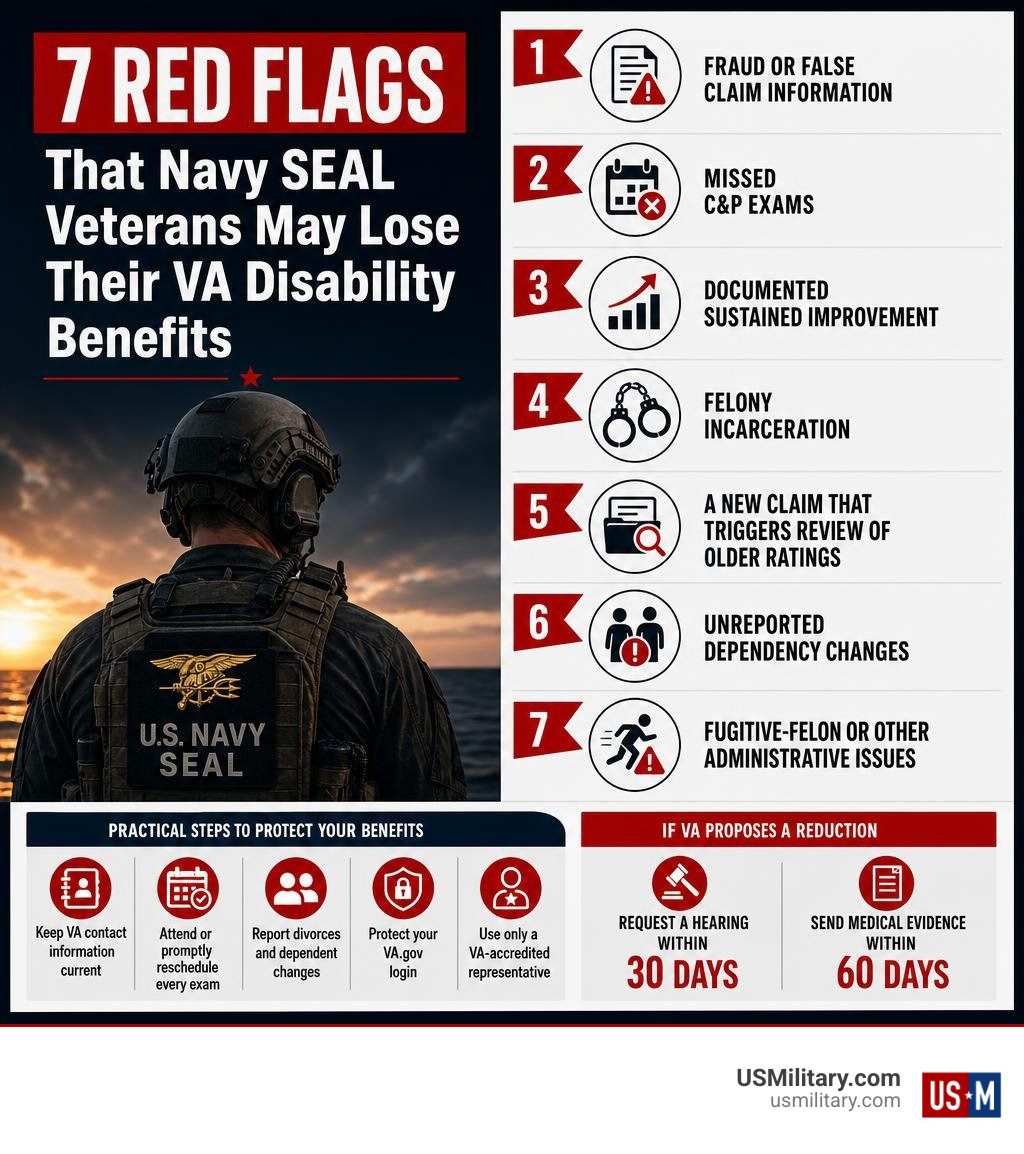
The 7 Red Flags That Navy SEAL Veterans May Lose Their VA Disability Benefits are fraud or false claim information, missed C&P exams, documented sustained improvement, felony incarceration, a new claim that triggers review of older ratings, unreported dependency changes, and fugitive-felon or other administrative issues.
The practical steps are simple: keep VA contact information current, attend or promptly reschedule every exam, report divorces and dependent changes, protect your VA.gov login, and use only a VA-accredited representative. If VA proposes a reduction, request a hearing within 30 days and send medical evidence within 60 days.
Navy SEAL veterans can face added scrutiny because conditions such as PTSD, traumatic brain injury, chronic pain, and orthopedic injuries may change over time. Improvement in one area does not erase a service-connected condition, but VA can review whether the evidence supports the current rating. A new claim for an increase or secondary condition may also open existing ratings to review.
I am LARRY FOWLER, BUD/S Class 89, publisher of the NavySeal.com and the USMilitary.com Network since 2007, where I have helped military audiences understand VA disability trends, benefits, and claim-related decisions. This guide to the 7 Red Flags That Navy SEAL Veterans May Lose Their VA Disability Benefits explains what can put compensation at risk and what veterans can do to protect it.
Important 7 Red Flags That Navy SEAL Veterans May Lose Their VA Disability Benefits terms:
- How To Maintain Your VA Disability Rating If The Government Attempts To Lower It
- What is the 5 year rule for VA Disability
- how much does a va lawyer cost
7 Red Flags That Navy SEAL Veterans May Lose Their VA Disability Benefits
Serving in Naval Special Warfare demands operating at the absolute peak of human physical and psychological endurance. Decades of heavy rucks, combat diving, parachute insertions, blast overpressure, and high-intensity direct action take a massive toll. When team members transition out, VA disability compensation offers critical financial security for those lasting service-connected injuries.
However, many veterans assume their monthly compensation checks are a permanent, guaranteed lifetime subscription. In reality, benefits can be reduced, suspended, or terminated under federal law. Understanding The Complete Guide to VA Disability Claims is the first line of defense in keeping your hard-earned benefits intact.
How Fraud and Misrepresentation Show 7 Red Flags That Navy SEAL Veterans May Lose Their VA Disability Benefits
One of the fastest-growing threats to veteran benefits involves unauthorized consulting companies and predatory actors. According to the Federal Trade Commission, veterans reported being swindled out of $419 million in 2024 due to fraud and deceptive schemes. While the VA has issued formal cease-and-desist warnings to dozens of unaccredited companies, at least 29 of 38 warned companies appeared to still be operating as of late November 2025.
Unaccredited "claims predators" frequently target Special Operations veterans by promising guaranteed 100% disability ratings. They often charge exorbitant fees—sometimes demanding a one-time fee equal to five times the monthly increase, running upwards of $10,000 to $20,000.
These companies frequently utilize questionable Disability Benefits Questionnaires (DBQs) filled out by remote medical providers who never conducted an in-person physical examination or properly reviewed the service treatment records.
Are You Able To Increase Your VA Disability Rating? Talk With An Expert. Free Call. Click Here.
If the VA Office of Inspector General (VA OIG) determines that a rating was established through fraudulent medical evidence, the VA can sever service connection entirely, terminate monthly payments, and demand full recoupment of all past benefits paid.
Veterans must also guard their personal information. Phishing operations and payment redirection scams harvest login credentials to access VA.gov accounts and alter direct deposit information. Always check the official VA Office of General Counsel (OGC) Accreditation Search tool before working with any representative.
Why Missing a C&P Exam Is Part of 7 Red Flags That Navy SEAL Veterans May Lose Their VA Disability Benefits
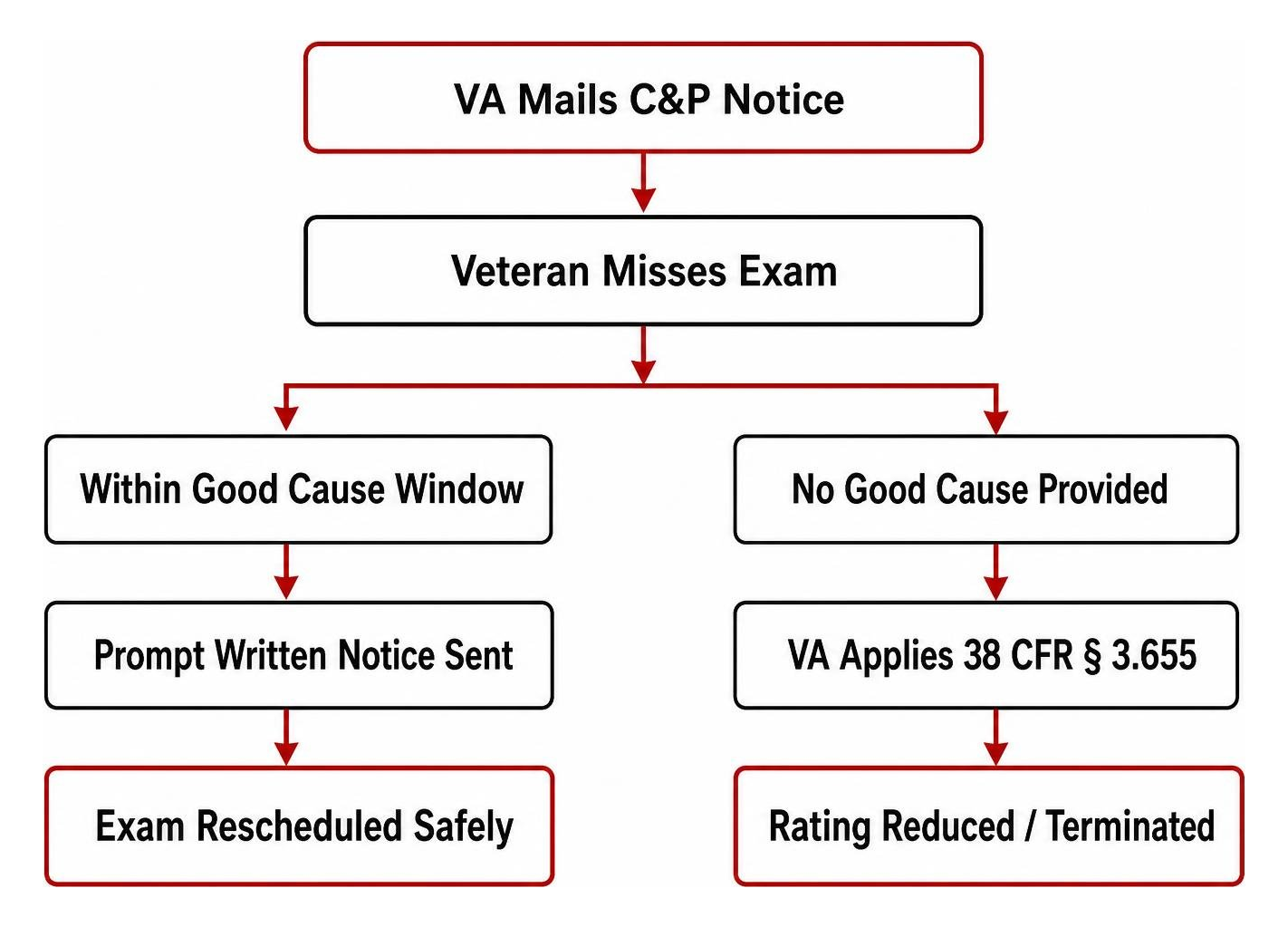
Under 38 C.F.R. § 3.655, if a veteran fails to attend a scheduled Compensation & Pension (C&P) re-evaluation examination without good cause, the VA has the direct legal authority to reduce or stop their disability payments.
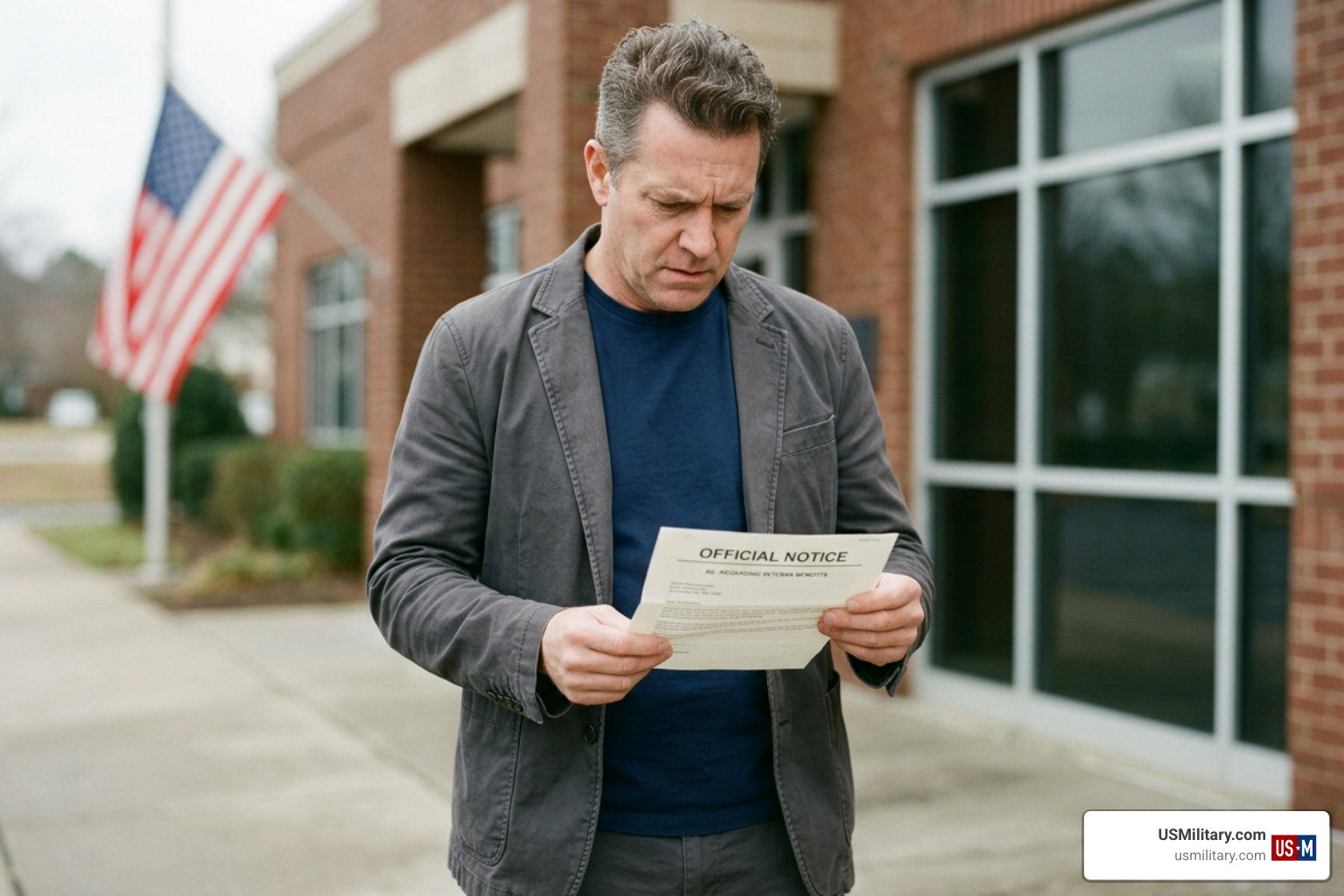
Because Navy SEALs and special operators frequently transition into high-tempo contracting overseas, maritime security, or private corporate roles, official VA correspondence sent by physical mail can easily sit unopened.
- Address Updates: Keep your physical address, phone number, and primary email up to date in your VA.gov profile.
- Good Cause Documentation: If you miss an exam due to international travel, family emergencies, or hospitalization, notify the VA and the contracted exam vendor (such as VES, QTC, or Loyal Source) immediately in writing to demonstrate good cause.
- Immediate Rescheduling: Request a prompt reschedule before the regional office closes the claim file or issues an adverse rating decision.
Sustained Medical Improvement in SEAL-Specific Disabilities
Special Warfare operators routinely sustain severe, compounding physical and psychological trauma. These include Traumatic Brain Injury (TBI) from breacher blast exposure, complex combat PTSD, spine damage, and joint degeneration.
The VA regularly schedules re-examinations for non-static conditions. For the VA to lower a rating based on medical recovery, federal regulations require them to demonstrate sustained medical improvement under the ordinary conditions of daily life and work—not just temporary relief from an isolated good day.
SEAL veterans often downplay their pain during routine checkups—a natural byproduct of special operations culture. If medical records repeatedly show notes like "patient reports zero joint pain" or "symptoms completely resolved," the VA rating official may interpret these entries as material improvement, triggering a proposed reduction.
Filing for Increases and the Re-Evaluation Trigger
Many veterans decide to file a new claim for an increased rating or submit a secondary condition linked to an existing service-connected injury. While this is often appropriate, it is essential to understand that filing any new claim acts as a re-evaluation trigger that reopens your entire claims folder.
When evaluating your overall rating, the VA uses the "Whole Man Theory" and non-linear combined disability math. Review our VA Disability Rating Increase Expert Guide and follow the 7 Critical Steps Increase VA Disability Rating to build a solid evidentiary record before filing.
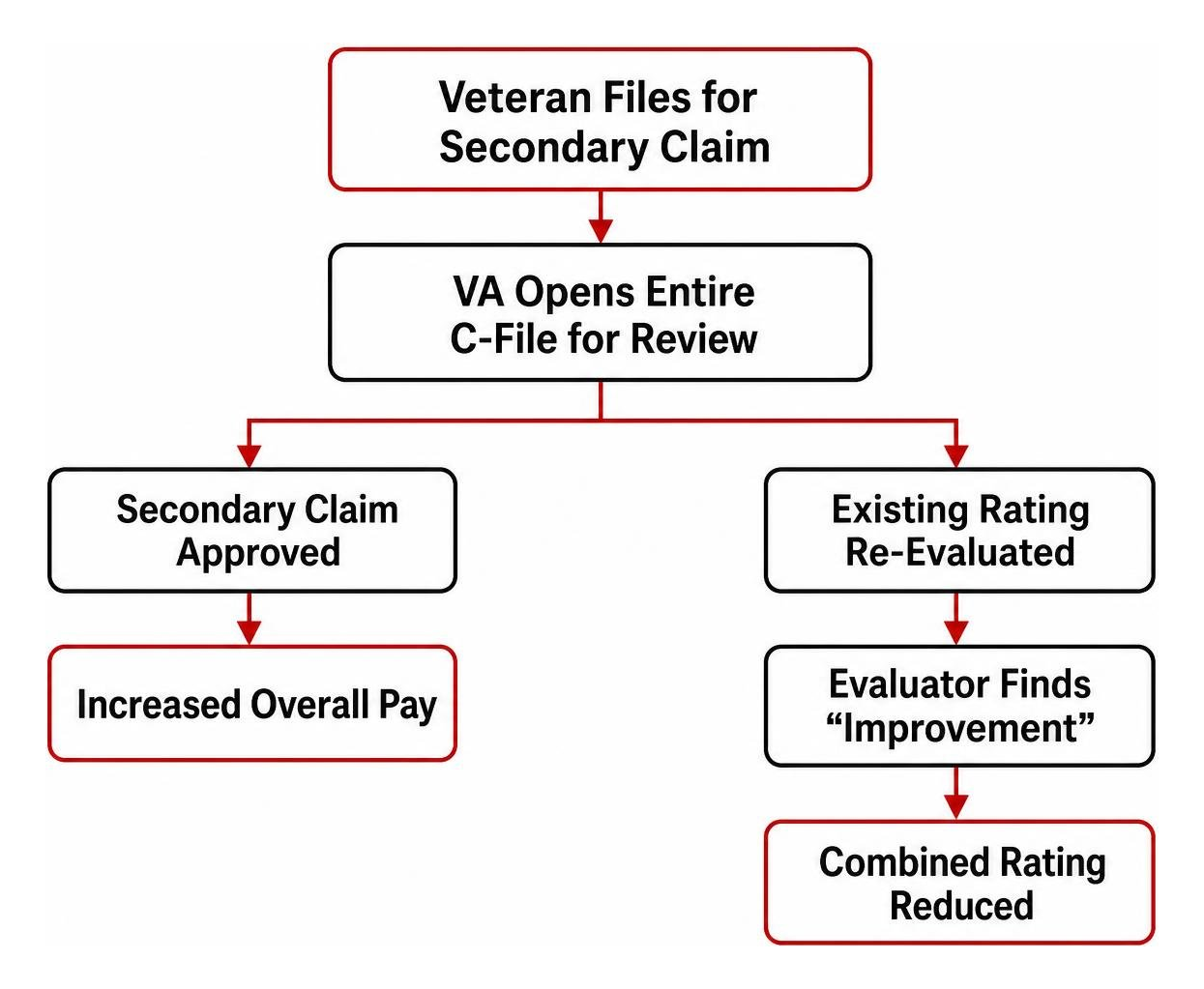
If an older condition has not been evaluated in several years, the rater may order a fresh C&P exam for that primary disability. If the new exam measures a greater range of motion or reduced symptom frequency, your overall combined rating could decrease rather than increase.
Incarceration, Dependency Errors, and Administrative Reductions
Administrative non-compliance is another primary path to payment disruption:
Felony Incarceration Rule
Under federal statute, if a veteran is convicted of a felony and incarcerated for more than 60 days, their monthly VA disability compensation is capped.
- Ratings of 20% or higher: Payments are limited to the 10% disability pay rate.
- Rating of 10%: Payments are cut by half (to 5%).
- Apportionment: The withheld compensation can be apportioned to qualified dependents (spouses, children) based on financial need, but family members must apply directly. Payments can be restored once the veteran is released.
Unreported Dependency Changes
Disability compensation for ratings of 30% or higher includes additional cash allowances for dependents. If you get divorced, a spouse passes away, or a child ages out without attending college, you must report the change to the VA immediately. Failing to do so leads to large overpayments that the VA will recoup by garnishing future monthly checks. Consult the VA Disability Pay 2026 Guide for exact pay tiers and dependent rates.
Fugitive Felon Status
Veterans with active felony arrest warrants for fleeing custody, avoiding prosecution, or violating probation conditions face immediate suspension of all VA benefit payments until the legal matter is cleared.
Understanding VA Protected Rating Rules and Reduction Safeguards
The VA cannot arbitrarily slash disability ratings whenever it chooses. Federal law establishes strict protective rules based on how long a rating has been continuously in effect.
To master these regulations and safeguard your compensation, consult our guides on How to Maintain Your VA Disability Rating in 5 Easy to Follow Steps and the VA Disability Rating Chart Guide 2026.
What to Do If You Receive a VA Notice of Proposed Reduction
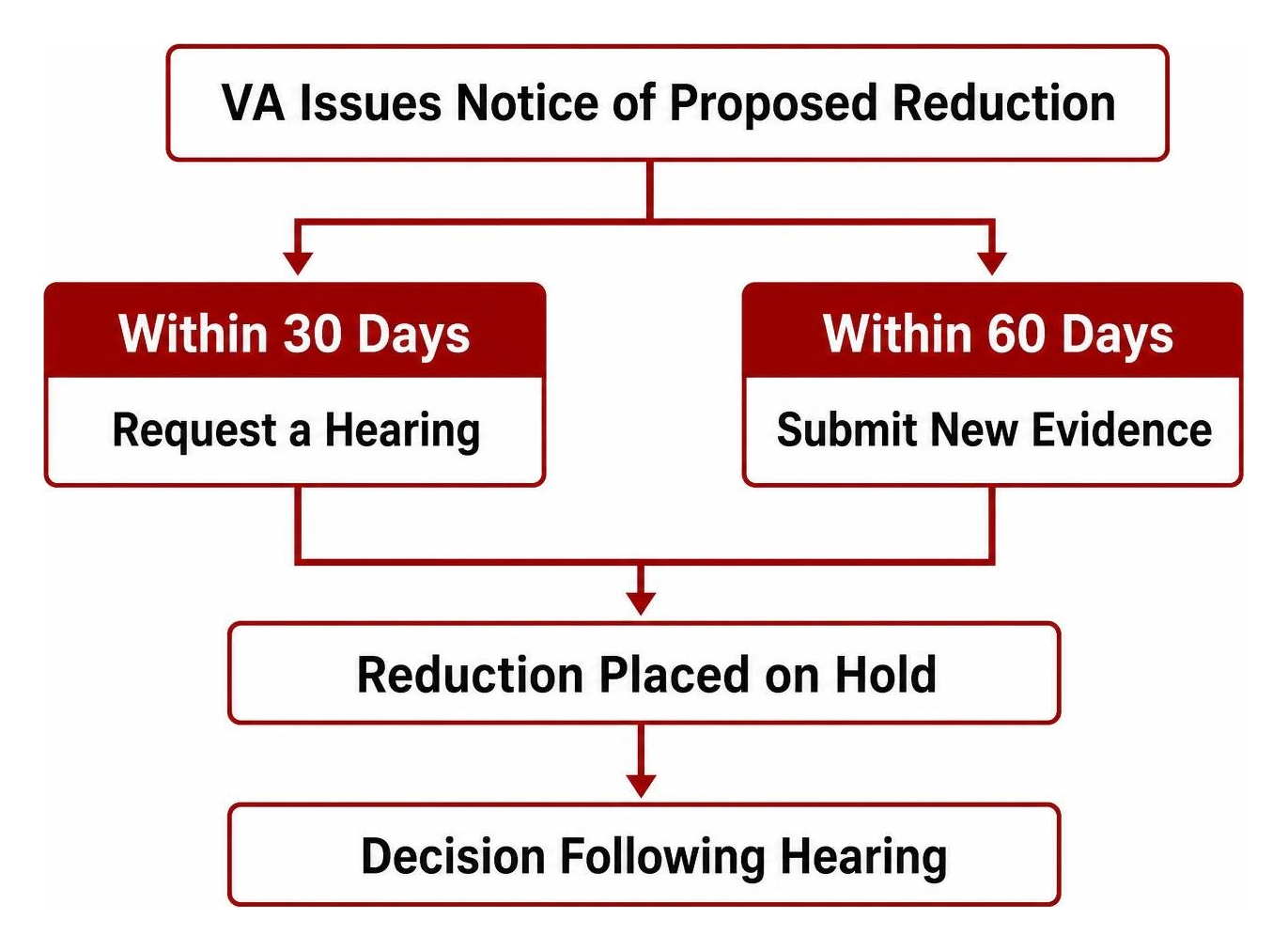
If the VA decides to lower your disability rating, they are legally required to provide advance written notice. This gives you a clear window to defend your rating.
Follow these critical steps immediately upon receiving a proposal letter:
- Request a Hearing Within 30 Days: Submitting a written request for a hearing within 30 days of the notice date legally freezes the proposed reduction until the hearing is held and a formal decision is issued.
- Submit Medical Evidence Within 60 Days: You have 60 days to provide objective medical documentation, doctor letters (nexus letters), diagnostic imaging, and personal statements showing your condition has not experienced sustained improvement.
- Engage an Accredited Representative: Work exclusively with an accredited Veterans Service Officer (VSO) or accredited VA disability attorney to organize your rebuttal.
- Gather Independent Medical Opinions: Obtain private clinical evaluations that accurately document flare-ups, functional limitations, and daily pain levels under ordinary living conditions.
Frequently Asked Questions About Navy SEAL VA Disability Reductions
Can the VA automatically reduce a Navy SEAL's disability rating without advance notice?
No. Under federal due process requirements, the VA must issue a formal Notice of Proposed Reduction before lowering a rating for any non-stabilized condition. Veterans have 30 days to request a hearing and 60 days to provide new medical evidence rebutting the reduction.
What happens to VA disability pay if a veteran is incarcerated for a felony?
If a veteran is convicted of a felony and incarcerated for more than 60 days, payments are capped at the 10% rate for veterans rated 20% or higher. For veterans rated 10%, payments are halved. The veteran or their dependents can request an apportionment so the withheld funds are redirected to family members.
Does filing for a new secondary condition risk triggering a re-evaluation of existing ratings?
Yes. Whenever a veteran submits a new claim for an increase or secondary service connection, the VA opens the entire claims file. If existing service-connected conditions lack recent documentation or show signs of recovery, the rater may order re-examinations that could impact your overall combined rating.
Conclusion
Your VA disability compensation represents recognition of the sacrifices made during your special warfare service. Preserving these benefits requires ongoing medical documentation, keeping your contact and dependent records current, and using only accredited representatives when filing claims.
Explore our comprehensive guides to applying for VA disability benefits and navigate your military benefits with confidence.