

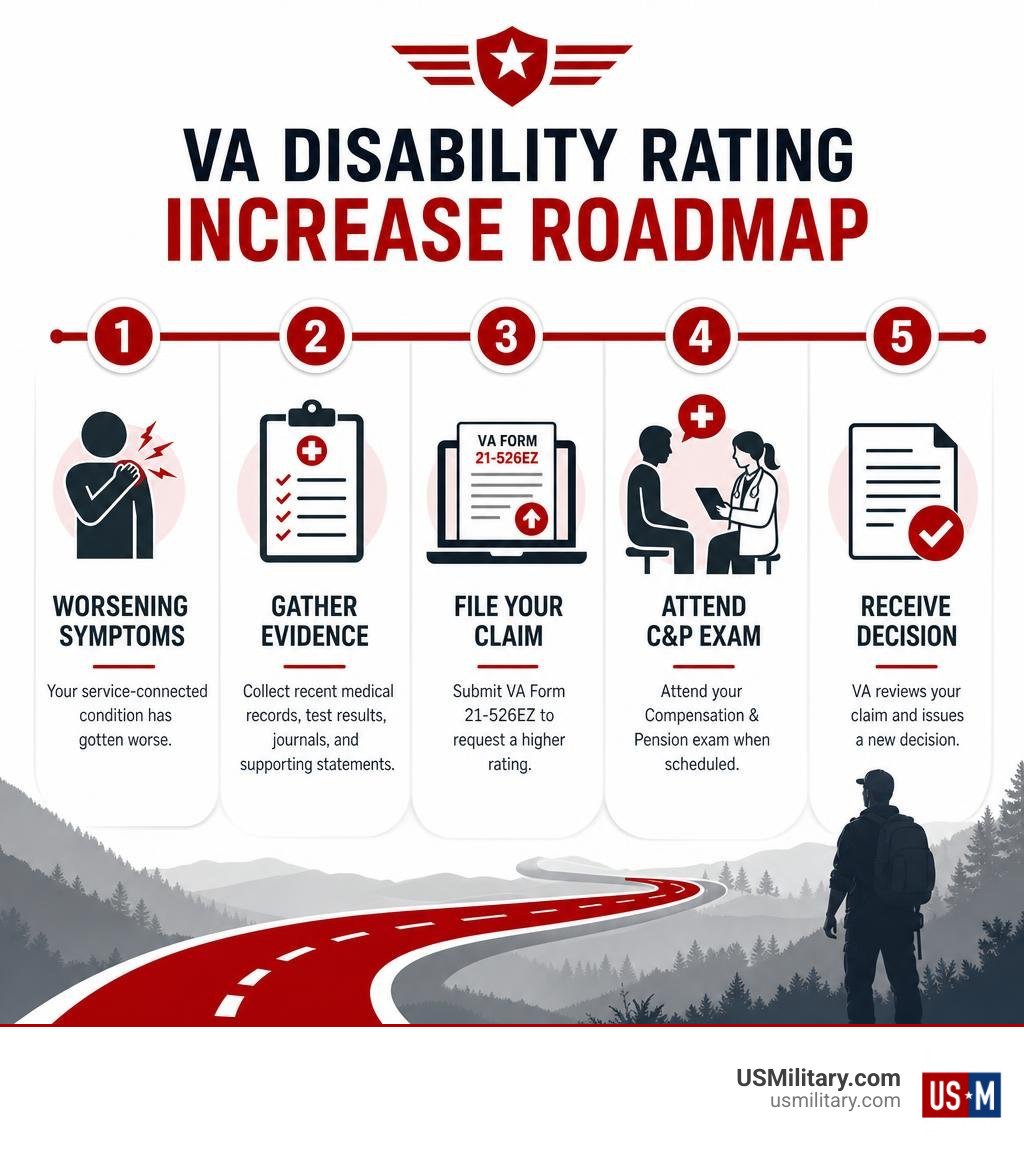
Yes. You can request a higher VA disability rating when an already service-connected condition has become worse. File an increased claim using VA Form 21-526EZ, submit recent medical evidence that shows the change, and attend any Compensation and Pension (C&P) exam the VA schedules.
Get Help Increasing Your VA Disability Rating Here!
A stronger claim shows more than a diagnosis. It explains how symptoms now affect your work, sleep, mobility, treatment needs, and daily life. Medical records, test results, a symptom journal, and statements from people who see your limitations can all help. Filing promptly also matters because VA may assign an earlier effective date when evidence shows the disability worsened within the year before your claim.
A rating increase can make a meaningful financial difference. Under 2026 rates, a single Veteran at 50% receives $1,111.87 per month, while a 70% rating pays $1,808.45 per month.
I am LARRY FOWLER, BUD/S Class 89, publisher of the NavySeal.com and the USMilitary.com Network, which has helped active-duty members and Veterans understand VA benefits and disability-rating trends since 2007. In this guide, I will break down the answer to: Can you increase your already existing VA disability rating? and the steps to pursue a higher evaluation with confidence.
Can You Increase Your Already Existing VA Disability Rating? Overview and Claim Types
Veterans frequently ask whether an assigned disability percentage is permanent or open to adjustment. Nearly seven million Veterans currently receive monthly compensation, but many live with service-connected conditions that have steadily worsened over time. The Department of Veterans Affairs recognizes that medical issues evolve, joints degrade, and functional impairment increases as we age. When your health deteriorates, you have the legal right to request an evaluation for higher compensation.
Talk to a VA Disability Expert About Increasing Your VA Rating!
Understanding the various claim types is the foundation of a successful filing strategy. You can review The Complete Guide to VA Disability Claims to see how initial filings differ from post-decision actions. When exploring how other service members handle changes after an award, resources like Can I increase my VA rating after receiving my decision letter? show that a rating decision is simply a snapshot in time rather than a closed chapter.
Increased Claim vs. Supplemental Claim vs. Secondary Claim
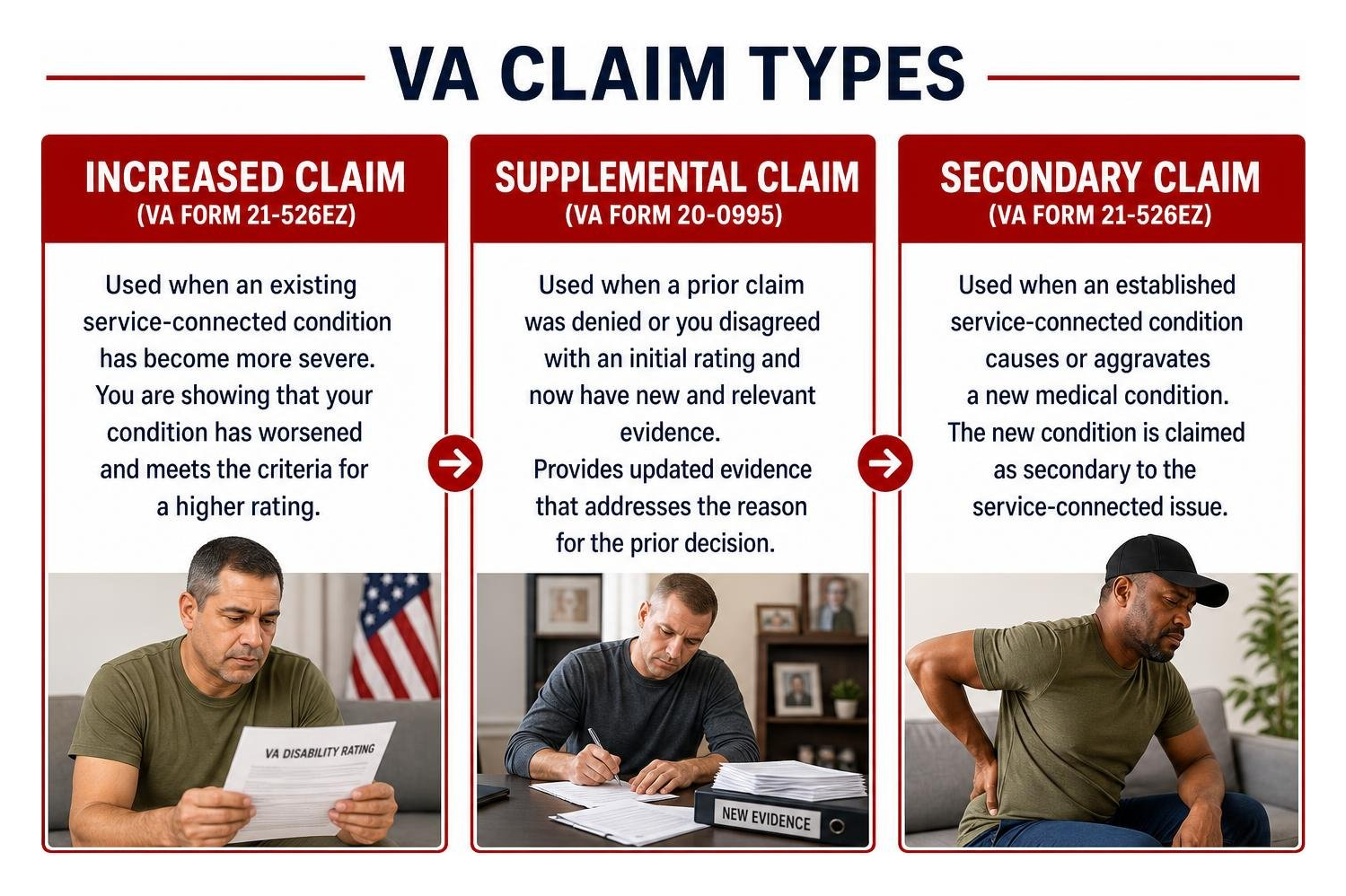
Choosing the wrong pathway is one of the most common reasons claims face unnecessary administrative delays. Veterans must distinguish between three primary filing categories:
- Increased Claim (VA Form 21-526EZ): This path applies when you have an existing service-connected disability that has grown more severe. You are not arguing that the VA made a mistake in the past; you are demonstrating that your condition has progressed and meets the criteria for a higher percentage under the rating schedule.
- Supplemental Claim (VA Form 20-0995): Used when a prior claim was denied or you disagreed with an initial rating decision within the appropriate window and now have "new and relevant" evidence. You can give your claim new life with Form 20-0995 by providing updated clinical documentation that directly resolves the original basis for denial.
- Secondary Service-Connected Claim: This is filed when an established service-connected issue causes or aggravates an entirely new medical condition. For example, if severe service-connected knee instability alters your gait and causes lumbar spine degeneration, the back condition can be claimed secondary to the knee.
Understanding the Combined Rating Table and VA Math
Calculating multiple disability percentages does not involve straightforward addition. The VA uses a non-additive system rooted in the "Whole Person Theory." The principle assumes that no individual can be more than 100% able-bodied.
When an initial disability is rated, it takes away a percentage of your overall health. Any subsequent disability rating is deducted only from the remaining non-disabled percentage of your body. Our VA Disability Rating Charts Ultimate Guide provides an in-depth breakdown of how this efficiency calculation operates.
For example, if you hold a 50% disability rating, your efficiency is reduced to 50% efficiency. If you are granted a new 30% rating for a secondary condition, the 30% applies to your remaining 50% capacity (0.30 × 50 = 15%). Adding 15% to your base 50% gives 65%, which rounds up to a 70% combined rating.
| Individual Ratings | Non-Additive Math Calculation | Final Combined Rating (Rounded) |
|---|---|---|
| 10% + 10% | 10% of 100 = 10; 10% of remaining 90 = 9 (Total: 19%) | 20% |
| 50% + 30% | 50% of 100 = 50; 30% of remaining 50 = 15 (Total: 65%) | 70% |
| 70% + 20% | 70% of 100 = 70; 20% of remaining 30 = 6 (Total: 76%) | 80% |
| 80% + 40% | 80% of 100 = 80; 40% of remaining 20 = 8 (Total: 88%) | 90% |
Signs It Is Time to File for a Rating Increase

Knowing when to file requires paying close attention to measurable changes in your daily functionality. Worsening health often creeps in gradually—a flare-up that used to last two hours now lasts three days, or a medication dosage that kept symptoms in check no longer works. When these physical or psychological changes restrict your personal care, career stability, or household tasks, your current rating is likely outdated.
If your service-connected conditions prevent you from maintaining substantially gainful employment, you should also look into options such as VA TDIU Explained Eligibility Rates How to File 2026, which pays at the 100% rate even if your combined rating is below 100%.
Signs That Answer "Can You Increase Your Already Existing VA Disability Rating?" for Your Condition
The VA evaluates severity based on the VA Schedule for Rating Disabilities (VASRD). Each diagnostic code lists clear benchmarks for higher percentages. For musculoskeletal conditions, such as knee or shoulder injuries, ratings depend heavily on range of motion measured by a goniometer, instability, and frequency of incapacitating episodes. For instance, our 38 CFR Knee Rating Chart VA Disability A Veterans Guide details how specific degrees of flexion and extension map directly to percentage tiers.
For mental health conditions like PTSD or major depressive disorder, progression is marked by increased panic attacks, social isolation, memory deficits, or occupational impairment. If your medical records reflect any of the following, it is time to consider an increase:
- Increased dosage, frequency, or strength of prescription medications to control symptoms.
- Diagnostic imaging (MRIs, X-rays) showing advanced degeneration or arthritis.
- Greater limitation in range of motion, chronic joint instability, or severe muscle weakness.
- More frequent emergency room visits or inpatient hospitalizations.
Financial Impact and 2026 Monthly Compensation Differences
Monthly disability compensation is tax-free and scales dramatically at higher rating thresholds. Learning about the 2026 VA Disability Rates Everything You Need to Know helps you understand the substantial financial support available to you and your dependents.
Under the current 2026 compensation schedules:
- A single Veteran with no dependents rated at 10% receives $175.51 per month, while a 20% rating provides $346.95 per month.
- A single Veteran rated at 50% receives $1,111.87 per month, compared to $1,808.45 per month at 70%—an annual increase of $8,358.96.
- A Veteran rated at 70% with a spouse receives $1,961.45 monthly, whereas reaching a 100% rating yields $4,158.17 monthly—a difference exceeding $2,196 per month.
To explore the broader benefits associated with maximum evaluations, review 100 VA Disability Rating What It Means for Your Wallet in 2026.
Step-by-Step Process to File for a VA Rating Increase

Pursuing a rating increase requires an organized, evidence-first approach. Following proven strategies, like the 7 Critical Steps to Increase VA Disability Rating, ensures your submission is clear and easy for a rating specialist to approve.
- Submit an Intent to File: Submit an Intent to File online via VA.gov or submit VA Form 21-0966. This action sets your effective date immediately, giving you 365 days to gather medical evidence while protecting your retroactive pay.
- Gather Updated Medical Evidence: Secure private clinical records, VA treatment notes, imaging studies, and updated specialist evaluations.
- Complete VA Form 21-526EZ: Submit your claim through the Fully Developed Claims (FDC) program online for faster processing.
- Attend Your C&P Exam: Attend all scheduled exams and clearly communicate how your condition limits your day-to-day functions on your worst days.
- Track Your Claim: Monitor your claim status through your VA dashboard and respond quickly to any requests for clarification.
Key Evidence to Establish: Can You Increase Your Already Existing VA Disability Rating?
To obtain an increase, you must present new medical proof showing that your condition has worsened since your last decision. Helpful evidence includes:
- Private and VA Treatment Records: Longitudinal treatment logs showing consistent treatment, therapy notes, physical therapy reports, and pharmacy records.
- Disability Benefits Questionnaires (DBQs): Completed by private doctors, DBQs capture the exact diagnostic metrics the VA rating specialists look for.
- Nexus Letters and Medical Opinions: Especially helpful if you are linking a secondary condition or establishing that service-connected medication caused a secondary complication.
- Personal Symptom Journals & Buddy Letters: Statements from spouses, coworkers, or fellow unit members describing noticeable functional decline in your daily routines.
Navigating the Compensation and Pension (C&P) Examination
The C&P examination is often the single most influential piece of evidence in your claim file. Approaching this appointment requires preparation; our guide on Winning the Battle for Your VA Disability Approval provides helpful tips on navigating these medical assessments.
During the exam, describe how your condition affects you on your worst days, not just how you feel in that specific exam room. When physical mobility or range of motion is tested, stop moving as soon as pain begins. Pushing through pain can lead the examiner to record a greater range of motion than you can actually perform safely in daily life.
Maximizing Back Pay and Understanding Effective Dates
VA back pay is calculated from your established "effective date" up to the date your increase is approved. You can learn more about how retro payments are calculated in our guide on Calculating Your VA Retroactive Benefits Without the Math Headache.
Generally, your effective date matches the day the VA received your formal claim or Intent to File. However, under VA regulations (38 CFR § 3.400), if you can provide medical documentation proving your condition worsened within the one-year period prior to your filing date, the VA can backdate your effective date to the point when the worsening factually occurred.
VA Rating Reductions, Rating Protections, and Denials
When you ask the VA to evaluate an existing disability, you open that specific condition up for review. While reductions are uncommon when supported by clear medical evidence of worsening, understanding the rules outlined in our VA Lowers Disability Rating Complete Guide will help protect your current benefits.
The VA cannot arbitrarily reduce a rating based on a single exam showing temporary improvement. Rating officers must show sustained, material improvement under the ordinary conditions of daily life and work before proposing a reduction.
The 5-Year, 10-Year, and 20-Year Rating Protection Rules
Federal regulations provide layers of protection against rating reductions based on how long an evaluation has been in place:
- The 5-Year Rule: Once a disability rating has been in effect for five years, the VA cannot reduce it unless medical evidence demonstrates sustained, permanent improvement across multiple examinations. Learn more about these criteria in Everything You Need to Know About the 5 Year Rule for VA Disability.
- The 10-Year Rule: After a condition has been service-connected for ten years, the VA cannot sever service connection unless the original grant was obtained through fraud.
- The 20-Year Continuous Rule: If a rating has been continuously held at or above a specific percentage for 20 years, the VA cannot reduce it below that percentage level under any circumstances, absent fraud.
- Permanent and Total (P&T): Granted when impairments are deemed unlikely to improve over the Veteran's lifetime, exempting them from future routine re-evaluations.
What to Do If Your Rating Increase Claim Is Denied
A denial or unsatisfactory rating evaluation is not the end of the road. You can review How to Turn Your VA Denial Into a Winning Appeal to plan your next steps under the Decision Review structure:
- Higher-Level Review (HLR - Form 20-0996): Request a senior adjudicator to review your existing claim file for errors without submitting new evidence.
- Supplemental Claim (Form 20-0995): Submit new and relevant medical evidence, such as an independent DBQ or updated imaging, to reopen the claim.
- Board of Veterans' Appeals (BVA - Form 10182): Appeal your claim directly to a Veterans Law Judge in Washington, D.C., with the option of a direct review, evidence submission, or a formal hearing.
Frequently Asked Questions About VA Rating Increases
Can filing for an increase cause my current rating to be reduced?
It is possible, but unlikely if you submit strong medical evidence that your condition has worsened. If an examiner finds your symptoms have significantly and sustainably improved, the VA must issue a proposal to reduce your rating. This proposal grants you 60 days to submit opposing evidence and 30 days to request a hearing, giving you full due process to defend your current rating.
How long does the VA take to decide an increased claim in 2026?
Processing times vary based on claim complexity and evidence quality. Fully Developed Claims filed electronically with all private records attached typically take between 90 and 125 days. By comparison, Supplemental Claims averaged roughly 56 days to completion in May 2026.
Can I apply for Individual Unemployability (TDIU) alongside a rating increase?
Yes. If your worsening conditions prevent you from maintaining steady, gainful employment, you can apply for TDIU alongside your increase. You can read The VA TDIU Process From Filing to Final Decision to learn how this benefit pays at the 100% compensation rate while your schedular rating is being evaluated.
Conclusion
Your service-connected disability rating is designed to reflect your current physical and mental health. If your injuries have progressed, you do not have to settle for yesterday's evaluation. By tracking your functional limitations, securing clear medical documentation, and following the proper VA claim pathways, you can pursue the compensation you earned through your service.
To view current benefit breakdowns and estimate your adjusted compensation, check out our comprehensive VA disability pay tables. Stay proactive, keep your treatment records up to date, and file an Intent to File today to protect your effective date.