Navy SEAL BUD/S vs. Marine MARSOC: Which Training Do You Believe Is Tougher?
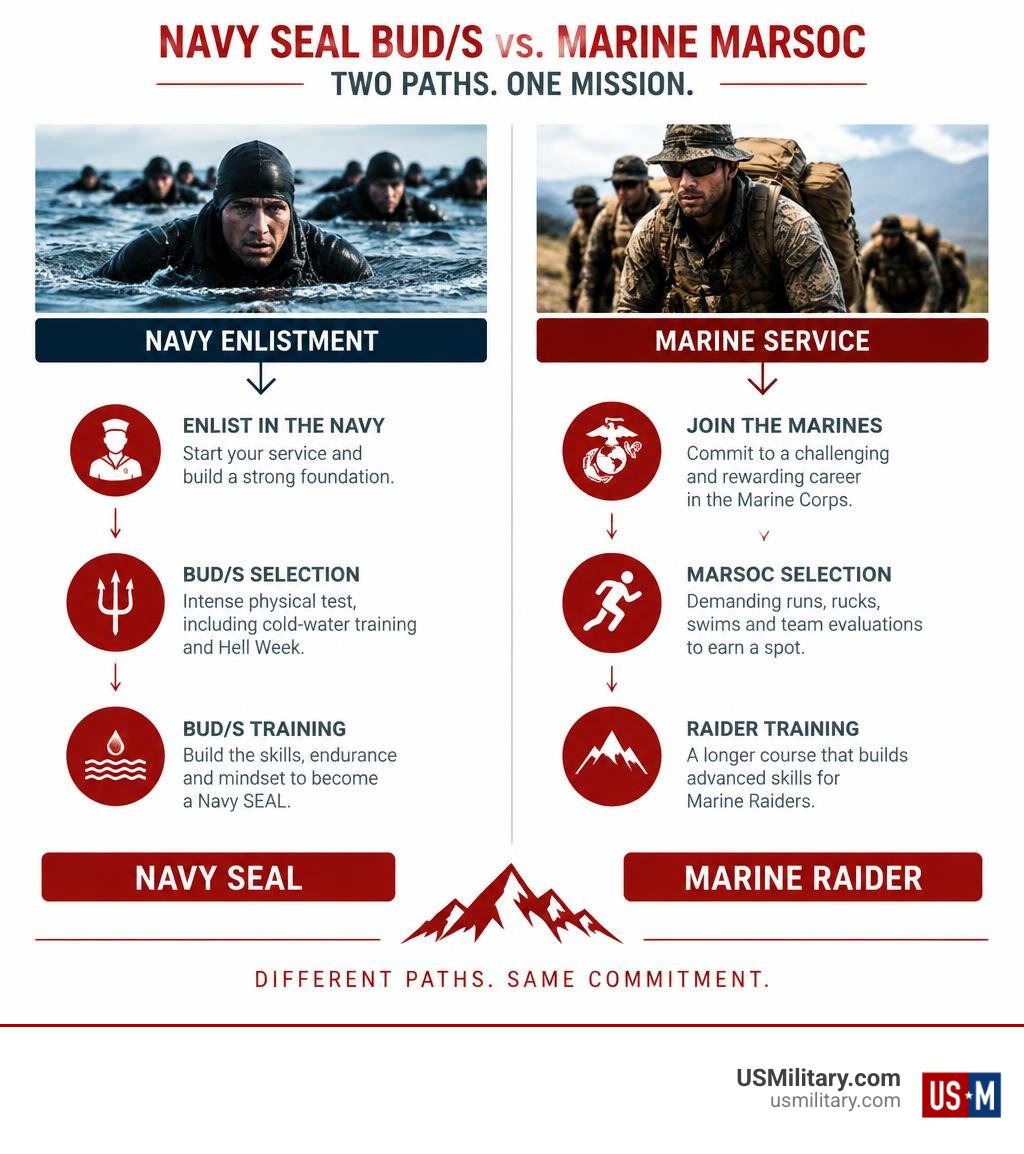
BUD/S is generally the tougher short-term physical test. Its cold-water training and Hell Week combine hard exercise with very little sleep, and roughly 75-80% of candidates do not finish. MARSOC is a different kind of test: Marines face demanding runs, rucks, swims, and team evaluations before a longer course that builds Raider skills. Neither path is easy, and the answer depends on whether you mean the harshest selection experience or the broader training pipeline.
I'm Larry Fowler, BUD/S class 89, publisher of NavySeal.com and USMilitary.com, where I've helped readers explore military career options since 2007. In Which Is the Toughest Training: Navy SEAL BUD/s vs Marine MARSOC, I use that experience to clarify the differences between these paths. Granted, I may be a little partial but will do my best to be fair and balanced.
Glossary for Which Is The Toughest Training: Navy SEAL BUD/s vs Marine MARSOC:
Pipeline Overview: BUD/S and SQT vs. MARSOC A&S and ITC
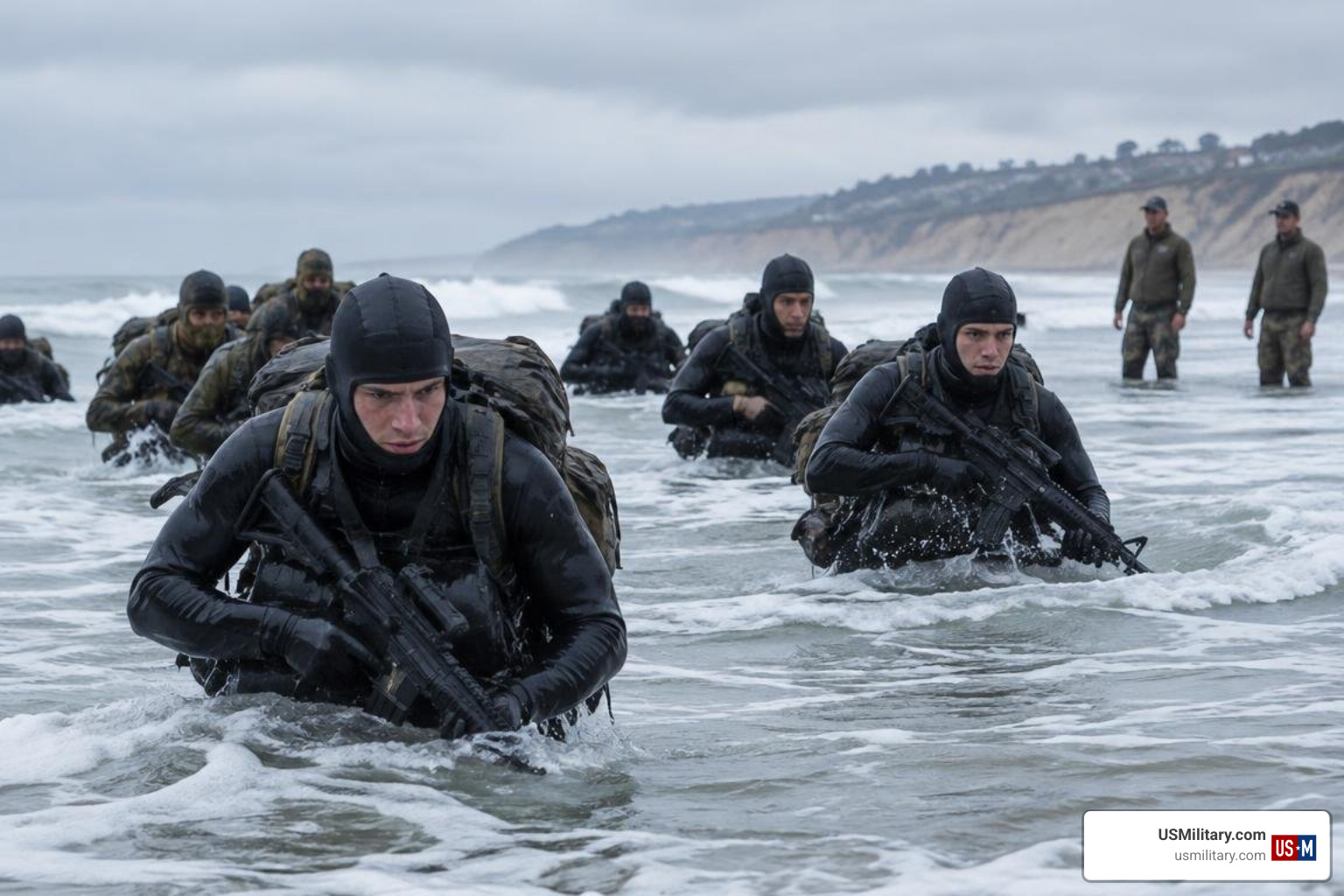
When we evaluate special operations training, we have to look past the Hollywood montages and examine the actual gauntlet. Both the Naval Special Warfare and Marine Corps Special Operations Command pipelines are masterclasses in human performance, but they are built on fundamentally distinct instructional philosophies.
The Navy SEAL pathway begins with Basic Underwater Demolition/SEAL (BUD/S) training in Coronado, California. BUD/S is a 24-week initial crucible divided into three distinct phases:
- First Phase (Physical Conditioning): Seven weeks of continuous physical conditioning, ocean swims, obstacle courses, and the infamous Hell Week.
- Second Phase (Combat Diving): Seven weeks dedicated to open-circuit and closed-circuit SCUBA diving, underwater navigation, and high-stress pool competency testing.
- Third Phase (Land Warfare): Ten weeks on San Clemente Island focusing on weapons handling, demolitions, land navigation, and small unit tactics.
Following BUD/S, graduates do not immediately receive their Tridents. They advance to the 28-week SEAL Qualification Training (SQT), detailed in our SEAL qualification training guide, where they learn advanced combat medicine, tactical communications, cold-weather survival, and military freefall parachuting.
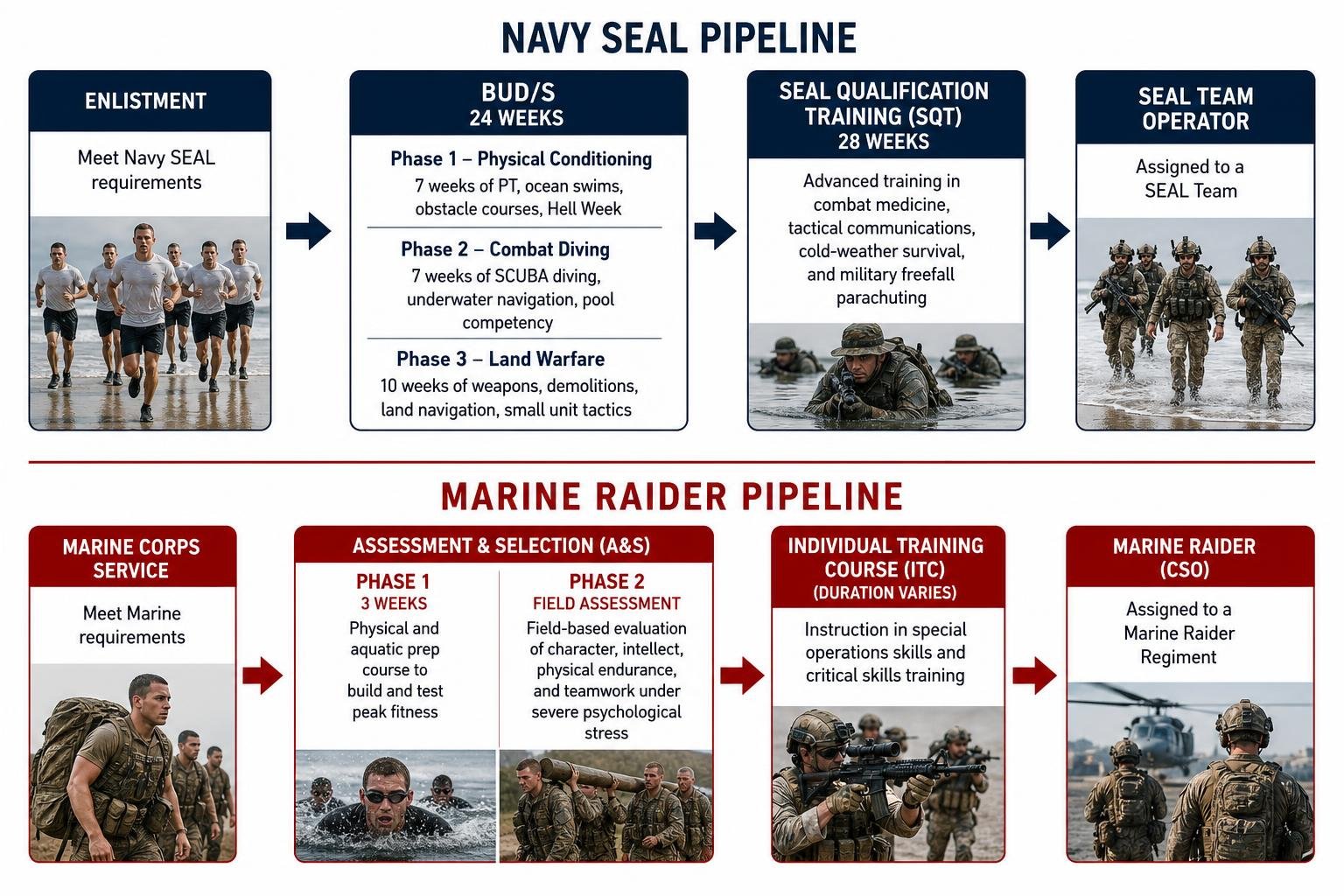
In contrast, the Marine Special Operations pathway is governed by Marine Forces Special Operations Command (MARSOC). To earn the title of Critical Skills Operator (CSO) and wear the Marine Raider badge, candidates must first pass Assessment & Selection (A&S).
As outlined in our MARSOC assessment overview, A&S is a two-phase evaluation:
- A&S Phase 1: A grueling three-week physical and aquatic prep course designed to filter out anyone below peak physical condition.
- A&S Phase 2: A secretive, highly intense field-based assessment where Marine instructors evaluate individual character, intellect, physical endurance, and teamwork under severe psychological stress.
Marines who are selected then attend the nine-month Individual Training Course (ITC), also referred to as the Marine Raider Course (MRC). ITC is structured into four progressive phases: Basic Skills (Phase 0/1), Small Unit Tactics (Phase 1), Direct Action/Close Quarters Battle (Phase 2), Special Reconnaissance (Phase 3), and Irregular Warfare (Phase 4).
Core Differences in Duration, Structure, and Mission Focus
The structural timeline highlights the different operational focus of each organization. The SEAL training continuum—from BUD/S preparation through SQT—spans roughly 12 to 14 months before an operator reports to a SEAL Team. Once on a team, the operator undergoes another 18-month pre-deployment workup.
MARSOC operates on an extended 1.5+ year training continuum. However, because MARSOC recruits almost exclusively from active-duty Marine ranks, candidates already possess years of conventional infantry or technical fleet experience before ever setting foot at A&S.
These pipelines reflect distinct core mission profiles within the broader elite military training structure:
- Navy SEALs: Primarily built for direct action raids, special reconnaissance, counterterrorism, and maritime sabotage. Their training focuses heavily on high-speed kinetic assaults, over-the-beach insertions, and underwater combat demolitions. You can learn more about their fleet life in our Navy SEAL career guide.
- Marine Raiders: While exceptionally lethal in direct action and close-quarters battle, Raiders place immense strategic focus on Foreign Internal Defense (FID) and Irregular Warfare (IW). They are trained to embed alongside indigenous guerrilla forces, train foreign militaries, gather intelligence, and operate independently across extended, austere expeditionary environments.

Which Is The Toughest Training: Navy SEAL BUD/s vs Marine MARSOC
Evaluating which pipeline represents the ultimate crucible requires analyzing entry baselines, attrition rates, and physical benchmarking. Both pipelines test human endurance to the breaking point, but they emphasize entirely different physical capacities.
| Metric / Standard | Navy SEAL BUD/S Pipeline | Marine MARSOC Pipeline (A&S / ITC) |
|---|---|---|
| Initial Assessment Test | SEAL Physical Screening Test (PST) | Marine PFT / Raider OPFIT Benchmarks |
| Swim Standard | 500-yard breast/sidestroke (<9:00 competitive) | 300m in cammies & boots (<10:00 competitive) |
| Running Standard | 1.5-mile timed run (<9:00 competitive) | 3-mile run (<20:00) & 5-mile run (<35:00) |
| Upper Body Strength | 75+ Push-ups, 75+ Sit-ups, 15–20+ Pull-ups | 20+ Strict Pull-ups, 3:45+ Plank Hold |
| Load-Bearing Ruck | Secondary focus (intensifies during Third Phase) | Primary focus: 8–12+ miles (45+ lbs @ <12:00/mile pace) |
| Initial Gate Attrition | 75% to 80% dropout rate during BUD/S | ~50% to 60% attrition across A&S Phases |
| Total Pipeline Attrition | 80% to 85% from initial boot camp to SQT graduation | Significant (pre-screened fleet veterans only) |
| Pipeline Length | ~52–56 weeks (BUD/S + SQT) | ~1.5+ years (A&S Phase 1/2 + 9-month ITC) |
Evaluating Attrition: Which Is The Toughest Training: Navy SEAL BUD/s vs Marine MARSOC?
When examining raw dropout statistics, Navy SEAL BUD/S holds the reputation for higher attrition, regularly posting a 75% to 80% failure rate during BUD/S alone, and roughly 80% to 85% across the entire pipeline. The majority of SEAL candidates quit voluntarily via "Drop on Request" (DOR)—the act of ringing the brass bell in the courtyard three times to surrender their helmet.
BUD/S is deliberately constructed as a high-stress biological and psychological filter. It subjects candidates to immediate, acute thermoregulatory shock, relentless sleep deprivation, and continuous physical punishment in the Pacific surf. If an individual has a subconscious reason to quit, First Phase will expose it within days.
MARSOC A&S exhibits lower total attrition (often between 50% and 60%), but this number is deceptively intense. MARSOC does not accept raw recruits straight off the street; their applicant pool is already composed of seasoned, active-duty Marines who have survived boot camp, the School of Infantry, and operational deployments.
MARSOC attrition is rarely driven by candidates voluntarily quitting. Instead, instructors drop candidates via administrative removal, failure to hit strict land navigation time gates, or poor peer evaluations. A Marine may give 100% effort, march until their feet bleed, and still be dropped by the selection board for showing poor interpersonal communication or toxic leadership traits during Phase 2.
The Only Easy Day Was Yesterday: BUD/S Class 89
Eligibility Requirements and Candidate Maturity
A major factor in the culture of these two courses is candidate maturity. Prospective Navy SEALs can enter the pipeline as 18-year-old civilians through the Navy SEAL Challenge Contract. These candidates transition directly from civilian life through Navy Recruit Training Command and Naval Special Warfare Prep before hitting the grinder at Coronado. For more on entry qualifications, see our breakdown of Navy SEAL requirements and selection standards.
MARSOC does not offer a direct-enlistment contract for civilians. To be eligible for MARSOC A&S, an individual must:
- Be an active-duty Marine (enlisted Corporal or Sergeant, or Captain for officers).
- Have completed a minimum of three years of active-duty service.
- Hold a minimum GT score of 105 on the ASVAB.
- Possess competitive fitness scores (typically a 275+ on the Marine Corps PFT).
- Be eligible for a Secret or Top Secret clearance.
Because MARSOC candidates are non-commissioned officers who have already led Marines in conventional units, A&S instructors evaluate them as tactical professionals from day one. BUD/S instructors, on the other hand, spend substantial time breaking down civilian habits and building basic military discipline from scratch.
Mental Resilience, Stress Inoculation, and Team Dynamics
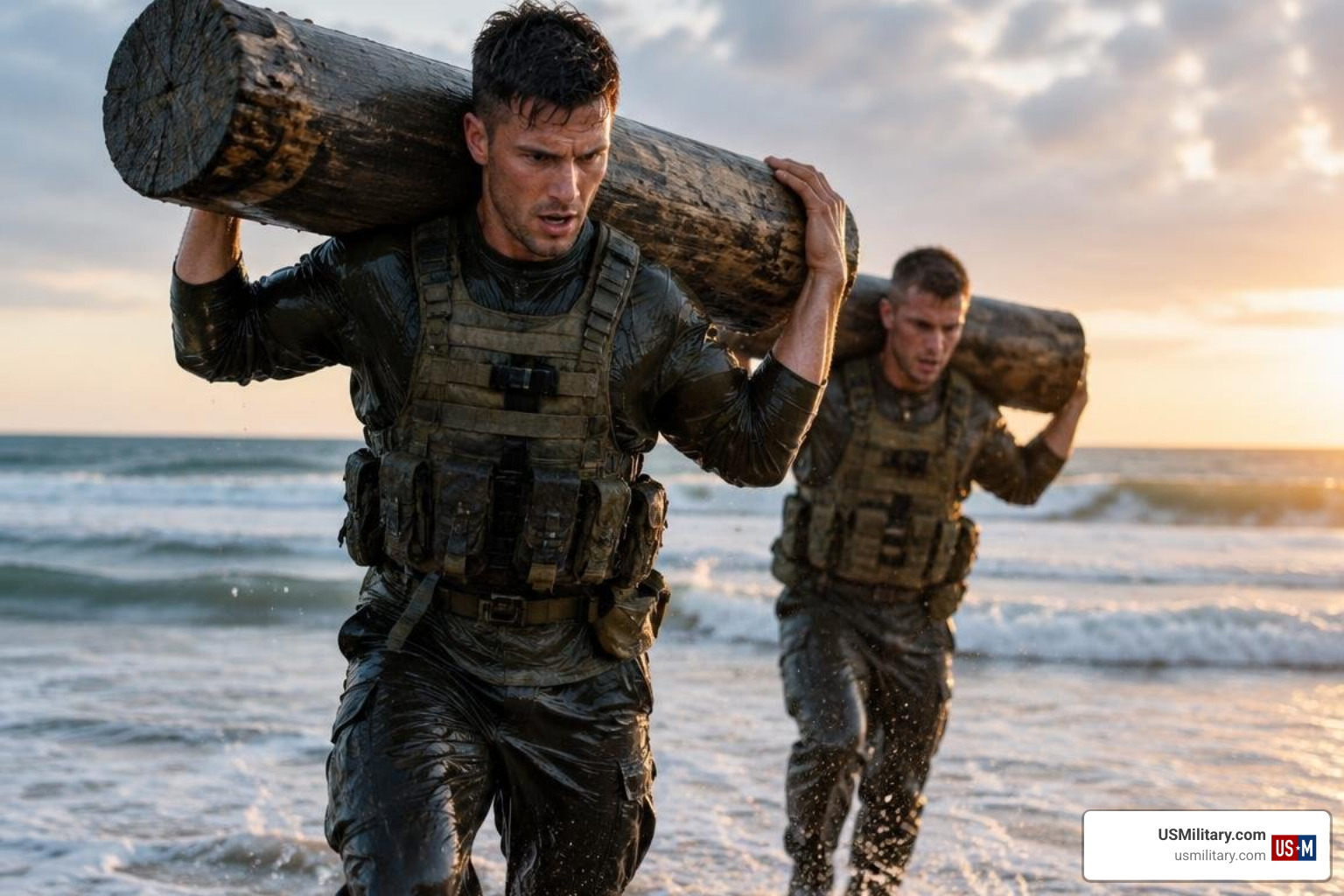
Physical fitness is merely the baseline ticket to enter either course. The real battle occurs between the ears. Both pipelines employ extreme physiological stress to strip away ego and reveal true character, but they apply that stress in completely different tactical environments.
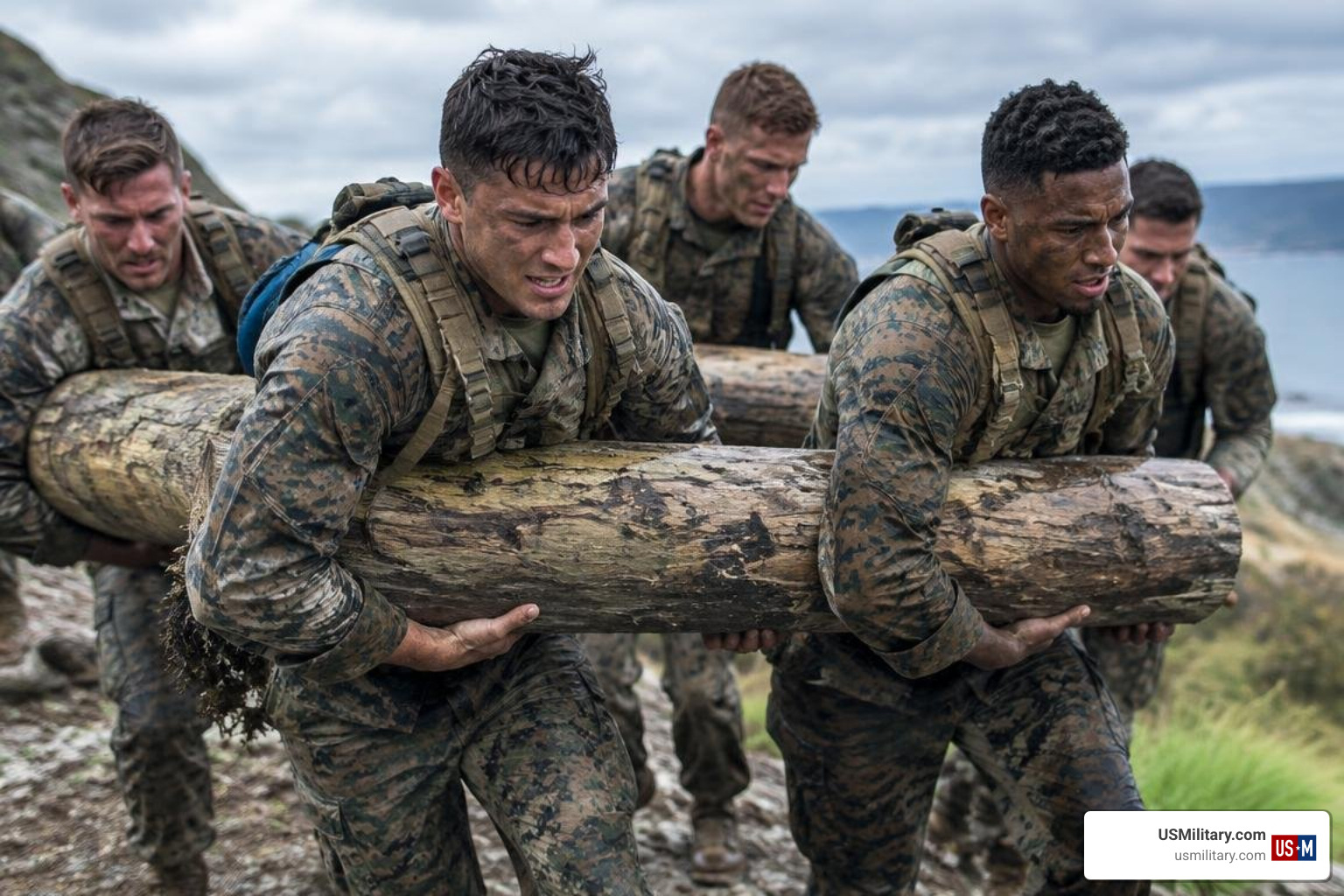
BUD/S utilizes cold-water immersion and sleep deprivation to create sustained biological stress. During Hell Week—a 120-hour crucible occurring in week four of First Phase—candidates run over 200 miles, perform hours of log physical training, and paddle rubber boats through crashing surf while receiving a total of just two to three hours of sleep over five and a half days.
The Pacific Ocean water in Coronado averages 55°F to 60°F. Because water conducts heat away from the human body 25 times faster than air, candidates are constantly on the borderline of mild hypothermia. This constant cold breaks down mental resolve rapidly. To understand how candidates process this stress, see these mental toughness lessons from BUD/S.
MARSOC leverages prolonged expeditionary fatigue, heavy load-carrying, and cognitive problem-solving under austere conditions. Instead of the acute ocean surf, Raider candidates face the silent, grueling grind of multi-day solo land navigation across broken, heavily wooded terrain. Carrying 65- to 85-pound rucksacks for miles without knowing the destination or the time limit creates intense psychological tension. In MARSOC selection, you rarely know what time it is, how far you have walked, or how well you are performing relative to your peers.
Aquatic Stress vs. Land Endurance and Peer Evaluation
The aquatic stress in BUD/S is designed to test underwater composure and panic management. During Second Phase, candidates must pass "Drownproofing"—a test where their wrists and ankles are tied together while they bob, float, flip, and swim across a nine-foot-deep pool.
This is followed by the high-stakes Pool Competency test, where instructors actively attack candidates underwater, tying knots in their breathing regulators and pulling off their masks. If a candidate panics, holds their breath, or surfaces without permission, they fail.
MARSOC’s greatest psychological hurdle is its heavy reliance on socio-emotional screening and blind peer evaluations. Throughout Phase 2 of A&S, candidates are continuously ranked by their teammates.
If a candidate is a physical monster who runs sub-18:00 three-mile runs, but is selfish during heavy team carries, complains under pressure, or fails to support exhausted teammates, their peers will mark them down. MARSOC’s organizational model requires operators who can integrate smoothly into four-man tactical teams or work diplomatically with foreign allied forces. Toxic personalities are identified and dropped, regardless of their physical endurance. We explore these contrasting team mentalities further in our review of Green Beret and Navy SEAL training dynamics.
The Final Verdict on Which Is The Toughest Training: Navy SEAL BUD/s vs Marine MARSOC
When comparing the training programs directly, the answer depends on how you define toughness:
- For acute physical suffering and pure attrition: Navy SEAL BUD/S is the toughest. The combination of 55°F ocean surf, severe sleep deprivation during Hell Week, high-stress combat diving tests, and an 80% dropout rate makes BUD/S the most punishing basic selection filter in the U.S. military.
- For sustained professional mastery and load-bearing endurance: The MARSOC pipeline is more demanding. Spanning 1.5+ years of continuous assessment and tactical development, MARSOC demands advanced maturity, heavy rucking capability, irregular warfare expertise, and high emotional intelligence from combat-tested Marines.
BUD/S is a biological weed-out filter designed to forge elite naval frogmen for direct action and maritime combat. MARSOC ITC is a long-term schoolhouse built to mold expeditionary warrior-diplomats. Both pipelines produce elite special operations forces capable of operating at the highest level. You can see how these courses compare to Army SOF in our guide comparing elite special forces pipelines.
Frequently Asked Questions About BUD/S vs MARSOC
What are the main physical fitness testing differences between BUD/S and MARSOC?
The Navy SEAL Physical Screening Test (PST) prioritizes upper-body muscular endurance and aquatic speed: a 500-yard breaststroke or sidestroke swim, push-ups, curl-ups, pull-ups, and a 1.5-mile run in running shoes.
The MARSOC physical screening process focuses on load-bearing stamina and expeditionary strength. In addition to the standard Marine Corps PFT (three-mile run, strict pull-ups, and plank hold), Raider candidates must pass the Marine Raider OPFIT, march long distances with 45- to 65-pound rucksacks, and complete a 300-meter utility swim wearing utilities (cammies) and combat boots.
Can a civilian enlist directly into MARSOC like they can for BUD/S?
No. Civilians cannot enlist directly into MARSOC. Prospective Marine Raiders must first enlist in the Marine Corps, complete recruit training, graduate from their Military Occupational Specialty (MOS) school, serve in the operating forces for at least three years, and achieve the rank of Corporal before applying for Assessment & Selection.
The Navy allows civilian recruits to enlist directly on a SEAL Challenge Contract, which guarantees a seat at BUD/S prep upon graduating from basic training.
Why does BUD/S have a higher dropout rate than MARSOC A&S?
BUD/S has a higher attrition rate (75–80%) primarily because it accepts 18-to-20-year-old civilian recruits who often lack prior military seasoning or mental maturity under extreme physical distress.
Additionally, the early environmental shock of constant cold-water immersion during First Phase and Hell Week induces immediate biological quitting. MARSOC A&S candidates are pre-screened, mature active-duty Marines who have already served years in the fleet, resulting in an applicant pool that has already adjusted to military stress.
Conclusion
Choosing between the paths of a Navy SEAL and a Marine Raider is not simply a matter of picking the "hardest" course. Both represent the absolute pinnacle of special operations capability. The real question is how your personal strengths, operational preferences, and career aspirations align with the mission profiles of Naval Special Warfare versus Marine Corps Forces Special Operations Command.
If you are drawn to the water, excel in swimming, thrive in high-speed kinetic direct-action environments, and want to test your raw physical limits right out of civilian life, the Navy SEAL pipeline offers that path. If you are already an active-duty Marine or seek an expeditionary career focused on sustained land warfare, heavy load-bearing endurance, irregular warfare, and foreign internal defense, earning the Marine Raider dagger within MARSOC is an exceptional goal.
At USMilitary.com, we help active-duty service members, prospective recruits, and veterans navigate every stage of their military careers. Whether you are preparing for your initial physical screening test, evaluating transition benefits, exploring VA home loan options, or comparing specialized military occupational paths, we provide the verified resources you need. For a broader look at Tier 1 and elite military operations, explore our guide comparing Tier 1 and elite military units, or visit USMilitary.com to explore your path forward.