Is BUD/S Getting Easier As The Demand For SEALs Increases?

Every few years, rumors circulate across veteran forums and social media claiming that Basic Underwater Demolition/SEAL (BUD/S) training has softened. Critics often point to increased global mission taskings, force expansion initiatives, and modernized barracks life as evidence of a relaxed standard. However, the data reveals a completely different reality.
Naval Special Warfare (NSW) remains a quintessential high-demand, low-density force. While the wider military services reached 103% of their recruiting goals in 2025, NSW cannot simply mass-produce operators through industrial quotas. The community avoids "standard creep"—the gradual lowering of performance metrics to fill seats—because doing so would compromise combat lethality and operational safety.
| Metric / Benchmark | Historical Standards (1970s–1980s) | Modern Standards (2026) |
|---|---|---|
| 500-Yard Swim | Under 10:00 (Side/Breaststroke) | Sub-8:00 (Competitive PST Benchmark) |
| Push-ups (2 Minutes) | 50 reps (Minimum) | 100+ reps (Competitive Standard) |
| Pull-ups (Dead Hang) | 6–10 reps | 20+ reps |
| First-Phase Attrition | ~30% Historical Average | 48%–50% (Spikes recorded 2021–2022) |
| Pipeline Success Rate | ~10%–15% | ~9.5% Enlistment to Trident |
| Cognitive Screening | Basic ASVAB requirements | C-SORT & SOAS Assessments |
| Medical Protocol | Reactive / Field-expedient checks | Proactive biomarker screening & continuous monitoring |
The integrity of this all-volunteer community relies entirely on strict gatekeeping. While military planners constantly evaluate force architecture, lowering standards to meet headcounts has consistently proven to produce higher operational failure rates rather than more operators.
Analyzing Attrition Rates: 70% to 85% Brutal Consistency
The numbers reflect an uncompromising selection process. For more than half a century, BUD/S attrition has hovered relentlessly between 70% and 85%.
During Hell Week—a continuous 5.5-day evolution in First Phase where candidates log fewer than four total hours of sleep while completing thousands of repetitions of log PT, ocean swims, and mud flat races—roughly 21% of the starting class withdraws. The vast majority of these losses are Drop on Request (DOR), where a candidate voluntarily rings the brass bell hanging outside the First Phase grinder.
Between 2021 and 2022, first-phase failure rates spiked to nearly 50%, with DOR percentages reaching 48% to 49%—nearly double the historical baseline of 30%. This surge prompted comprehensive internal investigations into training culture. The historical context of United States Navy SEAL selection and training proves that regardless of geopolitical conflict cycles or force size requirements, the foundational crucible does not adjust to accommodate candidate comfort.
Is BUD/S Getting Easier As The Demand For SEALs Increases Over Time?
The Navy's throughput math confirms this balance. Each year, roughly 888 candidates arrive at Naval Special Warfare Center in Coronado, California, spread across five to six classes of roughly 148 men each. The pipeline's target is to graduate approximately 175 SEALs per year—a raw BUD/S completion rate of just under 20%.
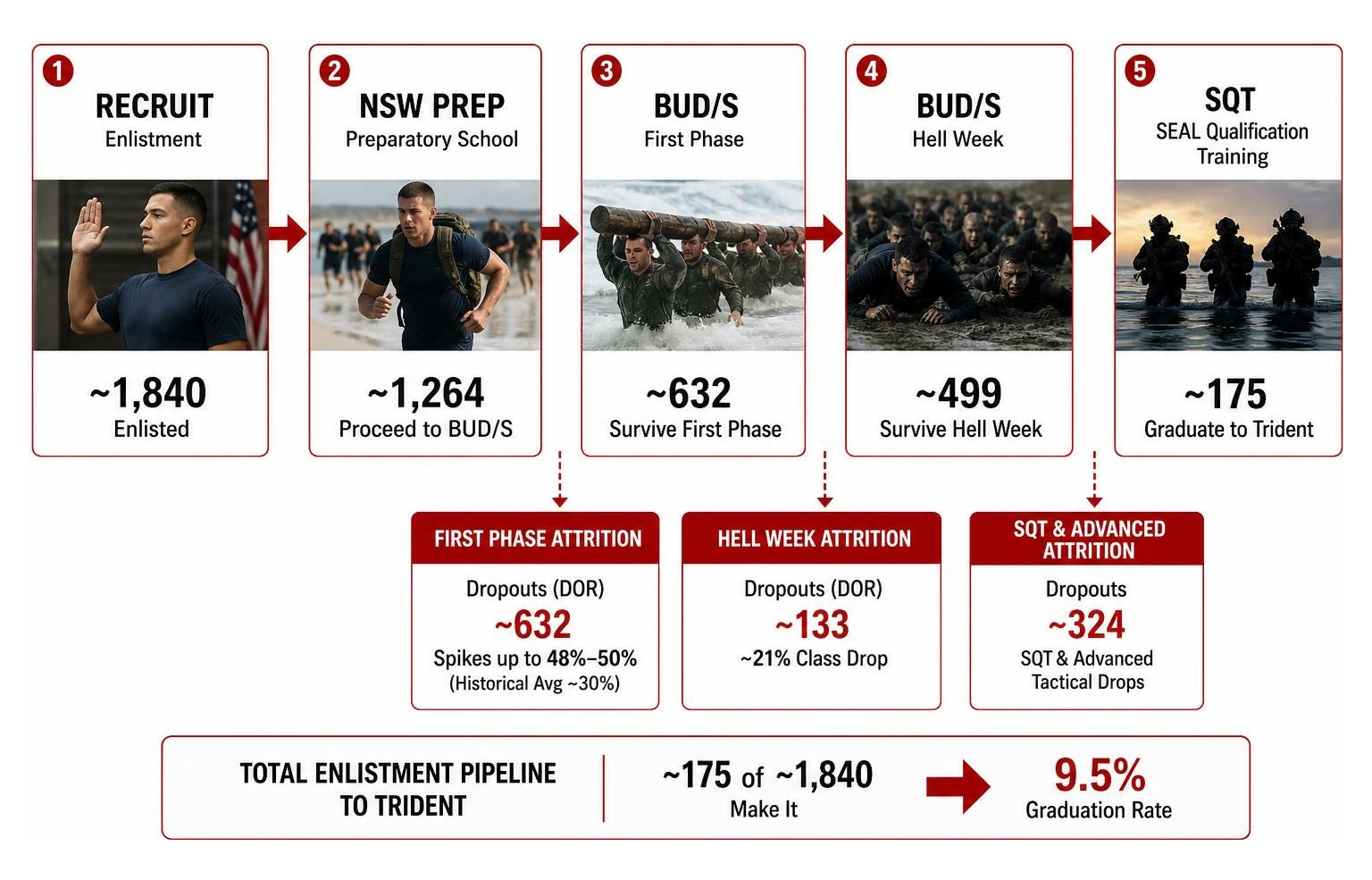
When calculating the entire journey from initial recruit processing through the Naval Special Warfare Preparatory School (NSW Prep), BUD/S, and SEAL Qualification Training (SQT), the total graduation rate drops to approximately 9.5%. If the program were getting easier to fulfill recruitment quotas, graduation rates would climb. Instead, the historical consistency of the attrition rate confirms that candidates are held to the same uncompromising standard.
Evolution of Physical Standards and Candidate Preparation
The physical benchmark for BUD/S trainees has shifted from raw baseline grit to elite, high-performance athletic ability. Decades ago, an applicant could report with basic physical conditioning and attempt to build endurance on the grinder. Today, candidates who treat published minimums as their training target rarely survive the first week.
The Difference Between Minimum and Competitive PST Scores
The Physical Screening Test (PST) demonstrates this competitive shift:
- 500-Yard Swim: Minimum passing standard is 12:30, but a competitive entry score requires a sub-8:00 time using the combat side stroke or breaststroke.
- Push-ups: Minimum is 50 reps in 2 minutes; competitive candidates routinely log 100+ unbroken reps with strict form.
- Sit-ups (Curl-ups): Minimum is 50 reps in 2 minutes; competitive targets require 100+ reps.
- Pull-ups: Minimum is 10 reps from a dead hang; competitive prospects achieve 20 to 25 repetitions.
- 1.5-Mile Timed Run: Minimum is 10:30 in running shoes; competitive applicants clock under 9:00.
Beyond physical conditioning, modern candidates must also pass the C-SORT (Computerized Special Operations Resiliency Test), a psychological tool designed to assess cognitive performance, mental toughness, and decision-making capacity under intense stress.
Officer Selection vs Enlisted Pipeline Disparities
The officer and enlisted pipelines show stark differences in candidate attrition. Over a five-year study period, officer attrition at BUD/S averaged roughly 39%, while enlisted attrition sat near 79%. In historical classes, such as Class 228 (1999–2000), 10 out of 13 officers graduated (a 23% attrition rate) compared to only 17 out of 97 enlisted candidates (an 83% attrition rate).
This gap does not mean officers face easier training standards. Officers and enlisted train side-by-side, carry the same boats, lift the same telephone poles, and endure the same ocean immersion. The statistical difference stems from extreme pre-selection vetting.
Officer candidates are screened through the Seal Officer Assessment and Selection (SOAS)—a multi-week evaluation where candidates are evaluated on physical performance and leadership before ever receiving a BUD/S billet. Only 70 to 80 officer candidates are selected annually across the Naval Academy, NROTC, and OCS programs, compared to 700 to 800 enlisted slots. Enlisted sailors now complete NSW Prep to help bridge this gap, but the officer pipeline remains exceptionally competitive long before Class Convening Day.
Post-2021 Reforms: Medical Oversight, Instructor Conduct, and PED Testing
Following the tragic death of Seaman Kyle Mullen in early 2022 after completing Hell Week, the Navy conducted thorough investigations into safety practices and instructor oversight at BUD/S. The findings revealed systemic challenges, including inexperienced medical leadership, aggressive instructor cultures that deviated from curriculum guidelines, and the illicit use of performance-enhancing drugs among candidates seeking an edge.
The resulting reforms were designed to eliminate preventable medical neglect, not to lower physical standards.
Advanced Medical Monitoring and Training Safety Protocols
Modern BUD/S now features comprehensive medical safety measures. Medical personnel monitor candidates for conditions such as Swimming-Induced Pulmonary Edema (SIPE), rhabdomyolysis, and profound hypothermia. Trainees are monitored with real-time biometric tools during extreme evolutions, and post-Hell Week monitoring protocols have been expanded.
These reforms introduce a unique safety dynamic: by monitoring physiological markers and providing immediate interventions for life-threatening conditions, instructors can safely challenge candidates near true physical limits without increasing the risk of preventable fatalities. Comprehensive scientific research on BUD/S physiological stress emphasizes that managing acute trauma and environmental injuries preserves the integrity of this high-intensity training.
Zero Tolerance for Performance-Enhancing Drugs
The Mullen investigation revealed that some candidates turned to unprescribed performance-enhancing drugs (PEDs)—such as anabolic steroids, human growth hormone (HGH), and SARMs—to survive severe physical breakdown.
Naval Special Warfare responded by instituting mandatory, randomized PED urine and blood testing protocols across all training phases. Removing illicit substances levels the playing field, ensuring that completion is earned purely through genuine physical conditioning and mental determination.
Modern Mission Complexity vs Raw 1970s Survival

Fifty years ago, BUD/S focused primarily on raw physical survival, cold-water tolerance, and basic underwater demolition tasks. Today's battlefield requires far more than physical endurance. Modern SEALs operate advanced communications systems, navigate complex aerial and maritime insertion platforms, utilize digital target-acquisition gear, and execute sensitive missions where strategic judgment is critical.
Consequently, modern training emphasizes cognitive problem-solving under extreme stress. During BUD/S and the subsequent 26-week SEAL Qualification Training (SQT), candidates are regularly sleep-deprived and then tasked with calculating dive profiles, coordinating close air support geometry, and executing mission plans under pressure. The training has evolved into a system of controlled, calculated stress that demands both physical endurance and mental adaptability.
Frequently Asked Questions About BUD/S Training Standards
Is BUD/S Getting Easier As The Demand For SEALs Increases in 2026?
No. The standard remains firmly anchored by a 70% to 85% attrition rate and an overall 9.5% pipeline completion rate. While medical safety and candidate prep programs have modernized, physical metrics and psychological performance standards remain as demanding as ever.
Why do officers have a higher graduation rate at BUD/S than enlisted candidates?
Officers undergo extensive pre-selection screening through programs like SOAS before securing an official BUD/S training slot. This high barrier to entry filters out underprepared applicants early, leading to an average officer attrition rate of around 39% compared to 79% for enlisted candidates.
What happens to candidates who Drop on Request (DOR) during Hell Week?
Candidates who drop are reassigned to the fleet based on the needs of the Navy and their previous enlistment contracts, or they may apply to cross-rate into other technical ratings.
Conclusion
Historical performance data, modern PST requirements, and steady attrition trends disprove the myth that BUD/S has softened as special operations demand has expanded. While candidate safety, medical monitoring, and preparation techniques have improved, earning the Trident remains one of the most demanding military achievements in the world.
For prospective candidates planning their military careers, preparing thoroughly is essential. You can research branch options, benefits, and special warfare pipelines using the Navy SEALs complete guide to build your roadmap toward earning the Trident.