What It Takes to Become a Navy SEAL

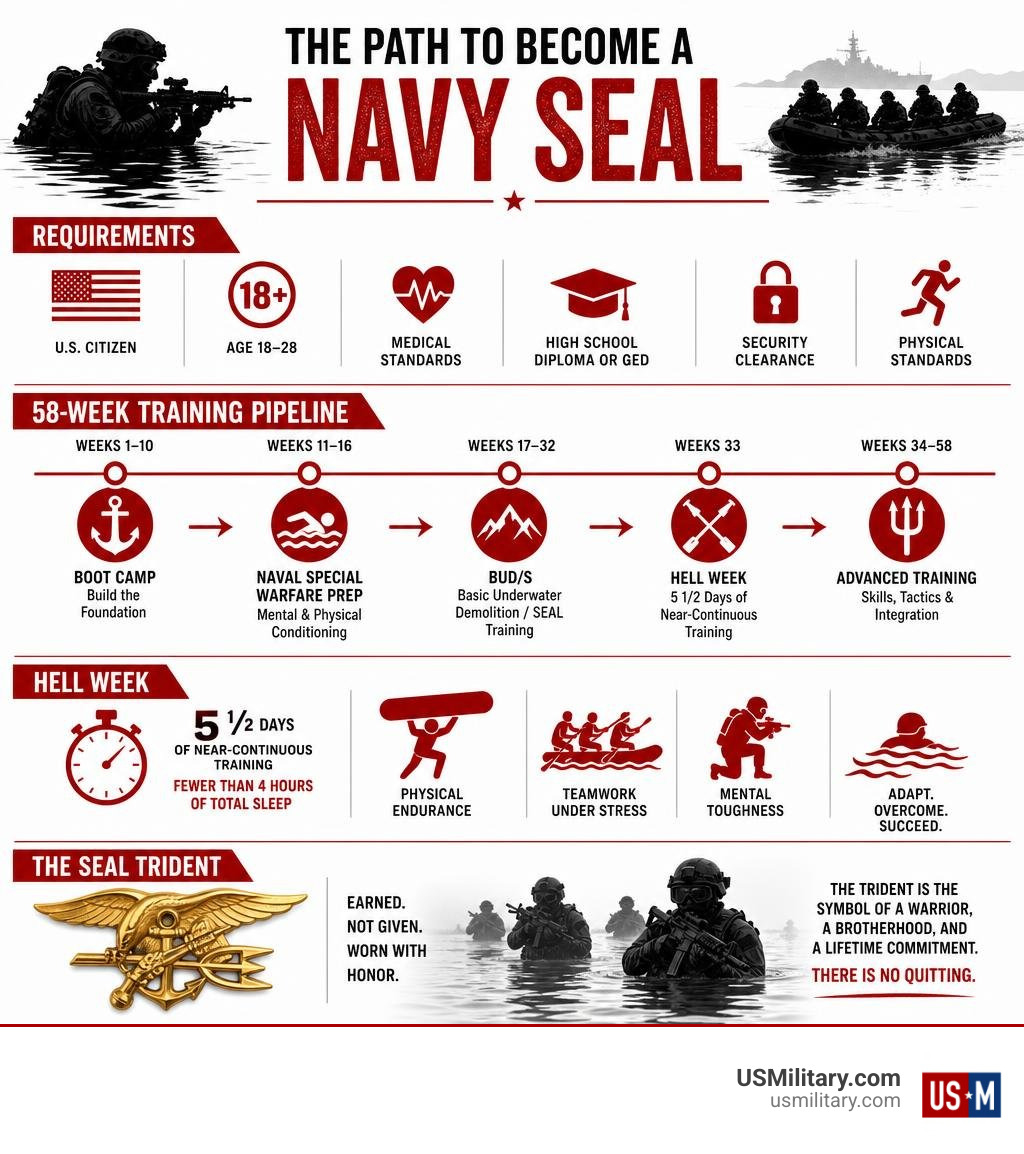
The Navy SEAL History, Requirements, Training, & Hell Week story starts with World War II beach-reconnaissance and demolition units, then leads to one of the U.S. military's hardest selection pipelines. Modern SEAL candidates must meet citizenship, age, medical, academic, security, and physical standards before they can attempt BUD/S training.
The path is long and demanding:
- Pass initial screening and the Physical Screening Test (PST).
- Complete Navy boot camp, Naval Special Warfare preparation, and BUD/S.
- Survive Hell Week: 5 1/2 days of near-continuous training with fewer than four hours of total sleep.
- Finish advanced qualification training to earn the SEAL Trident.
SEALs trace their heritage to Scouts and Raiders, Naval Combat Demolition Units, the OSS Maritime Unit, and Underwater Demolition Teams. The first SEAL Teams were formally established in 1962, but the culture behind their training is older. Hell Week grew from a World War II demolition-school filtering event built to test whether volunteers could keep working, thinking, and helping their team under extreme stress.
I am LARRY FOWLER, BUD/S Class 89, publisher of the NavySeal.com and the USMilitary.com Network, which has helped active-duty members, veterans, and prospective recruits understand military careers and service decisions since 2007. In this guide to Navy SEAL History, Requirements, Training, & Hell Week, I will break down the real standards, timeline, risks, and career realities in plain English.
Discover more about Navy SEAL History, Requirements, Training, & Hell Week:
- Navy SEALs BUD/S Training Requirements
- What are the 3 phases of Navy SEAL training, and why is it so tough
- SEAL Team Six
Navy SEAL History, Requirements, Training, & Hell Week: The Elite Heritage and Origins
The roots of the modern United States Navy SEALs trace directly to the violent amphibious operations of World War II. When Allied planners prepared to retake North Africa and Europe, they quickly realized that conventional landing craft could not navigate uncharted coastal sandbars or fortified barrier reefs without expert reconnaissance. In response, the Navy formed the Amphibious Scouts and Raiders in 1942 at Fort Pierce, Florida.
Led by visionaries like Lieutenant Phil H. Bucklew—widely honored as the "Father of Naval Special Warfare"—these early operators conducted covert night beach surveys for Operation Torch in North Africa. Bucklew’s units charted approach lanes, placed navigation markers, and neutralized coastal listening posts under complete darkness.
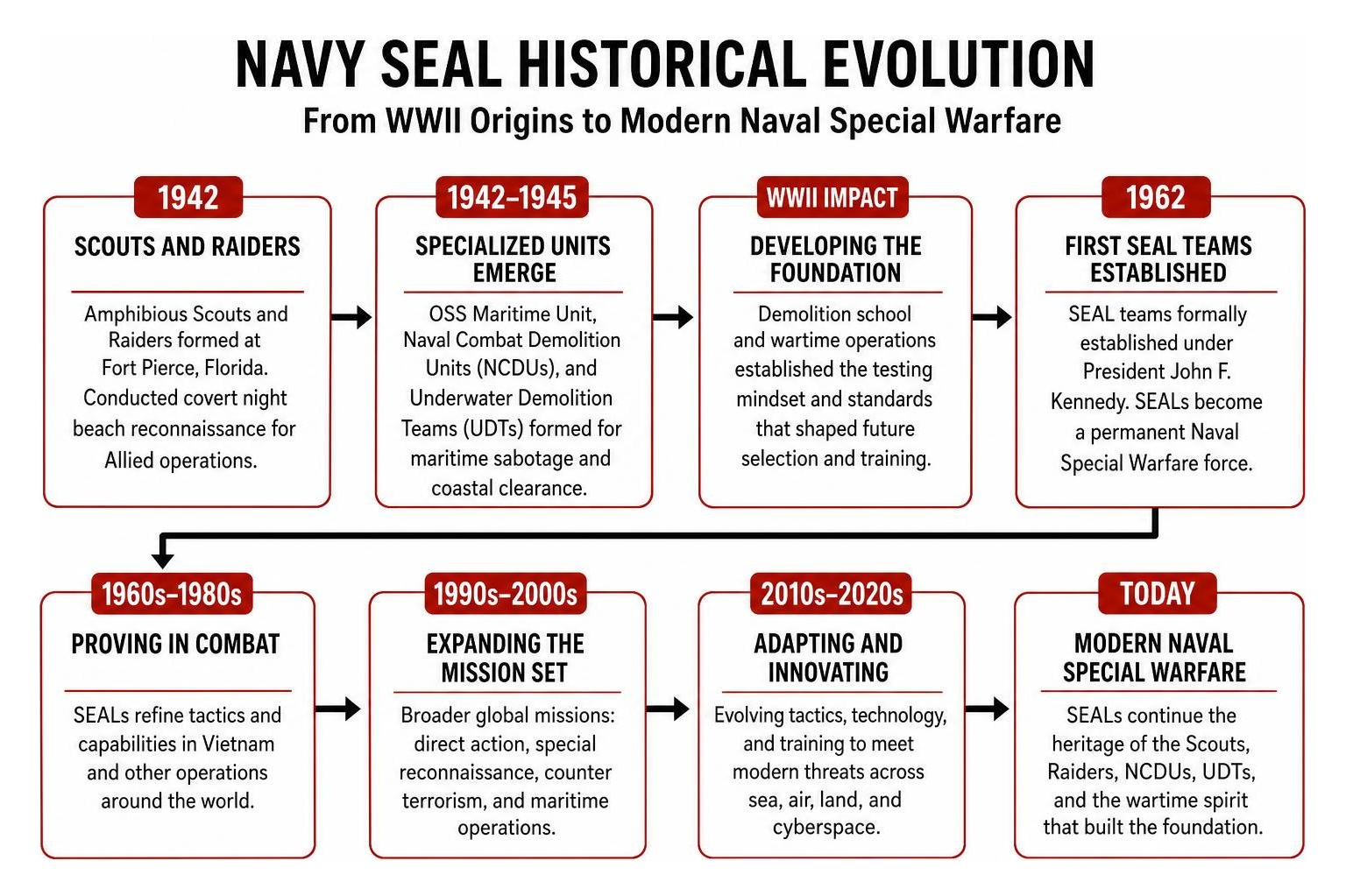
As described in historical overviews of the force, such as the Navy SEAL | History, Requirements, Training, & Hell Week entry by Britannica, the demands of global maritime conflict soon required dedicated clearance specialists. The eventual establishment of the SEAL teams in 1962 under President John F. Kennedy transformed these specialized amphibious demolition units into permanent maritime, airborne, and ground combat components capable of operating across Sea, Air, and Land.
From WWII Frogmen to 2026: Navy SEAL History, Requirements, Training, & Hell Week Lineage
Alongside the Scouts and Raiders, the Office of Strategic Services (OSS) Maritime Unit pioneered maritime sabotage, closed-circuit breathing gear, and submarine infiltration. Simultaneously, Naval Combat Demolition Units (NCDUs) and Underwater Demolition Teams (UDTs) were formed to destroy heavily mined coastal obstacles in Europe and the Pacific.
These frogmen, affectionately known as "Naked Warriors" because they operated in broad daylight wearing little more than swim trunks, dive masks, and combat knives, faced extreme danger. During the D-Day assault at Omaha Beach, NCDUs suffered an astonishing 52% casualty rate as they blew gaps in concrete obstacles while taking heavy machine-gun fire.
Our deep dive in Beyond the Legend: A Comprehensive Guide to the US Navy SEALs outlines how these tactics evolved through the Korean War and Vietnam War. In Vietnam, SEAL Teams One and Two earned the moniker "Men with Green Faces" for their devastating riverine ambushes and jungle reconnaissance. Today, the Naval Special Warfare Command manages active-duty SEAL Teams, reserve components, and specialized tactical development squadrons that execute high-stakes missions worldwide.
Draper Kauffman, NCDUs, and the Birth of Indoctrination Week
The architectural foundation of modern SEAL selection began with Lieutenant Commander Draper L. Kauffman. A bomb disposal expert who had previously defused unexploded ordnance during the London Blitz, Kauffman was tasked in 1943 with establishing the Naval Demolition School at Fort Pierce.
Kauffman knew that clearing underwater mines under direct enemy fire required men who would not panic when exhausted, cold, and under extreme pressure. To ensure only the most resilient volunteers made the cut, he designed a brutal 7-day filtering crucible known as "Indoctrination Week."
Kauffman’s guiding philosophy was simple: lead by example. Despite his professorial appearance, he completed every obstacle course, night swim, and heavy pack march alongside his men. During the first official class in July 1943, roughly 40% of the 98 trainees quit or were hospitalized. That grueling trial laid the cultural framework for what the military now calls Hell Week.
Candidate Requirements and the Physical Screening Test
Entering the Naval Special Warfare pipeline requires clearing strict administrative, academic, physical, and medical hurdles. Recruiters evaluate thousands of applicants each year, but only candidates who exceed baseline metrics secure a contract to attend Basic Underwater Demolition/SEAL (BUD/S) training.
You can study the full breakdown of entrance standards in our Navy SEALs BUDs Training Requirements Guide. Candidates must be U.S. citizens aged 18 to 29 (with 17-year-olds eligible via parental consent, and waivers occasionally granted for 29- and 30-year-olds). Applicants must hold a high school diploma or equivalent, possess good moral character, and qualify for a Secret security clearance.
| Test Evolution | Minimum Requirement | Competitive Benchmark |
|---|---|---|
| 500-Yard Swim | 12 minutes, 30 seconds | Under 9 minutes, 00 seconds |
| Push-Ups (2 min) | 50 repetitions | 80 to 100+ repetitions |
| Sit-Ups (2 min) | 50 repetitions | 80 to 100+ repetitions |
| Pull-Ups (No time limit) | 10 repetitions | 15 to 20+ repetitions |
| 1.5-Mile Run | 10 minutes, 30 seconds | Under 9 minutes, 30 seconds |
Eligibility Criteria, ASVAB Scores, and Medical Clearances
Academic qualifications center on the Armed Services Vocational Aptitude Battery (ASVAB). Applicants must achieve a combined score of at least 220 across specific composites (such as General Science, Mechanical Comprehension, and Electronics Information, or Arithmetic Reasoning, Mechanical Comprehension, and Assembling Objects).
Medical evaluation is equally rigorous. Candidates must have uncorrected vision no worse than 20/70 in the better eye and 20/100 in the worse eye, correctable to 20/25 in both eyes, with normal color perception. Prospective operators must pass an exhaustive dive physical that checks for cardiovascular health, pulmonary function, and tympanic membrane health.
Women have been fully eligible to volunteer for all Naval Special Warfare roles since defense combat exclusion rules were lifted in December 2015. The first female candidate completed the necessary screening to enter BUD/S in 2019, and the pipeline remains open to any candidate of any gender who meets the uncompromising physical and mental standards.
PST Standards: Minimum Scores vs. Competitive Reality
The Physical Screening Test (PST) evaluates raw cardiovascular conditioning and upper-body muscular endurance. Candidates perform a 500-yard swim using only the breaststroke or combat side stroke (CSS), followed by a 10-minute rest, maximum push-ups in two minutes, a two-minute rest, maximum sit-ups in two minutes, a two-minute rest, maximum pull-ups, and a final 10-minute rest before a timed 1.5-mile run in boots and long pants.
While meeting the minimum requirements lets a recruit take the test, it rarely earns an active contract. In our guide on 7 Big-Time Questions to Ask Before BUDs, we emphasize that successful candidates treat the competitive benchmarks as their absolute baseline before ever shipping out.
The 58-Week Pipeline: From Boot Camp to Earning the Trident
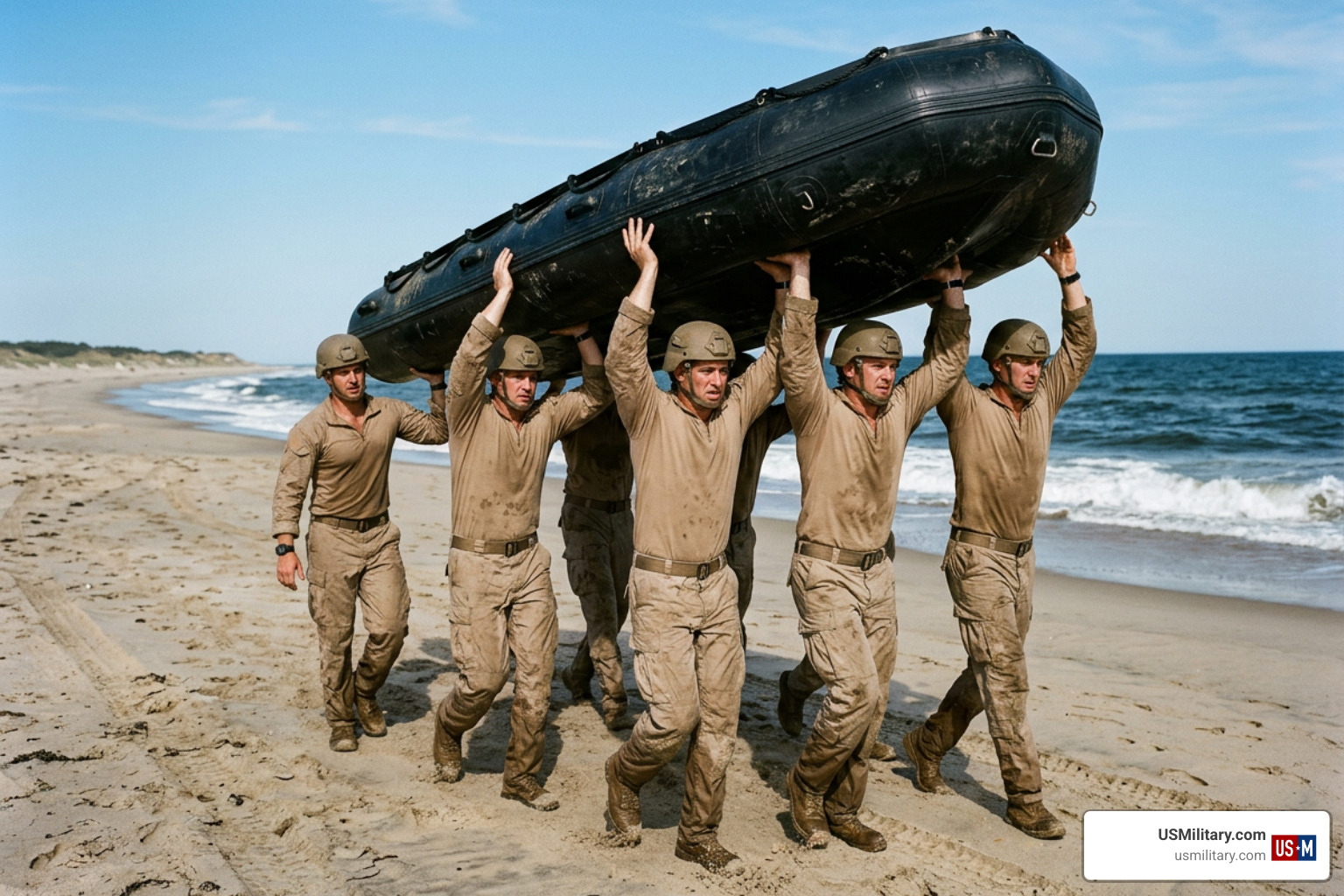
The journey to becoming an active-duty operator spans 58 continuous weeks of structured, intense military training. The pipeline takes raw civilian recruits and turns them into mission-ready tactical athletes.
Navigating the Pipeline: Training Milestones
The pipeline begins at Recruit Training Command in Great Lakes, Illinois (8 weeks), followed immediately by the Naval Special Warfare Preparatory School (8 weeks). At NSW Prep, trainees focus on swimming mechanics, running volume, and strength conditioning, culminating in a Modified PST that candidates must pass to transfer to Coronado, California.
At the Naval Special Warfare Center in Coronado, candidates complete a 3-week BUD/S Orientation before entering the formal 24-week BUD/S curriculum. Upon graduating BUD/S, sailors attend the 3-week Army Airborne School at Fort Moore (formerly Fort Benning) or military freefall training, followed by the 26-week SEAL Qualification Training (SQT). SQT delivers advanced instruction in combat marksmanship, close-quarters battle (CQB), SERE (Survival, Evasion, Resistance, and Escape), maritime operations, and cold-weather survival in Kodiak, Alaska. Graduates are awarded the Special Warfare Operator rating and receive their SEAL Trident.
BUD/S Three Phases and Combat Diving Competency
BUD/S is broken into three distinct 7-week phases, as explored in The Ultimate Guide to Navy SEAL Training 3 Phases and Why Is It So Tough:
- Phase 1: Basic Conditioning. Focuses on physical endurance, soft-sand running, timed obstacle courses, log physical training (Log PT), and ocean swims. Hell Week takes place during the fourth week of this phase.
- Phase 2: Combat Diving. Develops advanced underwater competency. Trainees master open-circuit SCUBA and closed-circuit rebreathers (Draeger rigs) for covert maritime infiltration. Instructors run high-stress pool competency drills, knot tying underwater, and emergency procedures to test candidates when their air supply is deliberately cut off.
- Phase 3: Land Warfare. Conducted primarily on San Clemente Island. Candidates learn tactical communications, small-arms marksmanship, land navigation, patrol formations, and demolitions.
Hell Week: The Ultimate Crucible of BUD/S Selection
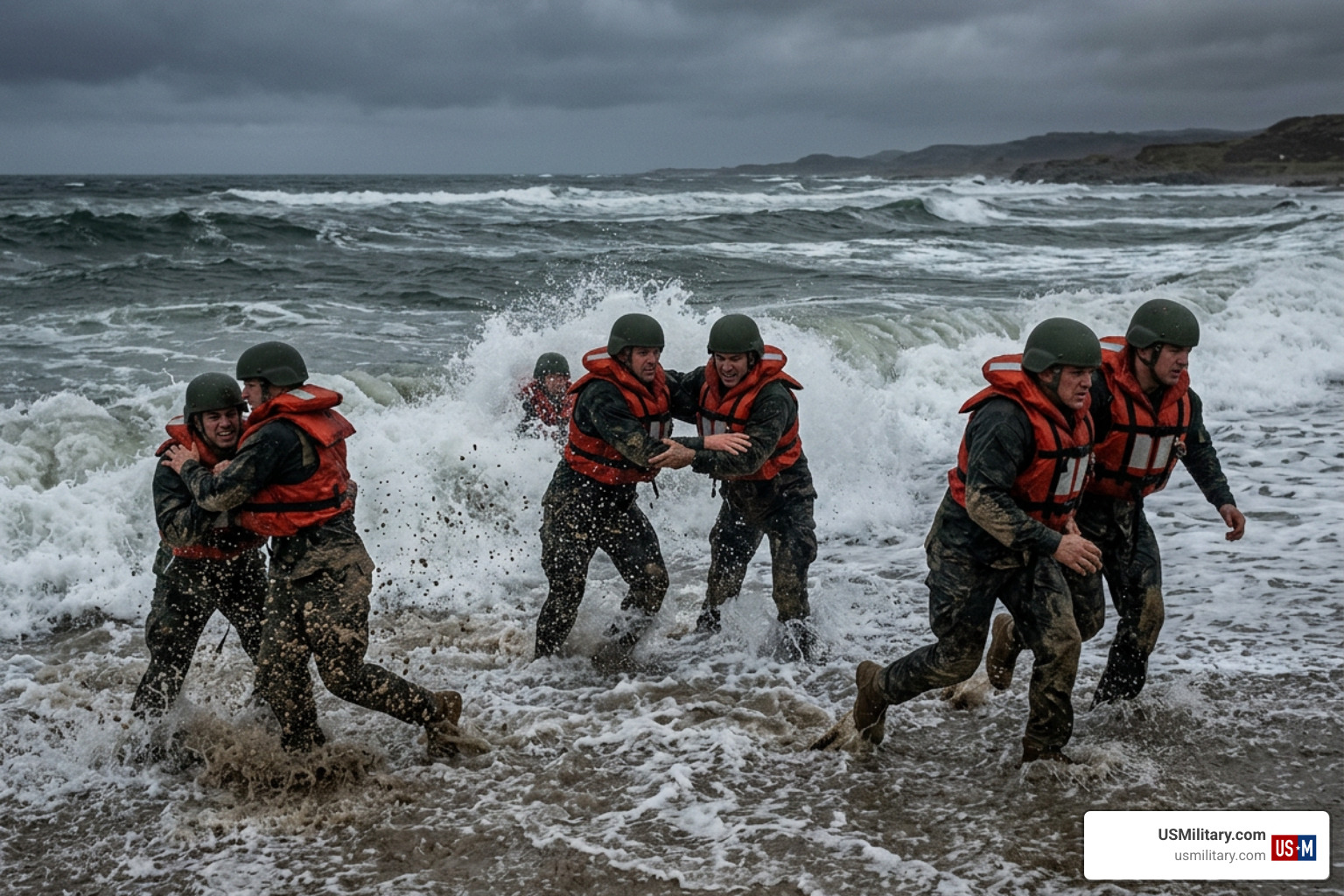
Hell Week occurs during Week 4 of BUD/S Phase 1. It is widely considered the toughest week in the U.S. military. For 5 1/2 days, candidates stay in near-constant motion, logging more than 200 miles of running and paddling while enduring more than 20 hours of physical training per day on less than four hours of total sleep.
Instructors use controlled stress, ice-cold Pacific surf, and relentless calisthenics to strip away pretense. The goal is simple: find out how a candidate behaves when completely exhausted, frozen, and miserable.
Physical Toll, Sleep Deprivation, and Environmental Stressors
Hell Week begins with "Breakout," where instructors light smoke grenades, detonate artillery simulators, and fire blank rounds to shatter the class's calm. Over the next five days, boat crews carry 150-pound inflatable combat raiding craft (IBS) on their heads, run through thick sand, and complete endless sets of Log PT with water-logged telephone poles known as "Old Misery."
Sleep deprivation leads to severe auditory and visual hallucinations by mid-week. Trainees regularly hallucinate seeing buildings, animals, or phantom highways while paddling in the dark ocean. Candidates must consume roughly 6,000 to 8,000 calories a day to offset the extreme energy burn and fight off hypothermia. Medical teams constantly monitor candidates for dangerous conditions like rhabdomyolysis (muscle breakdown that strains the kidneys) and Swimming Induced Pulmonary Edema (SIPE).
The transformative mental shifts required to survive these evolutions are reflected in What Navy SEAL BUDs Taught Me About Personal Growth, showing how extreme hardship reveals true personal capability.
Psychological Fortitude, Attrition Rates, and the Bell
On average, only about 25% of candidates who begin Hell Week successfully complete it. The overall attrition rate across the entire pipeline from initial enlistment through SQT is roughly 90.5%, meaning only about 9.5% of applicants ultimately earn the Trident.
Candidates can quit at any second through the "Drop on Request" (DOR) process. A trainee simply walks to the center of the Grinder courtyard, rings the brass ship's bell three times, places their helmet on the asphalt, and exits the program.
Instructors frequently tempt candidates to ring the bell by offering hot coffee, warm showers, and fresh doughnuts. Size and muscular strength do not predict who survives. Success comes down to intrinsic mental desire, an unyielding commitment to the boat crew, and an absolute refusal to quit.
Operational Life, Compensation, and Training Safety
Graduating from SQT is only the beginning of a SEAL's professional obligations. New operators are assigned to an East Coast or West Coast SEAL Team, where they enter an 18-month inter-deployment training cycle. During this time, operators earn advanced qualifications in combat medicine, tactical communications, breacher operations, or sniper skills.
Selected personnel attend the grueling 6-month Special Operations Tactical Medic (SOTM) course to provide advanced trauma life support on the battlefield.
Enlisted and Officer Military Pay Breakdown
SEAL compensation combines standard military base pay with multiple specialized hazard allowances. For an in-depth breakdown of current military earnings, see What Is the Salary for an Enlisted Navy SEAL in 2026.
An active operator’s monthly pay includes:
- Basic Pay: Dictated by rank and years of military service.
- Special Duty Assignment Pay (SDAP): Up to $450 per month for NSW operators.
- Dive Pay: Up to $340 per month.
- Hazardous Duty / Parachute Jump Pay: $150 to $225 per month for static-line and HALO freefall operations.
- Demolition Pay: $150 per month.
- Allowances: Basic Allowance for Housing (BAH) and Basic Allowance for Subsistence (BAS), along with substantial critical-skills retention bonuses and tax-free allowances during combat deployments.
Safety Measures and Mitigating Extreme Training Hazards
Due to the intense nature of selection, Naval Special Warfare Command enforces comprehensive safety and medical monitoring protocols. Dedicated medical officers, dive medical technicians, and emergency support units supervise every high-risk evolution, including ocean swims, live-fire houses, and underwater pool competency drills.
Following high-profile medical events and training reviews over the past decade, NSW implemented strict post-Hell Week observation periods, enhanced screening for cardiovascular anomalies, and random testing for illicit performance-enhancing substances. These safeguards ensure that selection remains safe without lowering the operational standards required for global combat readiness.
Frequently Asked Questions About Navy SEAL Selection
How long is the complete Navy SEAL training pipeline?
The pipeline spans approximately 58 weeks. This includes 8 weeks of Navy Recruit Training, 8 weeks of Naval Special Warfare Prep, 3 weeks of BUD/S Orientation, 24 weeks of BUD/S, 3 weeks of Jump School, and 26 weeks of SEAL Qualification Training (SQT).
What is the actual attrition rate of Hell Week and BUD/S?
Approximately 75% of candidates drop out during or before Hell Week. Overall, roughly 70% to 80% of candidates drop out of BUD/S, and only about 9.5% of all enlistees who sign a SEAL contract successfully graduate from SQT to earn the Trident pin.
Are women eligible to become Navy SEALs?
Yes. Since the removal of the combat exclusion policy in December 2015, female candidates have been fully eligible to earn a SEAL contract. All candidates must meet the exact same physical, academic, and training standards.
Conclusion
The legacy of the Navy SEALs was built on the beaches of Normandy, refined in the jungles of Vietnam, and proven across modern global battlefields. From Draper Kauffman's first demolition classes at Fort Pierce to the cold surf of Coronado, the standard has never wavered: physical strength alone is never enough; an operator's real power comes from mental determination and commitment to the team.
If you are planning your military career, evaluating service branches, or exploring military benefits and VA home loans, our team at USMilitary.com is here to support you. To learn more about career paths and preparation strategies, read our complete resource in the Navy SEALs Complete Guide.