
Navy SEAL vs Delta Force Pay: What Matters Most

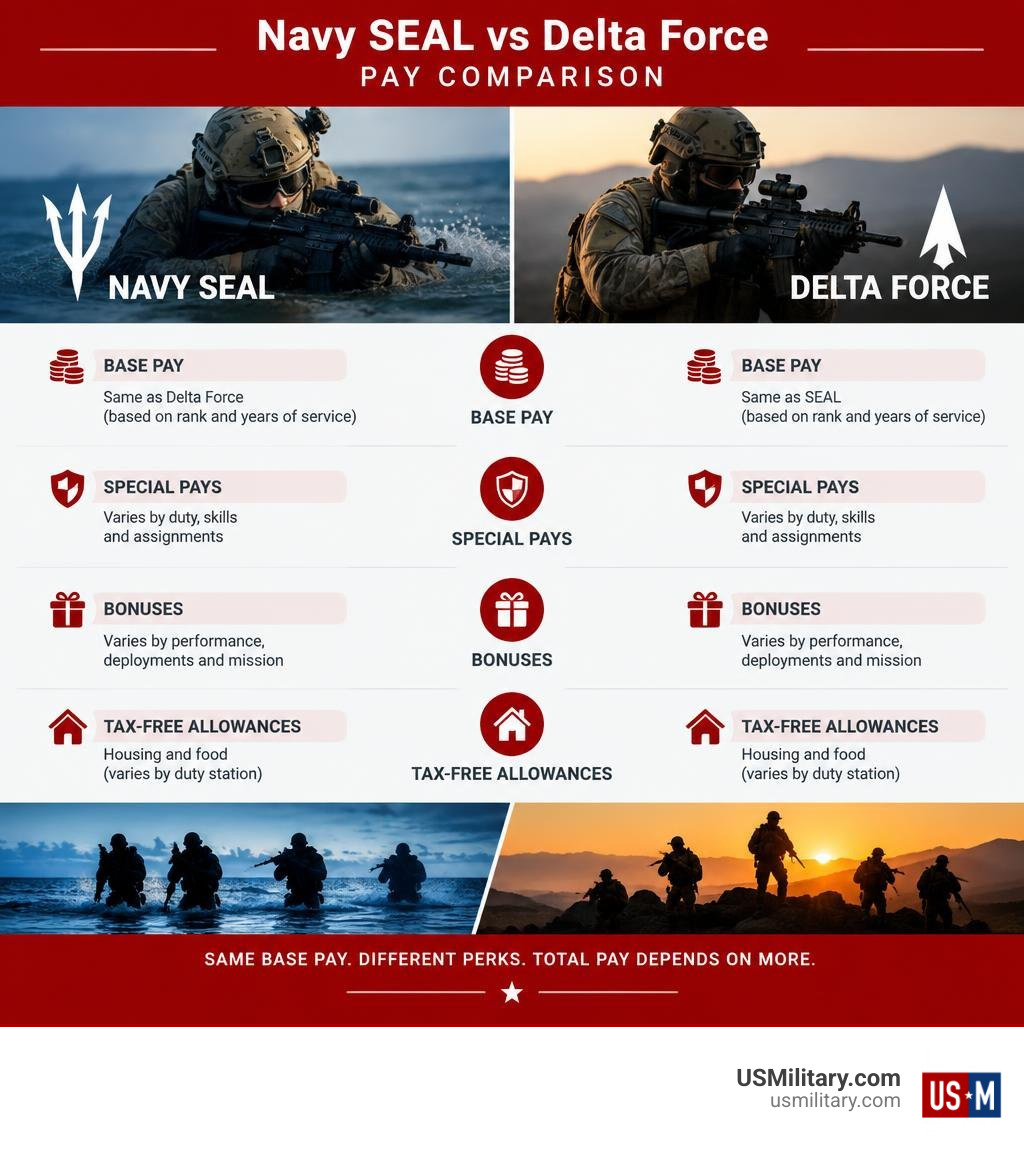
Neither unit automatically pays more. A Navy SEAL and an Army Delta Force operator with the same rank and years of service receive the same base pay. Their total pay can differ because of special pay, bonuses, deployments, and tax-free housing and food allowances. Duty station matters, too: a higher housing allowance may come with a higher cost of living.
I'm Larry Fowler, BUD/S Class 89, publisher of NavySEAL.com and USMilitary.com, where I've covered military career choices and benefits since 2007. In "Navy SEAL Pay vs Army Delta Force: Who Is Paid The Most?" I'll show you how to compare the full pay package, not just the salary.
Simple Navy SEAL Pay vs Army Delta Force: Who Is Paid The Most? glossary:
- Are Navy SEALs Paid The Same As Army Delta Force Operators
- How Much Do Navy SEALs Make Per Year
- How Much Are Navy SEALs Paid
Navy SEAL Pay vs Army Delta Force: Who Is Paid The Most?
When evaluating military compensation, civilian salary calculators often fall short. In the Department of Defense, base pay is strictly regulated by rank (pay grade) and cumulative years of service. A Staff Sergeant (E-6) in the Army and a Petty Officer First Class (E-6) in the Navy earn the identical monthly base pay according to the standard military pay scale in 2026 for enlisted and officers.
However, elite special operations personnel rarely take home just standard base pay. Both the Navy’s Special Warfare community and the Army’s 1st Special Forces Operational Detachment-Delta (1st SFOD-D, commonly known as Delta Force) layer additional compensation onto this foundation:
- Taxable Base Pay: Fixed across all branches according to DoD tables.
- Special and Incentive Pays: Added compensation for specialized skills (parachuting, combat diving, explosive demolition) and Special Duty Assignment Pay (SDAP).
- Tax-Free Allowances: Basic Allowance for Housing (BAH) and Basic Allowance for Subsistence (BAS).
- Retention and Reenlistment Bonuses: Lump-sum or installment incentives to keep elite operators in the ranks.
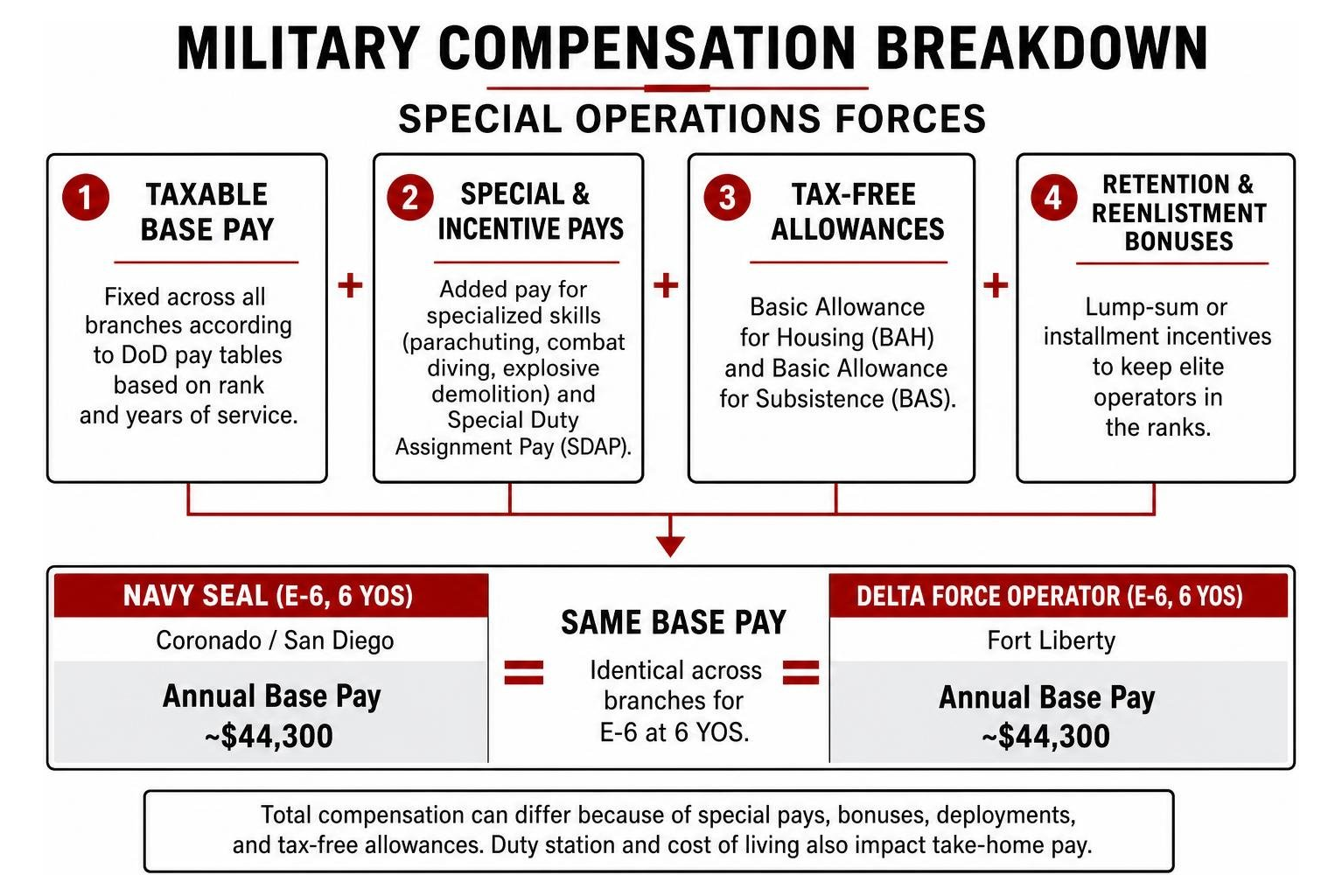
To see how these elements combine, let’s examine an annual compensation snapshot for an E-6 operator with 6 years of service:
| Compensation Component | Navy SEAL (E-6, 6 YOS, Coronado/San Diego) | Delta Force Operator (E-6, 6 YOS, Fort Liberty) | Notes / Details |
|---|---|---|---|
| Annual Base Pay | ~$44,300 | ~$44,300 | Identical across branches for E-6 at 6 YOS |
| Special Duty Assignment Pay (SDAP) | ~$5,400 ($450/mo) | ~$5,400 ($450/mo) | Tier-specific for high-demand specialties |
| Skill & Hazard Pays (Jump/Dive/Demo) | ~$7,800 ($650/mo) | ~$6,600 ($550/mo) | SEALs typically maintain constant dive + jump status |
| Basic Allowance for Subsistence (BAS) | ~$5,520 ($460/mo) | ~$5,520 ($460/mo) | Standard enlisted food allowance, 100% tax-free |
| Basic Allowance for Housing (BAH) | ~$49,060 (~$4,088/mo) | ~$24,120 (~$2,010/mo) | With dependents; location-dependent tax-free housing |
| Total Estimated Gross Compensation | ~$112,080 | ~$85,940 | Gross annualized package (tax-free allowances included) |
While the top-line dollar amount for a San Diego-based SEAL is notably higher, this reflects coastal California's real estate prices rather than higher base wages. When looking at effective purchasing power and uniform military pay charts, the underlying pay mechanisms remain closely aligned.
Evaluating Navy SEAL Pay vs Army Delta Force: Who Is Paid The Most? for Mid-Career Operators
At the mid-career mark (E-6 to E-7 with 6 to 10 years of service), operators in both units represent the operational backbone of their assault teams. Looking closely at how much do Navy SEALs make, a Petty Officer First Class stationed in Southern California takes home a substantial gross package because of local housing stipends. An E-6 with dependents in San Diego receives around $4,088 monthly in tax-free BAH, while a single E-5 might receive roughly $3,600.
By contrast, an Army Delta Force operator stationed at Fort Liberty, North Carolina, receives a lower monthly BAH reflecting local housing markets. If you review a branch comparison on which military branch pays the most, you quickly see that base salaries across the Army, Navy, Air Force, and Marines are standardized by law. The variance in gross income comes down almost entirely to zip-code-based allowances and specialized qualifications.
Comparing Junior Operators and Senior Leadership Pay Across Both Units
The career pathways of junior operators create an interesting difference between the two units:
- Navy SEALs: Recruits can enlist under an SO (Special Warfare Operator) contract directly through the BUD/S pipeline. A successful candidate can become an active SEAL as an E-4 or junior E-5 within 2 to 3 years of joining the Navy, earning an initial compensation package of $75,000 to $90,000 annually.
- Delta Force Operators: Delta Force is a Tier-1 Special Mission Unit that generally recruits seasoned soldiers from the 75th Ranger Regiment, Special Forces (Green Berets), or conventional military units. Most candidates entering Selection and Assessment are already mid-career non-commissioned officers (E-5 to E-7). As a result, you rarely encounter very junior enlisted personnel serving as primary assault operators in Delta Force.
At the top end of the enlisted spectrum, an E-9 (Master Chief Petty Officer in the Navy or Sergeant Major in the Army) with over 20 years of service commands an impressive financial package. An E-9's total package, including maximum base pay, leadership SDAP, multi-skill incentive pays, and allowances, regularly approaches or exceeds $150,000 annually.
For commissioned officers reaching highest paying military ranks like O-4 (Major / Lieutenant Commander) to O-6 (Colonel / Navy Captain), annual compensation packages surpass $160,000 to $190,000 when factoring in basic pay, staff allowances, and senior leadership incentives.
Special Pays, Bonuses, and Hazardous Duty Incentives

Special operations personnel maintain dangerous qualifications that qualify them for stacked special incentive pays. When calculating how much you will earn on active duty in 2026, these incentives add significant income every month:
- Military Freefall (Jump) Pay: High-Altitude Low-Opening (HALO) and static-line parachuting qualifications earn operators $150 to $225 per month.
- Combat Diver Pay: Rigorous diving qualifications add $215 to $240 per month. Because maritime operations are central to Naval Special Warfare, SEALs maintain dive status continuously.
- Demolition Pay: Handling and employing explosive breaching charges adds an extra $150 per month.
- Special Duty Assignment Pay (SDAP): Depending on skill tier and operational assignment, operators can receive an additional $225 to $450 per month.
- Foreign Language Proficiency Pay (FLPB): Both units value regional and linguistic expertise. Operators fluent in high-demand strategic languages can earn an additional $100 to $1,000 per month depending on proficiency.
Combined, skill pay, hazard incentives, and SDAP commonly add $1,100 or more per month in taxable income over standard base pay.
Reenlistment and Retention Bonuses for Elite Units
Elite training requires significant time and defense investment, prompting the military to offer lucrative retention incentives to prevent seasoned operators from leaving for the civilian security sector.
Selective Reenlistment Bonuses (SRB) for enlisted SEALs and Special Forces personnel can reach $75,000 to $100,000 for multi-year commitments in critical specialties. For officers, the Navy offers targeted retention programs with lump-sum bonuses of up to $100,000 for Chief Warrant Officers (designators 7151 and 7171) who agree to a 5-year service commitment ($20,000 per year) or $37,500 for a 3-year agreement ($12,500 per year).
Similar retention pay programs and critical skills retention bonuses (CSRB) exist for Army Special Forces and Tier-1 operators, as detailed in our guide on Navy SEAL Salary vs. Other Special Forces.
Deployment and Combat Zone Tax Benefits
Operational deployments can temporarily increase an operator's monthly take-home pay through specific combat pays:
- Hostile Fire / Imminent Danger Pay (HFP/IDP): Provides an additional $225 per month when operating in designated combat areas.
- Hardship Duty Pay (HDP): Up to $150 per month based on austere living conditions.
- Combat Zone Tax Exclusion (CZTE): Enlisted service members pay 0% federal income tax on all earnings while serving in an active, designated combat zone. Commissioned officers also receive significant tax relief up to the maximum enlisted pay tier plus hostile fire pay.
When serving in operational theaters, understanding what is Delta Force and how Tier-1 units deploy highlights how months of tax-free earnings alongside saved living expenses can create substantial annual savings.
Location and Allowances: BAH, BAS, and Geographic Impact
A significant portion of every service member's compensation comes in the form of non-taxable allowances: the Basic Allowance for Housing (BAH) and the Basic Allowance for Subsistence (BAS). In-depth reports on How Much the US Military Pays, Including Benefits emphasize that these allowances often make up 30% to 50% of an operator's total take-home pay.
Because BAH is 100% exempt from federal and state income taxes, its financial value is higher than an equivalent amount of taxable salary. For example, receiving $4,000 a month in tax-free BAH provides the same take-home pay as an employer paying roughly $5,200 to $5,500 in taxable wages, depending on your tax bracket.
Cost of Living and Real Purchasing Power
Duty location explains why top-line compensation varies across elite units:
- Navy SEAL West Coast Teams (Coronado/San Diego, CA): High housing expenses produce one of the military's highest BAH rates. While an E-6 receives substantial housing allowances, local rent, utilities, state sales tax, and fuel balance out the higher numbers.
- Delta Force (Fort Liberty, NC): Fayetteville, North Carolina has a far lower cost of living than coastal California. While an operator's monthly housing allowance is lower on paper, each dollar goes further when renting, buying real estate, or purchasing everyday goods.
When comparing a Delta Force vs Navy SEALs career path, geographic preference and housing goals are often just as important as the numbers on a monthly pay stub.
Long-Term Financial Value: Pensions, Healthcare, and Post-Service Benefits
Direct salary is only one part of the total military compensation package. Both Navy SEALs and Army Delta Force operators receive comprehensive benefits that support long-term financial security:
- 20-Year Retirement Pension: Under the Blended Retirement System (BRS), operators retiring after 20 years of active duty receive a lifetime monthly pension equal to 40% of their highest average basic pay over 36 months (increasing by 2% for each additional year served).
- Thrift Savings Plan (TSP): The DoD automatically matches up to 5% of service members' basic pay contributions in their retirement accounts.
- Comprehensive Healthcare (TRICARE): Active-duty operators and their families receive zero-deductible, zero-copay medical and dental coverage, saving thousands of dollars every year compared to civilian health plans.
- Post-9/11 GI Bill: Provides 36 months of fully funded tuition at public institutions, a monthly housing stipend, and a textbook allowance—all of which can be transferred to a spouse or dependent children after 10 years of service.
- VA Home Loan Benefits: Zero down payment mortgages with no private mortgage insurance (PMI) and competitive interest rates through VA-backed lending programs.
Frequently Asked Questions About Special Operations Pay
Navy SEAL Pay vs Army Delta Force: Who Is Paid The Most?
Neither unit automatically earns more than the other. Base pay and standard special pays are set by federal law based on rank, time in service, and operational qualifications. SEALs often show a higher total dollar figure on paper due to duty assignments in high-cost coastal areas like San Diego, but their real purchasing power matches a Delta Force operator stationed at Fort Liberty.
How much do brand new Navy SEALs and Delta Force operators earn?
A newly pinned Navy SEAL (E-4 or E-5 with 2 to 3 years of service) earns between $75,000 and $90,000 per year in total compensation, depending on dependent status and duty station. Delta Force operators are rarely brand-new enlistees; because candidates are recruited from seasoned military ranks, a new Delta operator is usually an E-6 or E-7 earning $85,000 to $115,000+ per year.
What is the maximum annual compensation an elite operator can earn?
A senior enlisted operator (E-9 Master Chief or Sergeant Major) with over 20 years of service can make $140,000 to $155,000+ in annual compensation when combining base pay, SDAP, dive/jump allowances, maximum BAH, and retention incentives. Senior commissioned officers (O-5/O-6) leading special operations units can exceed $170,000 to $190,000 annually.

Conclusion
Choosing between these elite career paths rarely comes down to a small difference on a pay stub. Both Navy SEALs and Army Delta Force operators earn top-tier military compensation packages backed by special duty pays, retention bonuses, tax-free allowances, and lifetime retirement benefits.
If you are considering a career in special operations, exploring home loans, or planning your military retirement, we provide the tools to guide your path. Explore our comprehensive Navy SEAL guide to learn more about training pipelines, career pathways, and the unique benefits available across the United States Armed Forces.