
Navy SEAL VA Disability Pay: The Same Rules, Different Injury Profiles

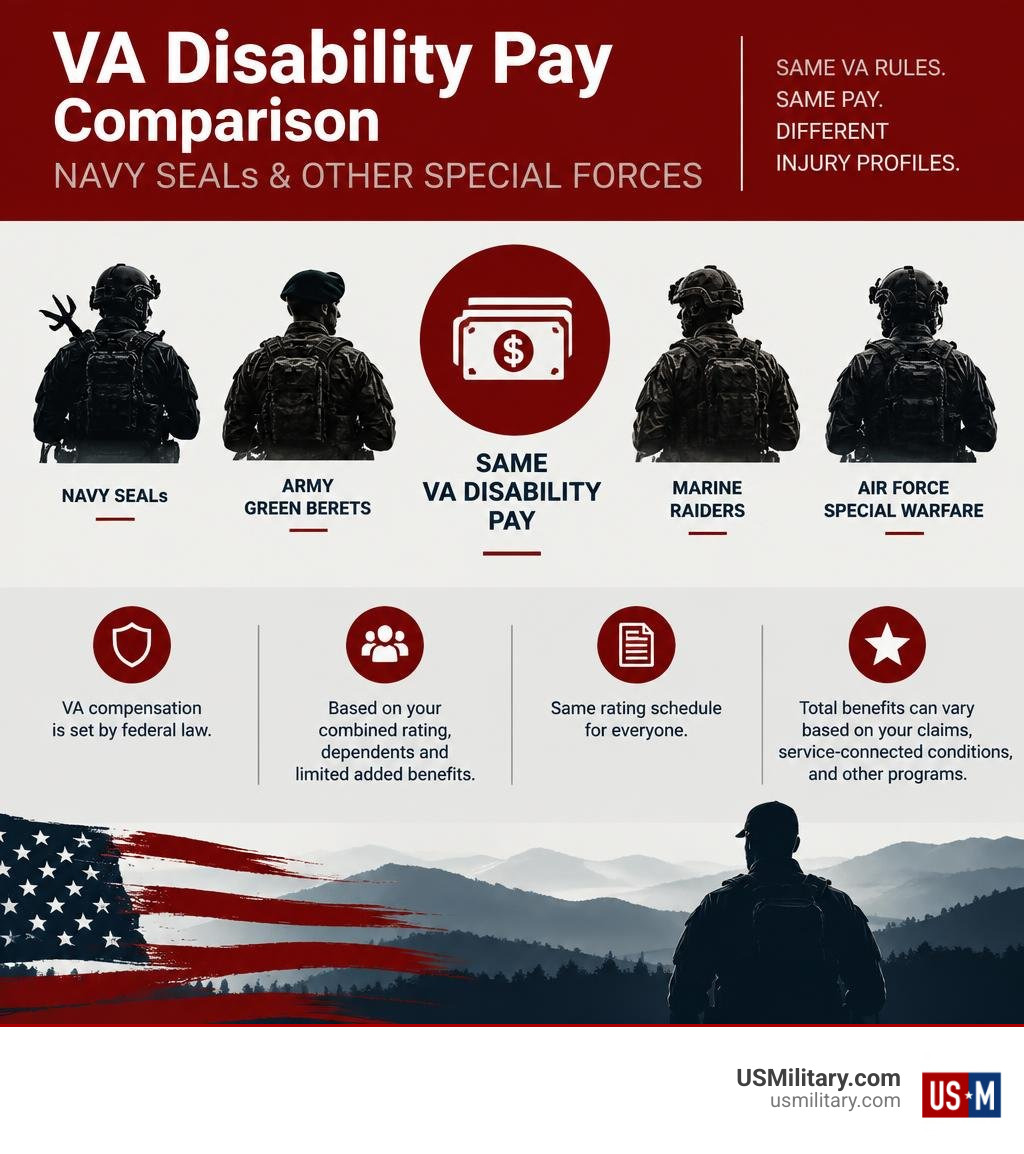
Navy SEALs do not receive a higher VA disability pay rate than Army Green Berets, Marine Raiders, Air Force special warfare veterans, or any other veteran with the same rating. Federal law sets VA compensation based on the veteran's combined disability rating, dependents, and limited added benefits such as Special Monthly Compensation.
In 2026, a single veteran rated 100% receives the same base monthly VA payment regardless of branch, rank, or special operations background. SEALs may appear to receive more because demanding training, repeated deployments, combat exposure, noise, blast exposure, and joint injuries can lead to more service-connected conditions. But the VA uses the same rating schedule for everyone.
More Than 90% Of Clients Have Increased VA Disability Ratings! Why Settle For Less Than You Deserve? Expert Priority Help With Your VA Claim! Free Evaluation Call!
The key difference is usually not a SEAL-only benefit. It is the evidence behind each claim, the number of service-connected conditions, and whether secondary conditions are properly documented. For retired operators, military retirement pay, Concurrent Retirement and Disability Pay (CRDP), and Combat-Related Special Compensation (CRSC) can also change total monthly income.
I am LARRY FOWLER, BUD/S Class 89, publisher of NavySeal.com and the USMilitary.com Network since 2007, where I have covered VA benefits, disability trends, and military transition topics for active-duty members and veterans. In this guide to Do Navy SEALs Receive More VA Disability Pay Than Other Branch Special Forces Groups, I will separate the uniform VA rules from the real-world claim patterns that can affect an operator's total benefits.
Explore more about Do Navy SEALs Receive More VA Disability Pay Than Other Branch Special Forces Groups:
- Are Navy SEALs Paid The Same As Army Delta Force Operators
- How Much Do Navy SEALs Make Per Year
- Navy SEAL vs Delta Force
Do Navy SEALs Receive More VA Disability Pay Than Other Branch Special Forces Groups?
When analyzing Department of Veterans Affairs benefits, the short answer is an unequivocal no. The Department of Veterans Affairs operates under Title 38 of the United States Code, which establishes a universal disability rating schedule for all eligible veterans. Whether you served as an administrative clerk, a conventional infantryman, an Army Green Beret, a Marine Raider, an Air Force Combat Controller, or a Navy SEAL, the statutory payout for any given disability percentage is identical.
The VA evaluates service-connected disabilities using specific diagnostic criteria found in the VA Schedule for Rating Disabilities (VASRD). Once your conditions are evaluated, the VA uses non-additive "VA Math" to calculate your combined disability rating, rounded to the nearest 10 percent. Under the 2026 VA disability rates, every single veteran with a 70% rating and no dependents receives $1,808.45 per month. Every veteran rated 100% with no dependents receives $3,938.58 per month tax-free.
The following table breaks down the baseline monthly compensation rates across all rating tiers in 2026 for a veteran with no dependents:
| Disability Rating | 2026 Monthly Payment (Veteran Alone) | 2026 Annual Payment (Tax-Free) |
|---|---|---|
| 10% | $180.42 | $2,165.04 |
| 20% | $356.66 | $4,279.92 |
| 30% | $552.47 | $6,629.64 |
| 40% | $795.84 | $9,550.08 |
| 50% | $1,132.90 | $13,594.80 |
| 60% | $1,435.02 | $17,220.24 |
| 70% | $1,808.45 | $21,701.40 |
| 80% | $2,102.15 | $25,225.80 |
| 90% | $2,362.30 | $28,347.60 |
| 100% | $3,938.58 | $47,262.96 |
As shown above, the VA rating schedule does not include multipliers for branch prestige, combat deployments, or elite qualification tabs. To understand your specific baseline, check our VA disability rating chart.
Why People Think Navy SEALs Receive More VA Disability Pay Than Other Branch Special Forces Groups
The public perception that Navy SEALs receive higher disability payouts stems primarily from media prominence, bestselling books, major films, and public awareness of their brutal training pipeline. SEALs endure rigorous conditioning, including Basic Underwater Demolition/SEAL (BUD/S), extreme cold-water exposure, thousands of high-altitude jumps, repetitive blast waves from close-quarters battle (CQB) training, and continuous heavy load carriage.
While on active duty, elite operators qualify for specialized incentive pay. When you look at active-duty enlisted Navy SEAL earnings, base salary is supplemented by demolition pay, jump pay, dive pay, and Special Duty Assignment Pay. When comparing elite units in our Navy SEAL vs Delta Force breakdown, these special duty incentives create large active-duty compensation packages.
However, once an operator separates or retires from the military, all active-duty special pays vanish immediately. The VA does not replace lost hazard allowances or bonus structures.
Schedule Ratings vs Real Payouts: Do Navy SEALs Receive More VA Disability Pay Than Other Branch Special Forces Groups in Practice?
While base rates are identical, the average total monthly compensation collected by former Special Operations Forces (SOF) veterans is often higher than that of conventional military personnel. This difference occurs because SOF veterans typically have a much higher volume of distinct, severe, service-connected disabilities.
According to VA annual benefits data, the average veteran across all eras carries roughly 7.34 service-connected disabilities. However, Global War on Terror (GWOT) era veterans average 9.61 individual service-connected conditions. Because of sustained high operational tempos, repeated combat deployments, and decades of physical wear and tear, operators across USSOCOM—including Army Special Forces and Marine Raiders—routinely claim between 10 and 20 separate conditions.
When an operator stacks multiple moderate and severe ratings (such as 50% for sleep apnea, 30% for cervical spine disc disease, 20% for each knee, and 70% for PTSD/TBI), their combined rating frequently pushes into the maximum tier. Securing 100% VA disability pay means a single veteran receives $3,938.58 per month, or $4,158.17 per month with a spouse. With additional allowances, total annual tax-free payments can reach $49,584 to $51,827 or more.
Comparing Special Operations Service-Connected Disabilities Across Branches
To determine whether Navy SEALs out-claim other operators, we must examine how occupational hazards differ across special operations units. Every SOF component carries substantial physical wear, but specific combat environments create distinct medical profiles.
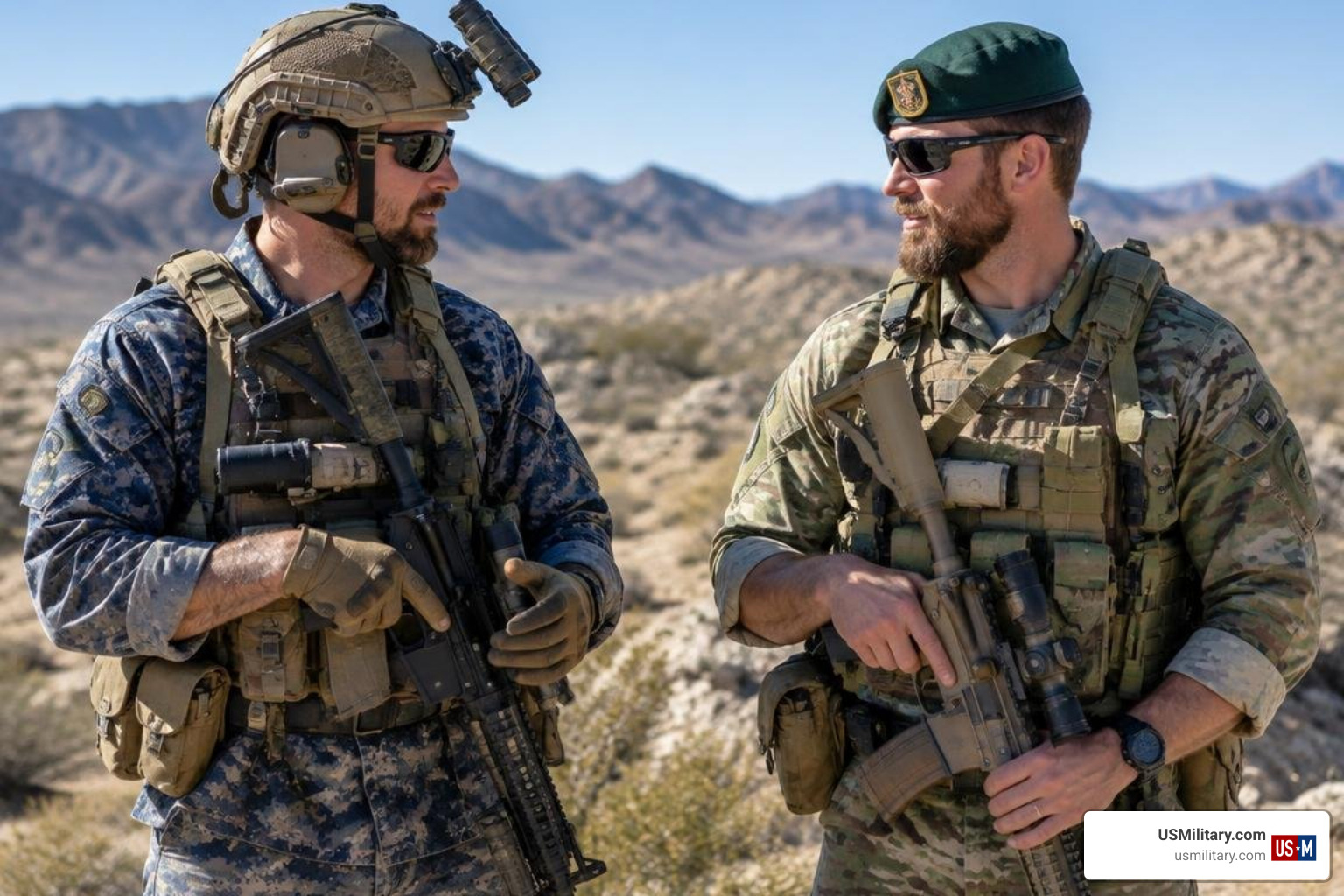
When reviewing our Green Beret vs Navy SEAL comparison and our analysis of Air Force PJs vs Navy SEALs, each branch faces distinct occupational stressors:
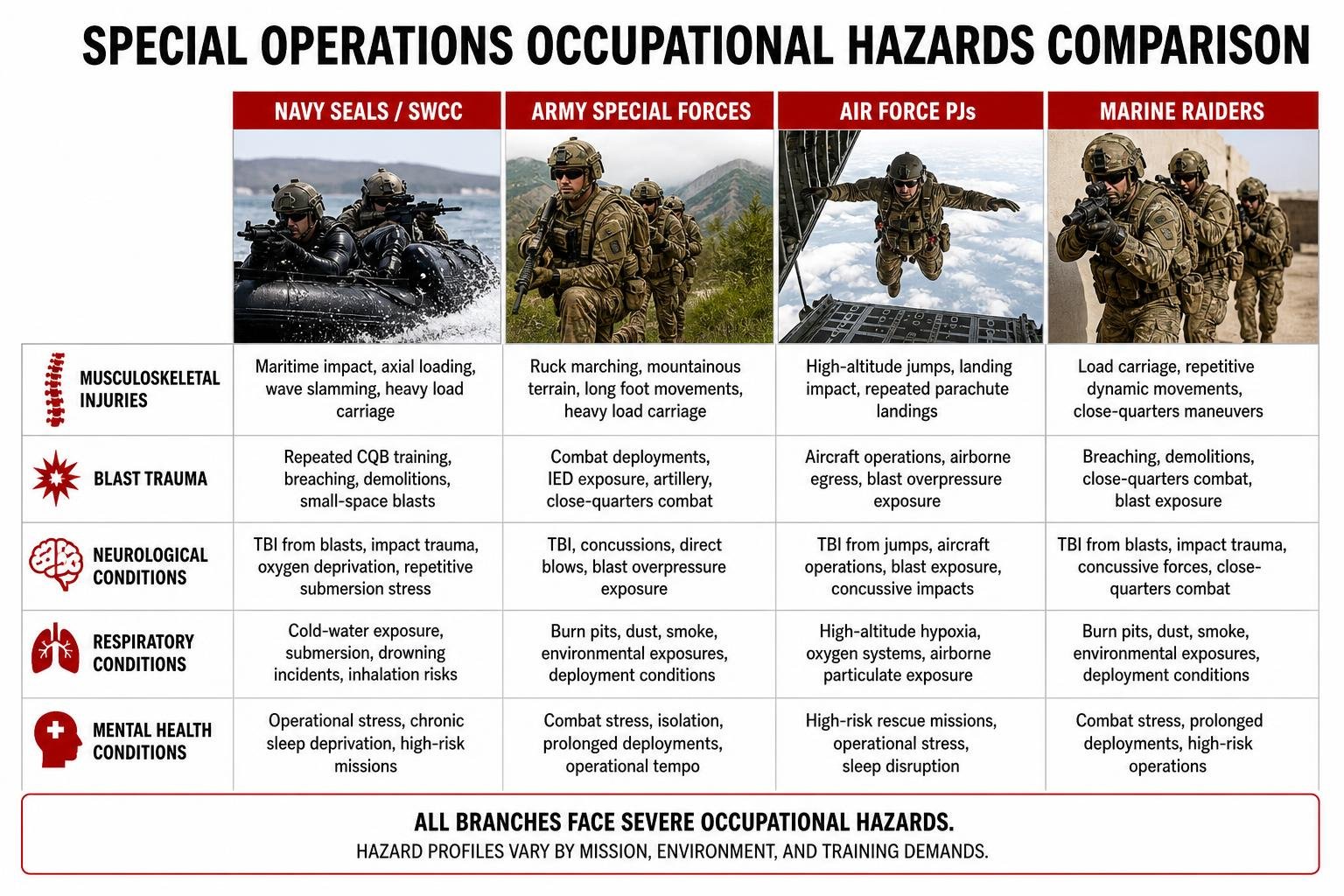
Musculoskeletal Injuries and Blast Trauma in Naval and Ground Operators
Musculoskeletal breakdown is the universal signature of special operations service. In our breakdown of Navy SEALs vs Army Rangers training, heavy ruck marching and explosive breaching take an immense toll on joints and spine health.
- Maritime Impact & Axial Loading: SEALs and Special Warfare Combatant-Craft Crewmen (SWCC) absorb continuous high-impact slamming forces while operating Combat Rubber Raiding Craft (CRRC) and high-speed assault vessels. Repeated wave slamming causes severe compression of the lumbar and cervical spine, leading to early degenerative disc disease, herniations, and facet arthropathy.
- Ground Operator Strain: Army Green Berets and Marine Raiders often carry combat rucksacks weighing 80 to 120 pounds over mountainous terrain for weeks. This long-duration load carriage creates chronic bilateral knee degeneration, meniscal tears, plantar fasciitis, and chronic lumbar strains.
- Breaching & Sub-Concussive Blast Waves: Both maritime and ground operators endure thousands of sub-concussive blast exposures during breaching, heavy weapons firing, and explosive ordnance disposal training. These exposures frequently cause mild Traumatic Brain Injury (TBI), leading to chronic vestibular dysfunction, sleep fragmentation, and neurological deficits.
Auditory, Respiratory, and PACT Act Presumptive Conditions
Auditory and respiratory damage represent some of the highest volume claims across all SOF components:
- Tinnitus & Hearing Loss: The VA’s Duty MOS Noise Exposure Listing rates special operations personnel across all branches (Navy SEALs, Army 18-series, Air Force Combat Control, Marine 0372 Raiders) in the highest probability bracket for hazardous noise exposure. Tinnitus carries a standard 10% disability rating under diagnostic code 6260, while sensorineural hearing loss is rated from 0% to 100% depending on speech discrimination scores.
- PACT Act Presumptions: The Sergeant First Class Heath Robinson Honoring our PACT Act established presumptive service connection for more than 20 toxic-exposure conditions, including chronic bronchitis, constrictive bronchiolitis, chronic sinusitis, rhinitis, and various cancers. Because SOF units deployed frequently to combat zones with open-air burn pits and industrial hazards across Iraq, Afghanistan, and the Middle East, all special operators qualify equally for these presumptive ratings without needing to prove a direct medical nexus.
Maximizing Ratings: Secondary Conditions, CRDP, and CRSC for Elite Operators
The true differentiator in monthly income between an average claim and a high-value SOF claim is how secondary conditions and military retirement programs are handled. Understanding how to structure claims properly is covered in detail in The Complete Guide to VA Disability Claims.

High-Impact Secondary Conditions for SOF Veterans
A primary service-connected condition often causes or aggravates additional medical issues over time. Filing for secondary conditions allows veterans to fairly capture the full scope of their injuries and pursue a VA disability rating increase:
- Radiculopathy Secondary to Lumbar/Cervical Strain: Chronic spinal disc herniation frequently causes nerve impingement. Operators can claim bilateral sciatic or femoral nerve radiculopathy, which can add separate 10% to 20% ratings for each affected limb.
- Obstructive Sleep Apnea Secondary to PTSD or TBI: Psychological trauma, hyperarousal, and traumatic brain injury can disrupt upper airway control or aggravate sleep apnea. When connected secondary to PTSD, a sleep apnea diagnosis requiring a CPAP machine warrants a 50% schedular rating.
- Migraines Secondary to TBI or Cervical Trauma: Severe, prostrating headaches that occur multiple times per month can provide an independent rating of up to 50% under diagnostic code 8100.
- Mental Health Aggravation: Chronic, debilitating physical pain from destroyed joints frequently causes or worsens secondary major depressive disorder, adjustment disorder, or anxiety.
Total Retirement Income: Military Pension, CRDP, and CRSC Combined
For SOF operators who complete a full 20-plus-year career, total compensation includes both Department of Defense (DoD) retirement pay and monthly VA disability compensation.
Normally, federal law prevents "double dipping," offsetting military retirement pay dollar-for-dollar by the amount of VA disability compensation received. However, two key statutory programs eliminate or mitigate this offset:
- Concurrent Retirement and Disability Pay (CRDP): Veterans who retire with 20 or more years of active service and hold a combined VA disability rating of 50% or higher automatically receive both their full taxable DoD military retirement pension and their full tax-free VA disability compensation without an offset.
- Combat-Related Special Compensation (CRSC): For operators with combat-related disabilities (incurred in combat, through hazardous duty like parachuting/diving, or through simulated war training), CRSC provides an added tax-free payment that restores retirement pay lost to the VA offset.
As demonstrated, combined retirement and disability packages for 20-year career operators regularly reach $7,500 to $10,500+ per month ($90,000 to $126,000+ per year), regardless of whether the operator wore a SEAL Trident, an Army Special Forces Tab, or Marine Raider insignia. Learn more about the financial benefits of reaching maximum schedular compensation in our guide to the 100% VA disability rating.
Frequently Asked Questions About Special Forces VA Disability Pay
What is the average VA disability rating for retired Navy SEALs?
While the VA does not publish data by individual military unit, retired Navy SEALs and other special operations veterans who serve 20 or more years frequently achieve combined ratings between 80% and 100%. This high rating is driven by an average of 10 to 18 separate service-connected conditions, including blast-induced TBI, spine compression, joint replacements, chronic tinnitus, and PTSD.
Can retired special forces veterans receive both military pension and VA disability?
Yes. Under Concurrent Retirement and Disability Pay (CRDP), any veteran who completes a standard 20-year active-duty retirement and receives a VA disability rating of 50% or higher is entitled to collect their full military pension and their full VA disability check concurrently.
Does classified special operations service prevent filing VA disability claims?
No. You do not need to reveal classified mission details, operational targets, or covert methods to win a VA disability claim. The VA requires medical evidence establishing a current diagnosis, proof of an in-service event or injury, and a medical nexus linking the two. Declassified after-action reports, military medical records, personal statements describing the mechanism of injury, and unclassified buddy statements from fellow team members satisfy these requirements.
Conclusion
At USMilitary.com, we are dedicated to providing clear, authoritative guidance on military careers, benefits, and retirement transitions. The claim that Navy SEALs receive higher VA disability pay than Army Green Berets, Marine Raiders, or Air Force Special Tactics operators is a myth. Every veteran is compensated under the exact same federal statutory schedule.
Understanding how the rating system works, properly documenting musculoskeletal injuries and blast exposures, identifying secondary conditions, and maximizing programs like CRDP or CRSC ensures that all special operations veterans receive the full compensation they earned. For more insights on naval special warfare careers, check out our Navy SEALs Complete Guide.
Explore more resources and tools across the USMilitary.com network, or read Larry Fowler's inspirational book Dare to Live Greatly for practical guidance on resilience and purpose during life transitions.