
The past, present, and future of military elite special forces like the Navy SEALs show one constant: elite units must adapt faster than the threats they face. Modern U.S. special operations grew from World War II units that conducted beach reconnaissance, sabotage, and clandestine missions. Today, Navy SEALs, Army Green Berets, and other SOF units combine direct action with intelligence support, partner-force training, and operations in difficult environments.
Looking ahead, success will depend on more than physical endurance. Drones, persistent satellite surveillance, electronic warfare, cyber tools, and AI make it harder for small teams to move unseen. Future operators will need strong judgment, technical skill, cultural awareness, and proven character alongside combat fitness.
The Navy SEALs were formally created in January 1962, but their roots reach back to WWII Scouts and Raiders, Naval Combat Demolition Units, and Underwater Demolition Teams. Army Special Forces developed along a different path, with a core focus on unconventional warfare and helping partner forces resist insurgencies or coercion. Those different origins still shape how each force trains and fights.
This guide explains the history, mission changes, ethical challenges, and reforms that will determine whether special operations forces remain effective in an era of great-power competition and highly watched battlefields.
I am Larry Fowler, BUD/S Class 89, publisher of the NavySeal.com and USMilitary.com Network, which has served active-duty personnel, veterans, and prospective service members since 2007. My work helping readers navigate military careers informs this overview of the past, present, and future of elite military special forces like the Navy SEALs, and what their evolution can mean for those considering service.
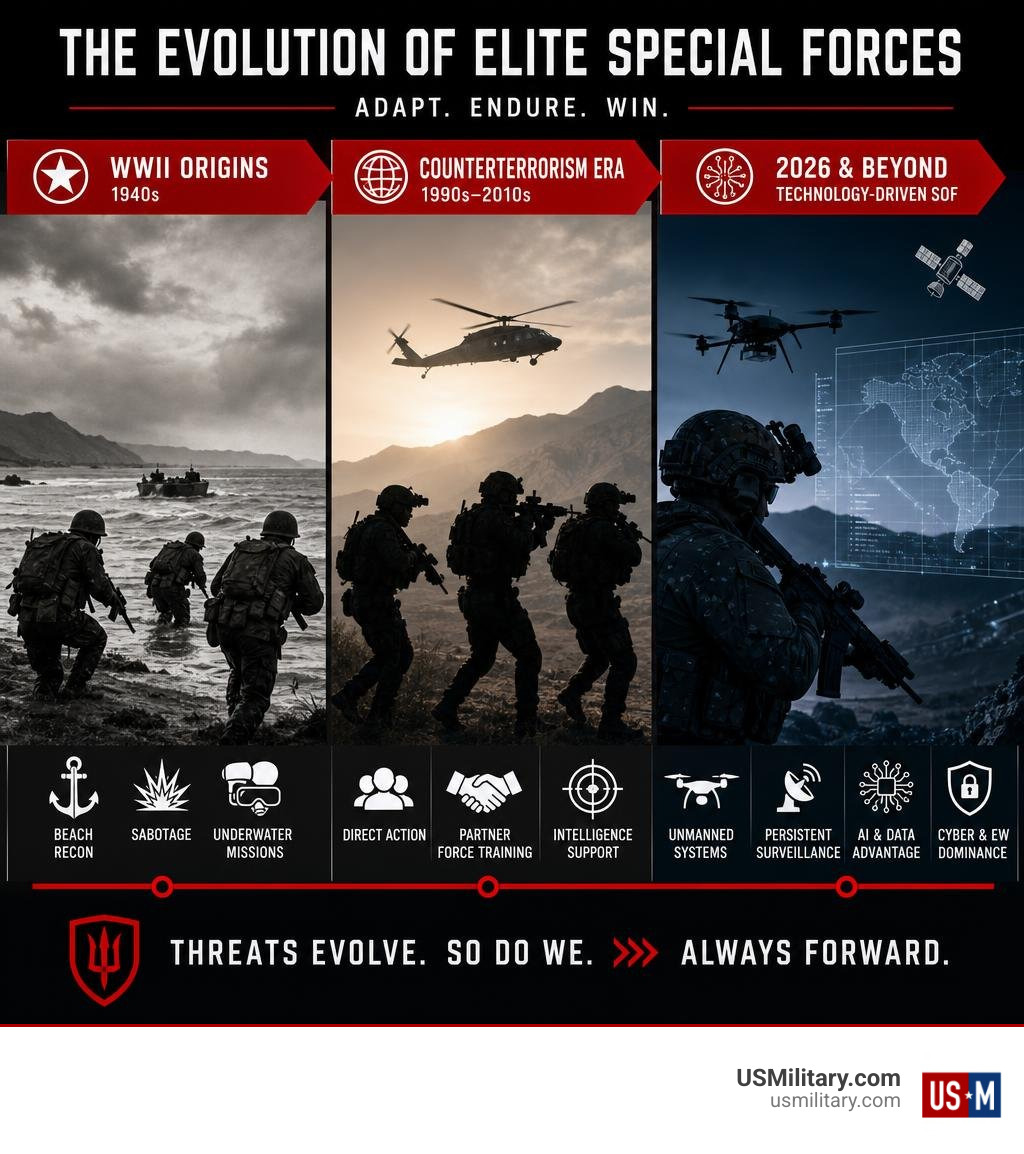
Quick look at the past, present, and future of military elite special forces like the Navy SEALs:
Historical Lineage and the Origin of Modern Commando Units
Modern special operations forces trace their lineage directly to the high-stakes battlefields of World War II. During this global conflict, conventional military doctrines met harsh friction, necessitating small, agile raiding elements capable of operating far behind enemy lines. In the European theater, the British Special Air Service (SAS), founded in 1941 by David Stirling, pioneered deep-penetration desert raids against Axis supply depots and airfields. Simultaneously, the American Office of Strategic Services (OSS) established maritime units, psychological warfare divisions, and guerrilla coordination cells to assist resistance networks across occupied territories.
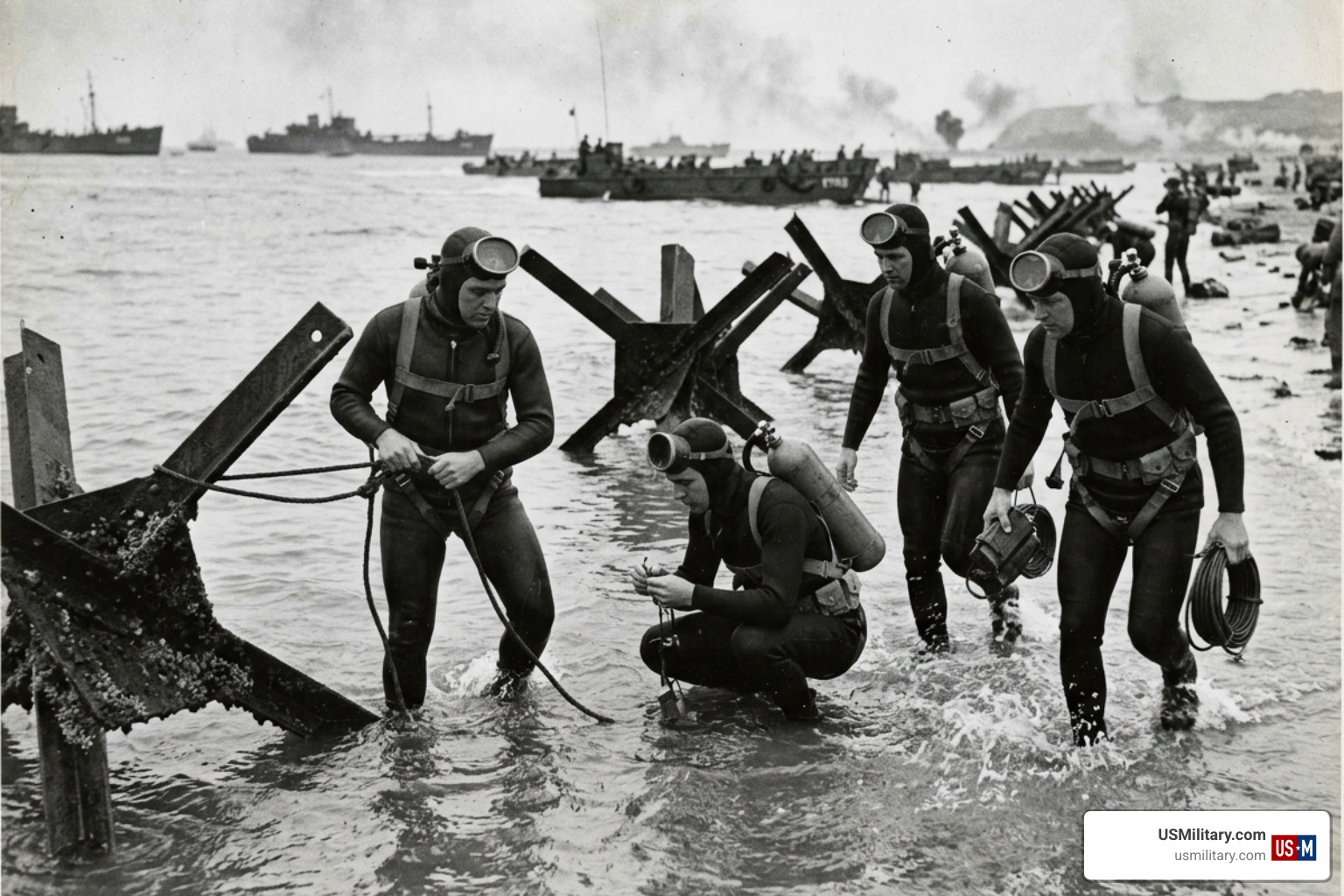
For maritime forces, the Pacific and European amphibious campaigns demanded a novel brand of commando. Before massive Allied fleets could land on hostile shores, specialized reconnaissance and demolition specialists had to scout the landing zones and clear lethal underwater obstacles. In 1942, the Navy formed Scouts and Raiders, followed quickly by Naval Combat Demolition Units (NCDUs). Phil H. Bucklew, widely revered as the "Father of Naval Special Warfare," led initial reconnaissance during Operation Torch in North Africa and later charted enemy shore defenses for Operation Overlord.
During the D-Day landings at Omaha Beach, 34 NCDUs deployed into the surf alongside Army combat engineers. Facing devastating machine-gun and artillery fire while working in freezing waters to blow paths through steel and concrete barriers, these units sustained a grueling 52 percent casualty rate (31 killed and 60 wounded). Their sacrifice proved vital to the landing craft reaching the shore.
In the Pacific, the Navy established Underwater Demolition Teams (UDTs)—popularly christened the "Naked Warriors" because they swam into heavily fortified reefs armed only with swim trunks, masks, fins, Ka-Bar knives, and satchel charges of C-2 explosives. By the war's conclusion, the Navy had mobilized 34 UDTs to secure island beaches from Kwajalein to Okinawa.
The post-WWII era and the Korean War (highlighted by the daring 861-day siege of Wonsan harbor) underscored the persistent need for unconventional amphibious capabilities. As detailed by SEAL History: The Story of Naval Special Warfare - Navy SEAL Museum, President John F. Kennedy formally commissioned the U.S. Navy SEALs in January 1962, standing up SEAL Team 1 on the West Coast and SEAL Team 2 on the East Coast.
These teams quickly adapted their maritime raiding skill set to the dense swamps, canals, and river networks of the Mekong Delta during the Vietnam War, executing ambushes, intelligence captures, and riverine patrols that cemented their legendary commando status.
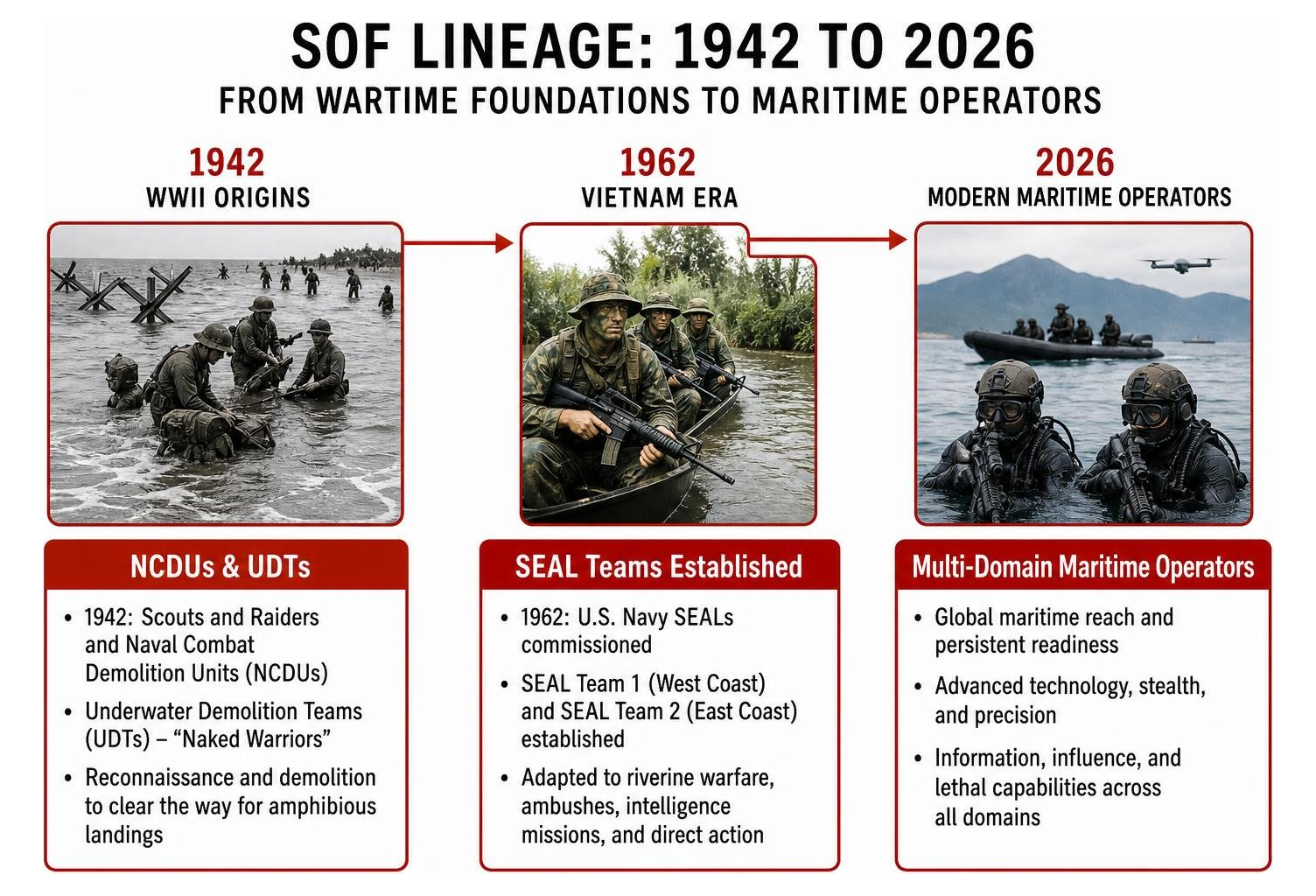
Historical Roots: The Past, Present, and Future of Military Elite Special Forces Like the Navy SEALs Examined
The journey of naval commandos from early beach scouts to modern global operators illustrates an unending operational adaptation. Early UDT frogmen focused purely on hydrographic reconnaissance and sub-surface demolition to support conventional fleet movements.
However, Cold War friction pushed the newly minted SEAL teams toward counter-guerrilla operations, airborne insertions, deep intelligence gathering, and snatch-and-grab direct action. Candidates seeking to join this maritime pipeline must conquer the rigorous Navy SEAL BUD/S training requirements to prove they possess the resilience needed for these multi-environment missions.
Branch Doctrine and Culture: Naval Special Warfare vs. Army Special Forces
Although the public often views elite special operators as interchangeable shock troops, the distinct doctrines of Naval Special Warfare (NSW) and U.S. Army Special Operations Command (USASOC) produce fundamentally different cultures and mission priorities.
Naval Special Warfare focuses heavily on maritime dominance, surgical direct action, counterterrorism, coastal interdiction, and amphibious infiltration. SEAL platoons are designed as self-contained strike instruments intended to bypass enemy perimeter defenses via sea, air, or land, strike a specific target with overwhelming violence of action, and extract cleanly.
In contrast, Army Special Forces—the Green Berets—are built around an institutional core of Unconventional Warfare (UW) and Foreign Internal Defense (FID). With a vast enterprise within USASOC (which commands a total force of roughly 36,000 personnel across active and reserve components), Green Berets operate via 12-man Operational Detachments Alpha (ODAs).
Each ODA functions as a force multiplier: their purpose is not necessarily to kick down the door themselves, but to train, advise, equip, and lead thousands of indigenous guerrilla forces or host-nation militaries to defend their own sovereign territory. This necessitates extensive training in regional languages, cross-cultural psychology, and political nuance, distinguishing the ins and outs of Green Beret vs Navy SEAL operational deployments.
| Attribute | Navy SEALs | Army Green Berets (Special Forces) | 1st SFOD-D (Delta Force) |
|---|---|---|---|
| Primary Domain | Maritime, Littoral, Amphibious (Sea, Air, Land) | Terrestrial, Mountain, Jungle, Deep Civil Sectors | Global Surgical Strike & Covert Operations |
| Core Doctrinal Focus | Direct Action (DA), Special Reconnaissance (SR), Maritime Interdiction | Unconventional Warfare (UW), Foreign Internal Defense (FID), Counterinsurgency | Precision Hostage Rescue, High-Value Target (HVT) Elimination, Counterterrorism |
| Standard Operational Unit | 16-Man Platoon (or 8-Man Squad) | 12-Man Operational Detachment Alpha (ODA) | Specialized Troops & Assault Squads |
| Skillset Specialization | Combat diving, submersibles, fast-boat insertion, close-quarters combat | Deep cultural immersion, language fluency, indigenous warfare, civil advisory | Extreme-precision shooting, covert urban entry, target exploitation |
| Command Architecture | Naval Special Warfare Command (NSWC) / USSOCOM | USASOC / 1st Special Forces Command / USSOCOM | Joint Special Operations Command (JSOC) |
Analyzing the Past, Present, and Future of Military Elite Special Forces Like the Navy SEALs
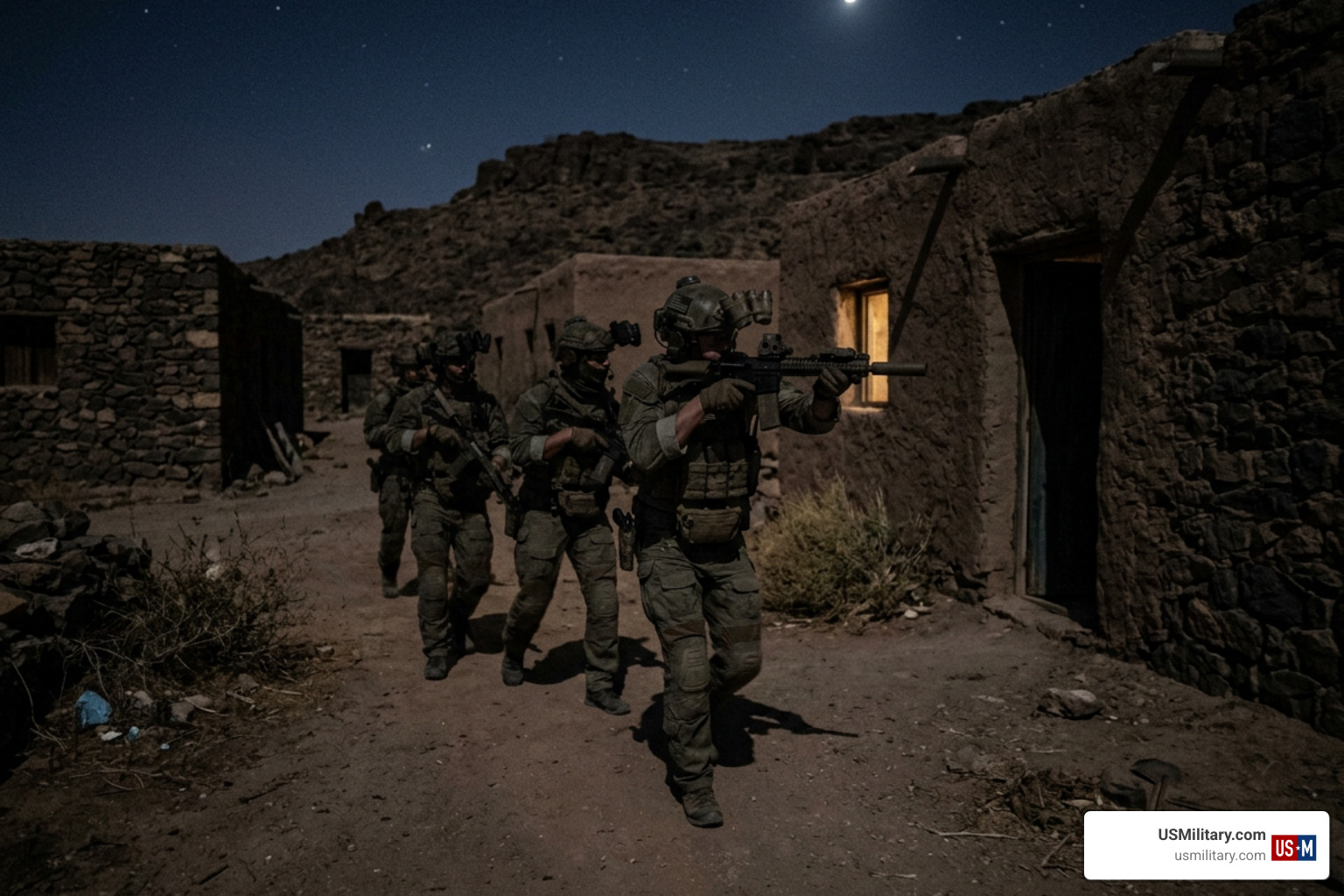
Over the past three decades, the operational focus of special operations units transitioned dramatically from strategic deterrence to hyper-kinetic counterterrorism (CT) operations. Following the creation of the United States Special Operations Command (USSOCOM) in 1987, the joint force was tested in operations across Panama, Grenada, the Persian Gulf, and the Balkans. However, the attacks of September 11, 2001, triggered an unprecedented 20-year cycle of continuous deployment.
During Operation Enduring Freedom (OEF) in Afghanistan, SEAL units adapted rapidly to high-altitude land warfare, executing more than 75 critical special reconnaissance and direct-action missions in mountainous redoubts. Shortly thereafter, the largest SEAL deployment in history mobilized for Operation Iraqi Freedom (OIF), where naval operators fought house-to-house across urban strongholds like Fallujah, Ramadi, and Baghdad alongside conventional Marine and Army units.
The Global War on Terror and High-Profile Direct Action Raids
The pinnacle of this era was the continuous deployment of Joint Special Operations Command (JSOC) task forces, which streamlined actionable intelligence into industrial-scale kill-capture cycles against insurgent networks. These capabilities were underscored by high-profile missions, such as the 2011 Abbottabad raid (Operation Neptune Spear) conducted by SEAL Team 6 to eliminate Osama bin Laden.
While the strategic raid captured international headlines, it also highlighted how distinct special missions units operate when understanding whats the difference between delta force and seals in organizational structure, mission mandates, and Tier-One command tasking.
Accountability, Ethics, and Cultural Challenges in Tier-One Units
Two decades of continuous rotational combat deployments, high operational tempo, and isolated command structures placed immense institutional strain on Tier-One and Tier-Two units. The heavy reliance on rapid direct-action missions occasionally eroded standard military discipline, leading to serious ethical failures, accountability lapses, and criminal misconduct.
Public trust was tested by severe controversies:
- The 2002 Battle of Takur Ghar and the tragic sequence surrounding the death of Air Force Combat Controller John Chapman, which involved years of contentious friction regarding aerial ISR evidence and unit accountability.
- The 2017 death of Army Staff Sergeant Logan Melgar in Mali, which exposed illicit behavior, hazing, and internal cover-ups involving members of SEAL Team 6 and Marine Raiders.
- The high-profile court-martial of Chief Petty Officer Eddie Gallagher, which brought operational dysfunction, ethical breakdowns, and command rifts to national attention.
These issues are analyzed deeply in Why I Will Never Trust Navy SEALs Again … EVER | Part Two: It didn’t start with John Chapman, and it didn’t end with him. The report explores how the commercialization of the elite commando brand—through memoirs, podcasts, clothing brands, and paid speaking circuits—clashed with the historic ethos of the "quiet professional."
When Matt Bissonnette wrote No Easy Day under a pseudonym, claiming direct credit for killing Osama bin Laden, he earned nearly $6.7 million before the federal government reclaimed the revenue for non-disclosure violations. Similarly, commercial engagements for speaking fees by former operators, like Marcus Luttrell charging up to $50,000 per appearance, underscored how personal branding became intertwined with military service.
Institutional reckoning followed: during one 15-month period, Naval Special Warfare expelled 33 SEALs from the community for drug abuse, ethical failures, and operational misconduct—a figure exceeding the number of combat fatalities suffered by the force over that same span.
In response, special operations leadership has enacted stringent command oversight, renewed focus on the written SEAL Ethos (originally drafted in 2005), and introduced proactive psychological screenings to preserve operational integrity.
Next-Generation Threats and Doctrinal Transformation in 2026
As of September 2026, the global operational landscape has shifted away from isolated counterterrorism hunts toward Great Power Competition (GPC) and gray-zone conflict. The battlefields of Eastern Europe, the Middle East, and the Indo-Pacific demonstrate that the tactics used during the Global War on Terror are vulnerable in high-density electronic and sensor-rich environments.
Today's peer and near-peer adversaries field integrated sensor architectures that challenge commando concealment:
- Proliferating Space Architecture: China has tripled its intelligence, surveillance, and reconnaissance (ISR) satellite platforms since 2018, ensuring rapid revisit rates over open oceans, airbases, and littoral zones.
- Biometric and AI Surveillance: Authoritarian regimes deploy artificial intelligence, facial recognition, and pervasive cellular tracking to deny covert operational transit within urban areas.
- Drone Saturation & Electronic Warfare: First-Person View (FPV) attack drones, acoustic sensors, and spectrum analyzers target electromagnetic emissions the moment an operator powers up a tactical radio.
- Mass Precision Strikes: As demonstrated when Operation Epic Fury struck more than 13,000 targets against hostile infrastructure, modern standoff precision fires reduce the need to insert ground commandos for basic kinetic strikes.
Strategic Outlook: The Past, Present, and Future of Military Elite Special Forces Like the Navy SEALs in 2026 and Beyond
To remain strategically relevant, elite forces are shifting back toward their maritime and unconventional roots. For the Navy SEALs, this means returning to the sea: subsea infrastructure defense, clandestine coastal reconnaissance in anti-access/area-denial (A2/AD) zones, underwater sabotage, and forward-deploying autonomous unmanned undersea vehicles (UUVs).
For the Army Green Berets, it means moving beyond counterinsurgency to conduct irregular warfare against adversary proxy forces and prepare partner nations to deter aggression.
Aspiring operators evaluating these complex responsibilities should review compensation systems, special duty pay structures, and career trajectories, such as what the salary is for an enlisted Navy SEAL in 2026, to understand the modern commitments of special warfare service.
Reforming Assessment, Selection, and Qualification (ASQ) for Cognitive Dominance
To survive in these complex environments, physical fitness alone is no longer sufficient. As documented by researchers in SOF Assessment, Selection, and Qualification, modern selection doctrine asserts that "the operator is the platform."
While six-mile timed runs, log carries, and Hell Week water-treading remain vital baselines for physical grit, assessment programs are modernizing to prioritize cognitive agility, cyber fluency, emotional stability, and moral reasoning.
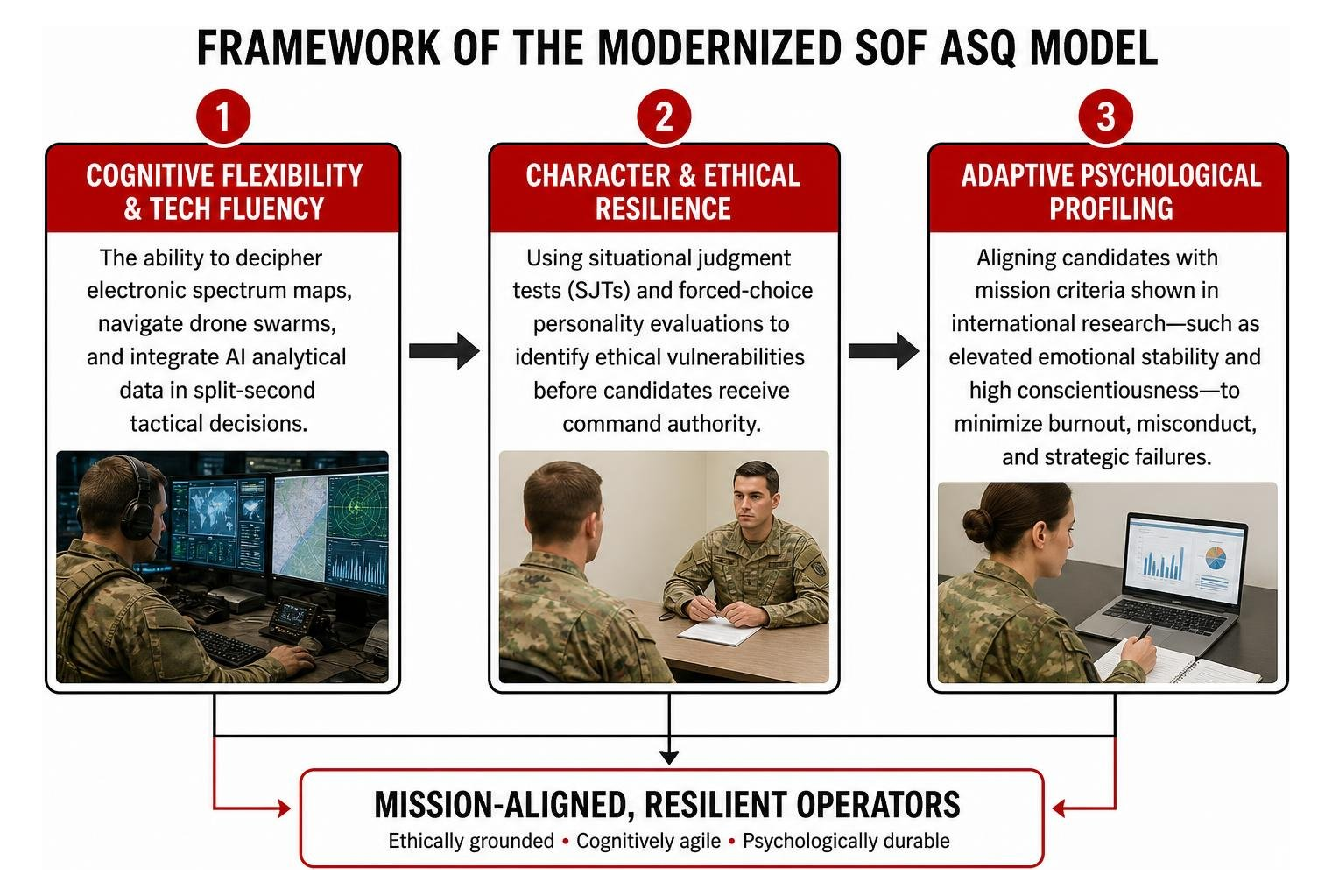
Modern Assessment, Selection, and Qualification (ASQ) frameworks evaluate:
- Cognitive Flexibility & Tech Fluency: The ability to decipher electronic spectrum maps, navigate drone swarms, and integrate AI analytical data in split-second tactical decisions.
- Character & Ethical Resilience: Using situational judgment tests (SJTs) and forced-choice personality evaluations to identify ethical vulnerabilities before candidates receive command authority.
- Adaptive Psychological Profiling: Aligning candidates with mission criteria shown in international research—such as elevated emotional stability and high conscientiousness—to minimize burnout, misconduct, and strategic failures.
Frequently Asked Questions About Special Operations Forces
What is the primary doctrinal difference between Navy SEALs and Army Green Berets?
Navy SEALs are primarily designed for maritime operations, direct-action raids, reconnaissance, and coastal interdiction, focusing on swift tactical strikes. Army Green Berets are organized, trained, and educated specifically for Unconventional Warfare (UW) and Foreign Internal Defense (FID), working through indigenous forces, civil authorities, and resistance groups over extended operational timelines.
How did WWII units like the UDTs and OSS shape today's elite operators?
World War II units established the tactical blueprints for today's special operations forces. The Naval Combat Demolition Units (NCDUs) and Underwater Demolition Teams (UDTs) developed modern combat diving, hydrographic surveying, and beachhead sabotage. Simultaneously, the Office of Strategic Services (OSS) established doctrines for intelligence collection, guerrilla coordination, psychological operations, and deep-behind-the-lines sabotage, serving as the common ancestor for the Green Berets and the CIA's Special Activities Center.
How are modern battlefield technologies like drones and AI impacting SOF survivability?
Proliferating autonomous drone systems, satellite ISR constellations, and electronic warfare have significantly reduced the margin for operational error. Small commando teams can no longer rely purely on physical darkness or rough terrain for concealment. To survive, modern operators must practice strict electromagnetic signature control, master counter-unmanned aerial systems (C-UAS), leverage AI data at the edge, and conduct operations beneath adversary sensor networks.
Conclusion
The evolution of America's elite special forces illustrates an ongoing process of strategic adaptation. From the daring WWII frogmen clearing Omaha Beach with satchel charges to the precision counterterrorism strikes of the Global War on Terror, units like the Navy SEALs and Army Special Forces have met every challenge by innovating under fire.
As we navigate 2026, the mission environment demands another transformation. Surviving in gray-zone operations, contested littoral environments, and sensor-saturated theaters requires operators who balance physical toughness with technical literacy, ethical discipline, and cognitive agility.
At NavySeal.com, we provide prospective service members, active-duty personnel, and veterans with the career comparisons, military benefit guides, and strategic insights needed to navigate service.
If you are evaluating your path in military special operations, compare Army Delta Force vs Navy SEALs to learn how these units train and operate, or discover the best ways to prepare for service today.