The Story of Chris Kyle Navy SEAL: America's Most Lethal Sniper
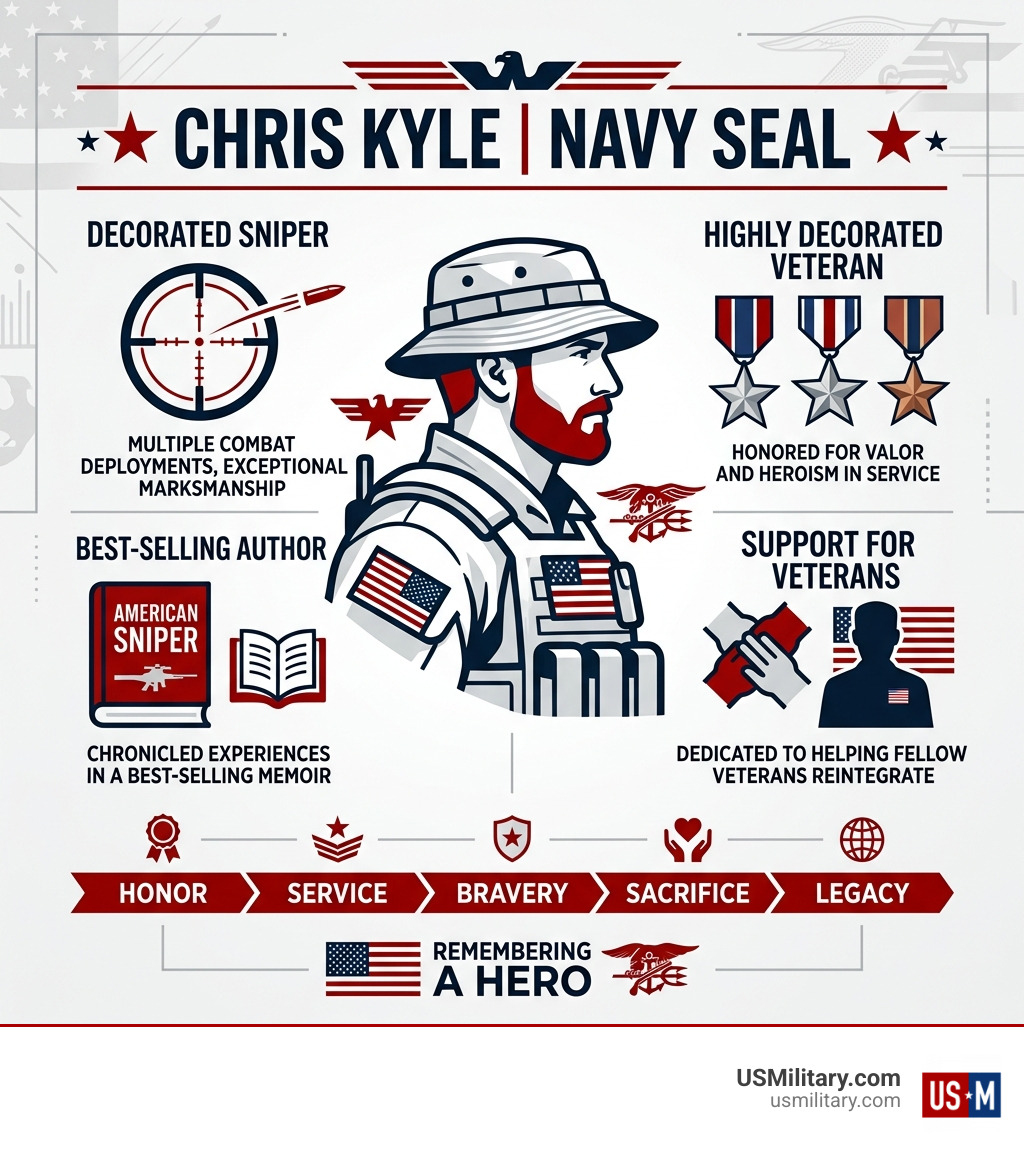
Chris Kyle Navy SEAL is one of the most recognized names in modern American military history. Here's a quick summary of who he was:
| Fact | Detail |
|---|---|
| Full Name | Christopher Scott Kyle |
| Born | April 8, 1974, Odessa, Texas |
| Died | February 2, 2013 (age 38) |
| Branch | U.S. Navy, SEAL Team 3 |
| Rank | Chief Petty Officer |
| Service Years | 1999–2009 |
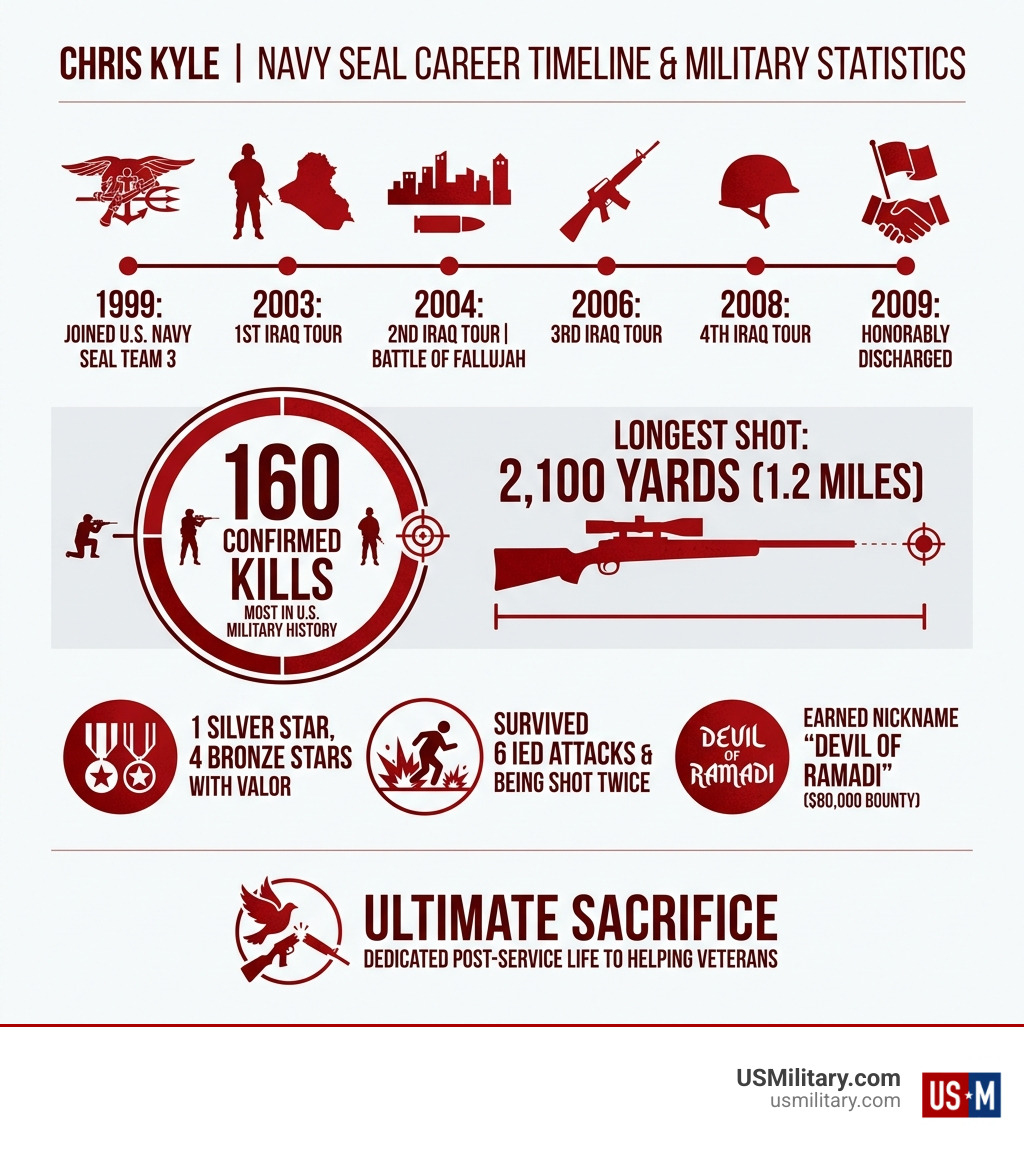
| Combat Tours | Four tours in Iraq |
| Confirmed Kills | 160 (most in U.S. military history) |
| Longest Shot | 2,100 yards (1.2 miles) |
| Key Awards | 1 Silver Star, 4 Bronze Stars with Valor |
| Known For | American Sniper memoir; deadliest U.S. sniper |
Chris Kyle grew up on a cattle ranch in Texas, learned to shoot at age eight, and went on to become the most lethal sniper in U.S. military history. He served four combat tours in Iraq, survived being shot twice and six IED attacks, and earned the nickname "Devil of Ramadi" from Iraqi insurgents who placed an $80,000 bounty on his head.
After leaving the military, Kyle dedicated himself to helping fellow veterans — a mission that ultimately cost him his life. He was murdered on February 2, 2013, at a Texas shooting range by a veteran he was trying to help.
As Kyle himself put it:
"It was my duty to shoot the enemy, and I don't regret it. My regrets are for the people I couldn't save: Marines, soldiers, buddies."
His story was turned into the bestselling memoir American Sniper and later a blockbuster film that brought his legacy to millions.
I'm Larry Fowler, author of Dare To Live Greatly and publisher of the USMilitary.com/NavySeal.com Network, where since 2007 I've covered military careers, veteran benefits, and the stories of those who served — including the enduring legacy of the Chris Kyle Navy SEAL story. In this guide, we'll walk through every major chapter of his life, from his Texas roots to his combat record, controversies, and the lasting impact he left behind.
Easy Chris Kyle Navy SEAL glossary:
- navy seals
- seal team six
- navy seal training
Early Life and the Path to Special Operations
Long before he was known as "The Legend," Christopher Scott Kyle was just a Texas boy with a rifle and a dream. Born on April 8, 1974, in Odessa, Texas, Kyle was raised in the heart of cattle country. His father, a Sunday school teacher, bought Chris his first rifle—a .30-06 Springfield—at the age of eight. This early exposure to hunting pheasant, quail, and deer laid the foundation for the marksmanship that would later define his military career.
According to this Chris Kyle Biography, his upbringing was steeped in traditional Texan values: hard work, faith, and a deep respect for the outdoors. He wasn't just a hunter; he was a true cowboy at heart. After graduating from high school, Kyle attended Tarleton State University in Stephenville, Texas, but his heart was in the rodeo arena rather than the classroom.
Kyle pursued a career as a professional bronco rider. However, the life of a rodeo athlete is notoriously punishing. His dreams of professional stardom came to a crashing halt when a bronco flipped on him, resulting in a debilitating arm injury that required pins in his wrists and several surgeries. For many, such an injury would be a career-ender, and for a while, it looked like it might keep him out of the military entirely.
When he first tried to enlist, the Navy initially rejected him because of the pins in his arm. But Kyle wasn't the type to take "no" for an answer. He persevered, and eventually, the Navy reconsidered, allowing him to enter the pipeline for the most elite unit in the world.
The Training of Chris Kyle Navy SEAL
Entering Naval Special Warfare is a feat in itself. Kyle was assigned to BUD/S (Basic Underwater Demolition/SEAL) Class 233. This training is widely considered the toughest in the U.S. military, designed to break those who aren't mentally and physically prepared for the rigors of special operations. Kyle didn't just survive; he thrived, proving that his rodeo-hardened grit was exactly what the SEAL teams needed.
Upon graduation, he was assigned to SEAL Team 3. While he was a capable operator in all aspects of direct action and underwater demolition, it was behind the scope of a long-range rifle where he truly excelled. His talent was so undeniable that he eventually became a Chief Instructor for the Naval Special Warfare Sniper and Counter-Sniper teams.
His influence on the community went beyond just pulling the trigger. Kyle was instrumental in shaping how future generations of snipers were trained. He even authored the Navy SEAL manual for snipers, known as the Naval Special Warfare Doctrine. This manual codified the tactics and techniques that would help keep American service members safe in the urban labyrinths of the Middle East.
The Combat Record of Chris Kyle Navy SEAL
When the Iraq War began, the Chris Kyle Navy SEAL legend truly took flight. Over the course of four tours in support of Operation Iraqi Freedom, Kyle became a guardian angel for Marines and soldiers on the ground. His primary mission was "overwatch"—perched on rooftops or concealed in ruined buildings, he scanned the streets for threats to American convoys and foot patrols.
The numbers associated with his service are staggering. The Pentagon officially credits him with 160 confirmed kills, making him the most lethal sniper in American history. However, the question of How many kills did Chris Kyle have? often yields higher estimates. Kyle himself claimed 255 kills, noting that many could not be "confirmed" by the strict military standard, which typically requires a third-party witness or physical evidence.
One of his most intense deployments was in Ramadi in 2006. During 32 sniper overwatch missions, Kyle was credited with 91 confirmed kills in that city alone. His presence was so disruptive to insurgent operations that they nicknamed him al-Shaitan Ramadi—the Devil of Ramadi. They even placed a bounty on his head that started at $20,000 and eventually rose to $80,000.
His most famous feat of marksmanship occurred in 2008 near Sadr City. From a distance of 2,100 yards—roughly 1.2 miles—Kyle spotted an insurgent about to fire a rocket-propelled grenade (RPG) at an Army convoy. Despite the incredible distance and environmental factors, Kyle took the shot and neutralized the threat. It remains one of the longest successful sniper shots in history.
Throughout these tours, Kyle wasn't just a distant observer. He was in the thick of the fight, surviving two gunshot wounds and being involved in six different IED attacks. His resilience earned him the nickname "The Legend" among his fellow SEALs.
Awards, Decorations, and Record Revisions
For his extraordinary heroism, Kyle was highly decorated. His initial records listed a massive haul of medals, including two Silver Stars and five Bronze Stars with the "V" device for valor. He also received the Texas Legislative Medal of Honor, the highest military decoration the state of Texas can bestow.
However, in 2016, a Navy investigation revealed clerical errors in Kyle's discharge papers (the DD-214). It turns out the Navy had inadvertently inflated his medal count in the official paperwork. The records were revised to show that he actually earned one Silver Star and four Bronze Stars with Valor. While some critics used this to question his record, the Navy clarified that these were administrative errors and did not diminish the incredible bravery he displayed during his ten years of service.
American Sniper: From Memoir to Global Phenomenon
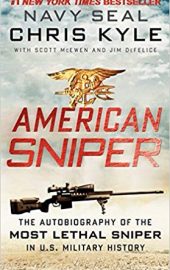
After retiring from the Navy in 2009, Kyle struggled, like many veterans, to adjust to civilian life. He eventually found his footing by writing his autobiography, American Sniper: The Autobiography of the Most Lethal Sniper in U.S. Military History. The book was a massive success, spending 37 weeks on the New York Times bestseller list. It provided a raw, unapologetic look at the reality of modern warfare and the psychological toll it takes on those who fight.
The book's success caught the attention of Hollywood. This VA News on American Sniper article notes how the story resonated with the public. Directed by Clint Eastwood and starring Bradley Cooper as Kyle, the film American Sniper became the highest-grossing war movie of all time, earning over $547 million worldwide and receiving six Oscar nominations.
While the film was a hit, it did take some creative liberties. For instance, the character of "Mustafa," the rival Syrian sniper, was largely an invention or a composite of various threats Kyle faced, used to create a cinematic "arch-nemesis." Similarly, a scene where Kyle dines with an Iraqi family who turns out to be insurgents was added for dramatic tension and did not happen in real life. However, his wife, Taya Kyle, worked closely with the production to ensure that Bradley Cooper captured Chris’s mannerisms and spirit accurately.
Controversies and Disputed Claims
With great fame came great scrutiny. Several claims in Kyle’s book and public appearances became the subject of intense debate. One of the most famous involved former Minnesota Governor and UDT veteran Jesse Ventura. Kyle claimed in his book that he had punched a man he called "Scruff Face" (later identified as Ventura) at a SEAL wake after Ventura allegedly made unpatriotic remarks. Ventura sued for defamation and won a $500,000 judgment, though the case was eventually settled for an undisclosed sum in 2017.
Other stories also came under fire. Kyle claimed he had traveled to New Orleans after Hurricane Katrina and shot dozens of looters from the top of the Superdome—a claim that local authorities and journalists found no evidence to support. He also told a story about killing two carjackers at a Texas gas station, which police records could not verify. These "tall tales" remain a complicated part of his legacy, leading some to wonder why a man with such a genuine record of heroism felt the need to embellish certain stories.
The Tragic Death and Lasting Legacy
Despite the controversies, Kyle’s post-military life was defined by his desire to give back. He founded Craft International, a tactical training firm, and became heavily involved in veteran advocacy. He partnered with FITCO Cares to provide fitness equipment to wounded veterans and those suffering from PTSD, believing that physical activity was a vital part of recovery.
His wife, Taya, has been instrumental in carrying on this mission through the About the Foundation page of the American Valor Foundation. This organization supports various programs that help veterans and first responders reconnect with their families and manage the stresses of service.
The Final Mission of Chris Kyle Navy SEAL
On February 2, 2013, Kyle’s mission to help his fellow veterans led him to a shooting range in Erath County, Texas. He was accompanied by his friend Chad Littlefield and a 25-year-old Marine veteran named Eddie Ray Routh. Routh’s mother had reached out to Kyle, hoping that spending time at the range with a legendary veteran might help her son, who was struggling with severe PTSD and schizophrenia.
Tragically, Routh turned his weapons on Kyle and Littlefield, killing them both. The news shocked the nation. Kyle, who had survived the deadliest streets of Iraq, had been taken down on home soil while performing an act of charity. Routh was later convicted of capital murder and sentenced to life in prison without the possibility of parole.
The outpouring of grief was immense. A 200-mile funeral procession followed his casket from Midlothian to the Texas State Cemetery in Austin. Nearly 7,000 people attended his memorial service at the Dallas Cowboys' AT&T Stadium, where his flag-draped coffin rested on the 50-yard line.
Frequently Asked Questions about Chris Kyle
How many confirmed kills did Chris Kyle have?
The U.S. Navy officially confirmed 160 kills for Chris Kyle. While he claimed 255 total kills, the military requires specific "confirmation" protocols that were not always possible in the heat of urban combat. Regardless of the exact number, he remains the deadliest sniper in U.S. history.
What was Chris Kyle's longest sniper shot?
His longest confirmed kill was 2,100 yards (approximately 1.2 miles). He took the shot in 2008 outside Sadr City, Iraq, using a .338 Lapua Magnum rifle to stop an insurgent who was targeting a U.S. Army convoy with an RPG.
How did Chris Kyle die?
Chris Kyle was murdered on February 2, 2013, at the Rough Creek Lodge shooting range in Texas. He and his friend Chad Littlefield were shot by Eddie Ray Routh, a veteran they were trying to mentor and help through his struggles with PTSD.
Conclusion
At USMilitary.com, we believe that the stories of our veterans provide the ultimate roadmap for service, sacrifice, and resilience. Chris Kyle Navy SEAL was a man of immense talent and complicated truths, but his primary motivation—protecting his "brothers"—never wavered. Whether he was on a rooftop in Ramadi or helping a struggling veteran in Texas, he lived by his motto: "It’s our duty to serve those who serve us."
If you are looking to learn more about the elite units Kyle served in, or if you are a veteran seeking the benefits you've earned, we are here to help. From navigating VA disability ratings to exploring our Navy SEALs Complete Guide, our mission is to provide the resources you need to succeed after your service.
Chris Kyle may be gone, but his legacy as "The Legend" is firmly etched into the history of the American warrior.
Ready to start your own journey?