
What Does A War With Iran Mean For A US Military Draft? is a question millions of Americans searched for when tensions with Iran spiked — and the short answer is: probably nothing, at least not right now.
Here's a quick breakdown:
- No active draft exists — the US has relied on an all-volunteer military since 1973
- Selective Service registration is required for males aged 18-25, but that is not the same as being drafted
- A draft requires an act of Congress plus a presidential signature — it cannot happen automatically
- A war with Iran alone is unlikely to trigger a draft — the US military handled Iraq and Afghanistan without one
- A draft would only be considered in an extreme scenario, such as a large-scale ground war involving major powers like Russia or China
When the US killed Iranian General Qasem Soleimani in January 2020, the Selective Service website crashed from panic-driven traffic — driven almost entirely by misinformation spreading on social media. The fears were understandable, but they were not grounded in how the draft actually works.
This guide cuts through the noise and gives you the facts.
I'm Larry Fowler, publisher of the USMilitary.com Network and a longtime resource for active-duty service members and veterans navigating everything from VA benefits to military career decisions — including questions about What Does A War With Iran Mean For A US Military Draft? Since 2007, I've helped hundreds of thousands of Americans understand their military obligations and options. Let's walk through exactly what you need to know.
Relevant articles related to What Does A War With Iran Mean For A US Military Draft?:
- Does the US currently have a military draft
- What disqualifies you from the military draft
- age for military draft
Current Status of the US Military Draft and Selective Service
To understand What Does A War With Iran Mean For A US Military Draft?, we first have to look at the system we have in place today. Currently, the United States does not have an active draft. What we do have is the Selective Service System (SSS).
The SSS is essentially a massive database. Its job is to keep a list of names and contact information for men who could be called upon if a national emergency ever forced the government to restart conscription. Think of it as a "break glass in case of emergency" backup plan.

Who Must Register?
Under federal law, nearly all male U.S. citizens and male immigrants (including undocumented immigrants, legal permanent residents, refugees, and asylum seekers) living in the U.S. who are between the ages of 18 and 25 must register.
There are very few exceptions. For example, men in hospitals or mental institutions don't have to register while they are committed, but they must do so within 30 days of being released if they are still under age 26. Transgender women (assigned male at birth) are still required to register, while transgender men are not. If you're curious about the deeper nuances of this requirement, you can read more about whether the military draft is coming back or check out our guide on the military draft in 2023.
Registration Methods
Registering is designed to be easy—and in many cases, it happens without you even realizing it.
- Online: The fastest way is via the official SSS website.
- Driver's License: Many states automatically register men when they apply for or renew their driver's license.
- FAFSA: Checking a box on federal student aid applications used to be a primary method, though recent changes have altered how this is integrated.
- Post Office: You can still pick up a physical registration "mail-back" form at any U.S. Post Office.
The Consequences of Not Registering
Failing to register is a federal felony. While the government hasn't prosecuted anyone for this since 1986, the "soft penalties" are severe. If you don't register by age 26, you may be permanently barred from:
- Federal student loans and grants.
- Federal job training programs.
- Jobs with the federal government and many state governments.
- U.S. citizenship (for immigrants).
What Does A War With Iran Mean For A US Military Draft?
When news breaks about "Operation Midnight Hammer" or strikes on Iranian nuclear sites at Fordow and Natanz, social media often goes into a tailspin. People start wondering if they—or their children—are about to be sent to the front lines.
However, military experts and history tell us a different story. The U.S. military is currently an All-Volunteer Force (AVF). We have spent the last 50 years perfecting a professional military that relies on high-tech equipment and highly motivated volunteers rather than sheer numbers of conscripts.
Why a Draft is Unlikely
The U.S. military outmatches Iran significantly in terms of technology, air power, and naval capabilities. Most experts agree that a conflict with Iran would likely involve limited strikes, drone operations, and naval engagements rather than a massive, Vietnam-style ground invasion.
We successfully managed the wars in Iraq and Afghanistan—conflicts that lasted two decades—without ever needing to touch the draft. The U.S. even sent thousands of additional troops to the Middle East following the Soleimani strike in 2020 using only existing active-duty and reserve personnel. You can find more details on will there be a military draft and the specific outlook for the US military draft in 2025 on our platform.
The Legal Hurdles
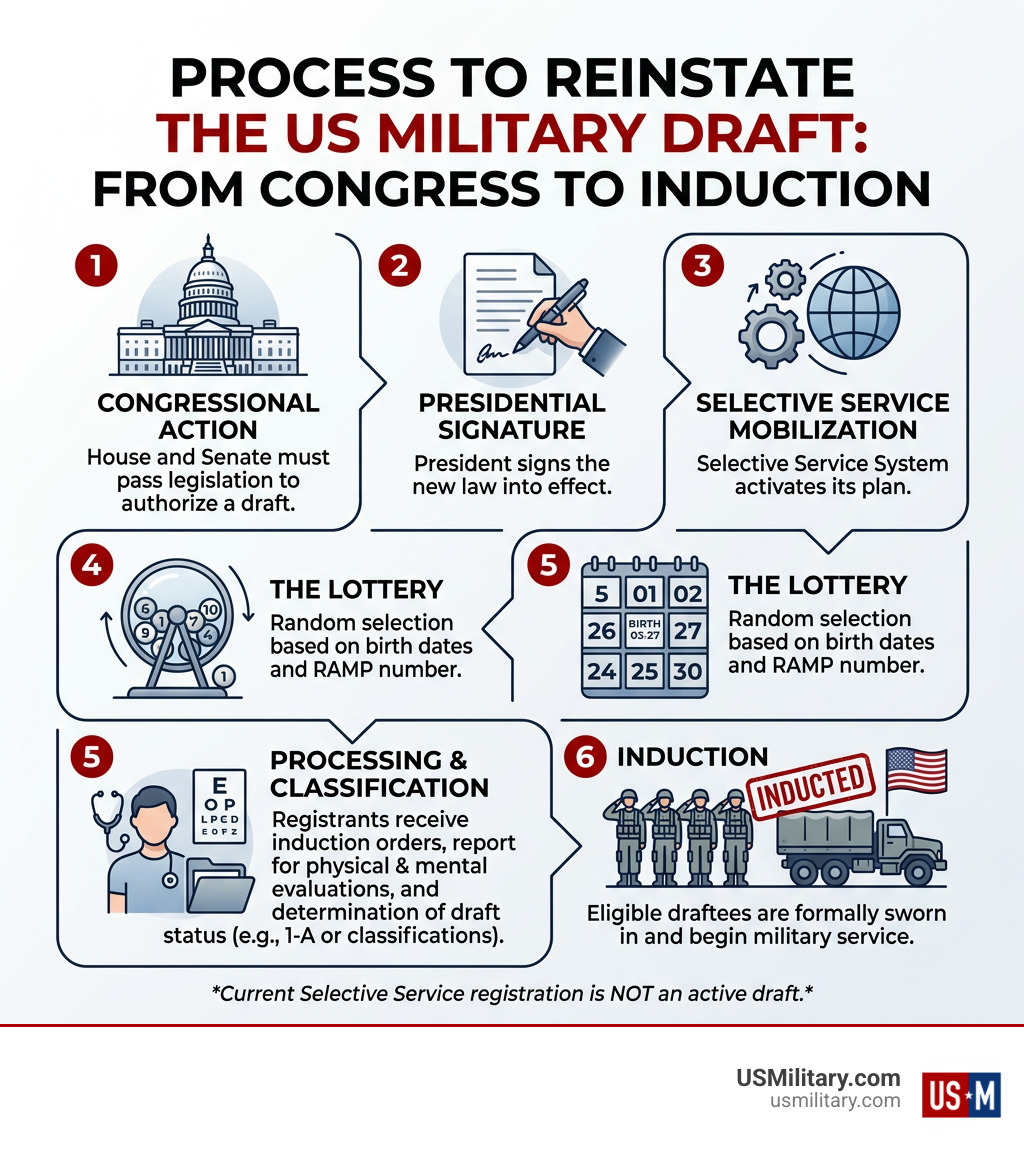
Even if the President wanted to start a draft tomorrow, they couldn't. It requires:
- Congressional Action: Congress must pass legislation to amend the Military Selective Service Act.
- Presidential Signature: The President must sign that legislation into law.
- The Lottery: Only then would the Selective Service activate its "Sequence of Events" to begin a lottery.
Reinstating the draft is widely considered "politically toxic." No politician wants to be the one to vote for sending unwilling citizens into combat, especially when the current volunteer force is so effective.
Eligibility and the Mechanics of a Modern Draft Lottery
If the unthinkable happened and a draft were reinstated, it wouldn't be a free-for-all. There is a very specific, regulated order in which people would be called.
The Age-Based Priority
The draft uses a "yearly age group" system. Interestingly, the youngest people aren't always the first to go.
- Priority 1: Men who turn 20 during the calendar year of the lottery.
- Priority 2: Men aged 21, then 22, 23, 24, and 25.
- Priority 3: Men aged 19.
- Priority 4: Men aged 18 (once they reach their 18th birthday).
The logic here is that 20-year-olds are considered at the peak of physical fitness and are old enough to have finished high school. Once you turn 26, you are generally "over the age of liability," though historical precedents (like during WWI) saw the age limit extended as high as 45. We discuss these nuances in our article on the draft age debate.
How the Lottery Works
The lottery would be a high-profile, televised event. Two large air-mix drums would be used:
- The first drum contains 365 capsules, each representing a day of the year (birthdays).
- The second drum contains numbers 1 through 365 (sequence numbers).
If "August 4" is drawn along with the number "1," then every 20-year-old born on August 4 would be the very first to receive an induction notice.
Exemptions and Deferments
Being "drafted" doesn't mean you are immediately sent to a trench. After receiving a notice, you would report to a Military Entrance Processing Station (MEPS) for physical and mental evaluations. During this time, you can apply for:
- Conscientious Objector Status: For those whose religious or moral beliefs forbid them from participating in war. They may be assigned to non-combat roles or alternative service.
- Hardship Deferments: If your service would cause extreme emotional or financial hardship for your dependents.
- Student Deferments: Usually, college students can finish the current semester (or the year if they are seniors).
- Medical Exemptions: For those with disqualifying physical or mental health conditions.
There is also ongoing debate about women and the draft, as women are currently not required to register but are eligible for all combat roles.
Historical Precedents and Modern Challenges to Reinstatement
The U.S. has a long and complicated history with the draft. It was used in the Civil War (where it sparked riots), World War I, World War II, and the Korean War. However, it was the Vietnam War that changed everything.
The Vietnam Legacy
The draft during Vietnam was deeply unpopular and led to widespread social unrest. By the time the last man was drafted in December 1972 (Dwight Elliott Stone, a plumber from Sacramento, was the final inductee in June 1973), the nation had seen enough. The shift to an all-volunteer force in 1973 was a response to the belief that a professional, willing military is more effective and less socially divisive than a conscripted one.
Modern Challenges: Misinformation and Tech
Today, the biggest challenge isn't just military—it's informational. In 2020, fake screenshots of "Trump tweets" claiming the draft was starting went viral. These were hoaxes, but they caused real panic.
Furthermore, modern warfare is less about "boots on the ground" and more about "brains on the keyboard." The military is currently facing recruitment shortfalls, but these are often in specialized areas like cybersecurity and tech. A general draft of 18-year-olds doesn't necessarily solve the need for a highly skilled coder or a drone pilot. Some officials have mused about a "national service mandate" to address these gaps, but such ideas rarely gain political traction. You can compare our situation to other nations by reading about whether North Korea is bringing back the draft.
Frequently Asked Questions about the US Draft
What Does A War With Iran Mean For A US Military Draft age limit?
The current legal age limit for the draft is 26. Under the Military Selective Service Act, men must register between the ages of 18 and 25. Once you hit your 26th birthday, you are no longer liable for the draft under current law. While Congress could theoretically vote to extend this age (as they did in WWI), it is highly unlikely in a modern context. For a deeper dive into these limits, see our guide on draft age liability.
Could women be drafted in a future conflict with Iran?
As of right now, no. Current law only requires "male persons" to register with the Selective Service. While there have been several legislative attempts to change this—most notably in 2016 and again in 2021—the law remains unchanged. However, since women are now eligible for all combat roles in the U.S. military, the Supreme Court or Congress may eventually revisit this to ensure gender equality in national service. Read more about the future of women in the draft.
What Does A War With Iran Mean For A US Military Draft registration?
War or no war, registration is a legal requirement. If you are a male between 18 and 25, you are mandated to register within 30 days of your 18th birthday. This requirement is not an indicator that a war is coming; it is simply a matter of administrative compliance. Most men register via the Selective Service website or automatically through their local DMV.
Conclusion
At the end of the day, the answer to What Does A War With Iran Mean For A US Military Draft is rooted in the strength of our current volunteer force. The U.S. military is designed to be ready for conflict without needing to resort to conscription. While the Selective Service remains a necessary database for national security, the likelihood of a draft being activated for a conflict with Iran is astronomically low.
Staying informed is the best way to combat the anxiety and misinformation that often follows geopolitical tensions. At USMilitary.com, we are dedicated to providing the most accurate, up-to-date resources for military members, veterans, and their families. Whether you are looking for info on VA disability, military loans, or just want to understand your civic duties, we are here to help.
Learn more about the US Military Draft and stay prepared by exploring our comprehensive guides on benefits and service.