
Total Compensation: Military vs Civilian Careers Breakdown

Evaluating military vs civilian careers begins with understanding the difference between simple base pay and Regular Military Compensation (RMC). In the civilian sector, your gross annual salary is the starting number from which taxes, health insurance premiums, and retirement contributions are deducted. In the armed forces, your base pay represents only a fraction of what you actually take home.
| Compensation Element | Military Service | Private Civilian Sector | Federal Civilian (GS) |
|---|---|---|---|
| Base Income | Base pay set by rank and years of service (taxable) | Negotiated gross salary (fully taxable) | General Schedule grade and step scale |
| Housing & Food Allowances | BAH and BAS provided tax-free | None (paid out of post-tax salary) | Locality pay adjustments (taxable) |
| Health Care | TRICARE Prime ($0 premiums, minimal co-pays) | Employer-sponsored ($1,500–$2,000/mo avg premium costs) | FEHB (government pays ~70% of premium) |
| Paid Leave | 30 days paid annual leave | 10 to 15 days standard entry-to-mid | 13 to 26 days based on tenure |
| Retirement Structure | Pension at 20 years + BRS TSP match | 401(k) match (typically 3% to 6%) | FERS Pension + TSP 5% match |
| Early-Career Earning Edge | 44% to 87% higher than civilian peers | Lower starting wages for non-degreed | Entry-level GS-5 to GS-7 bands |
For enlisted service members, RMC is roughly 44% higher than the compensation of civilian peers holding two-year associate degrees, and up to 87% higher than civilian workers with only high school diplomas. In fact, early-career military personnel typically outperform 70% to 90% of similarly educated civilians in overall financial value. When reviewing the highest-paying careers in the US military, these compensation disparities become even more pronounced in technical and leadership specialties.
The 1.3 to 1.5 Multiplier Rule
Because the Basic Allowance for Housing (BAH) and Basic Allowance for Subsistence (BAS) are completely exempt from federal, state, and FICA taxes, service members keep significantly more spendable income per dollar earned. A standard military compensation package carries a conversion multiplier of 1.3 to 1.5 times base pay.
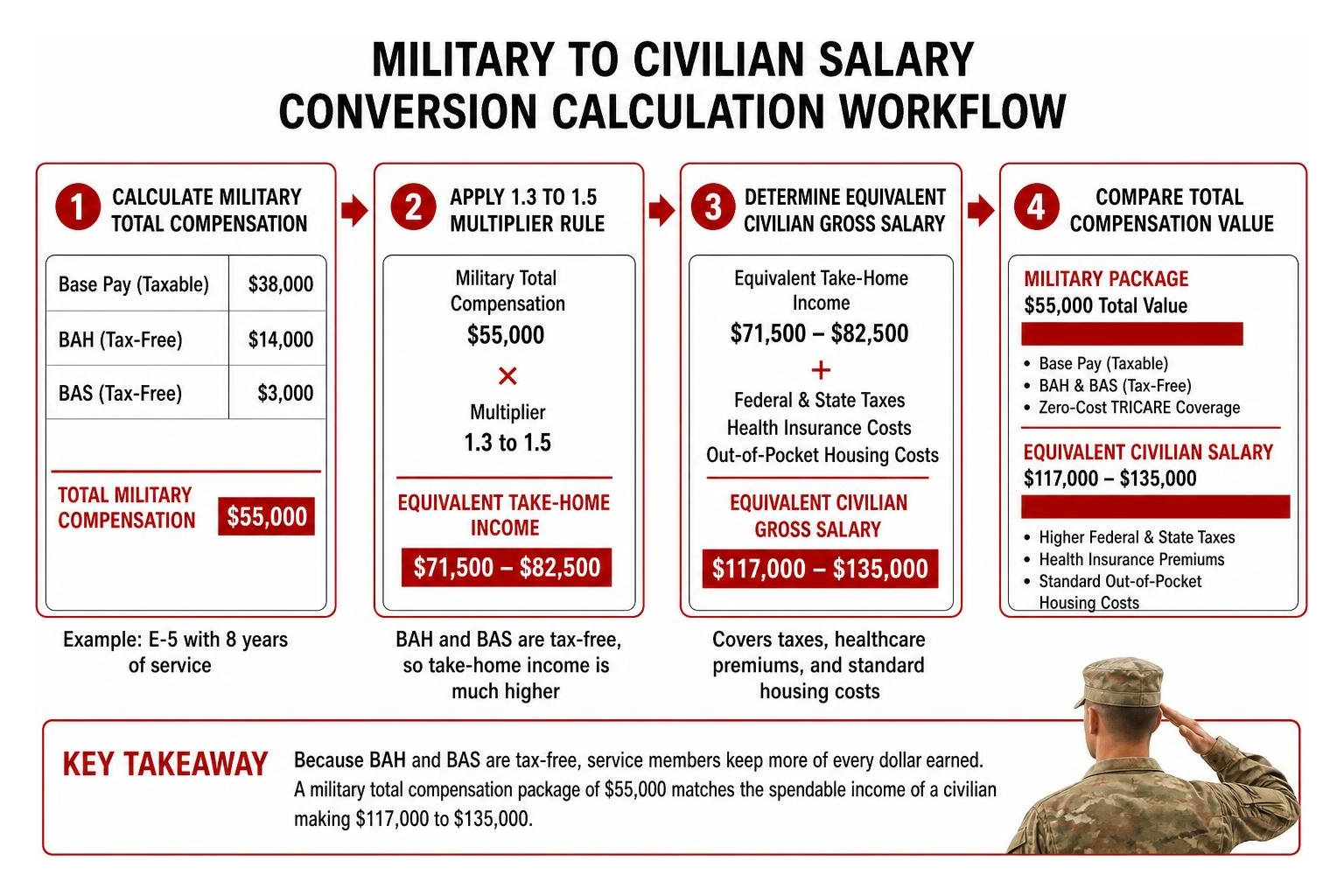
To put this math to work, consider an E-5 with eight years of service earning $38,000 in base pay, $14,000 in BAH, and $3,000 in BAS. While their gross income looks like $55,000 on paper, their actual take-home spendable income matches a civilian making between $71,500 and $82,500. When calculating your exit requirements, a military total compensation package valued at $90,000 typically demands a civilian gross salary of $117,000 to $135,000 to sustain the exact same standard of living. You can examine detailed financial models on military vs. civilian pay to confirm your individual numbers.
Healthcare, Leave, and Lifetime Retirement Value
Beyond take-home pay, the benefits portfolio creates substantial financial distance. Active-duty personnel receive comprehensive health coverage through TRICARE Prime with zero monthly premiums, zero deductibles, and negligible prescription costs. Across a standard 20-year career, this healthcare advantage alone represents between $200,000 and $300,000 in direct cash savings compared to civilian corporate healthcare plans. Exploring the core benefits of joining the military reveals how quickly these foundational perks compound.
Time off represents another stark difference: uniformed members receive 30 days of paid leave annually from day one, while private-sector jobs average only 10 to 15 days for entry and mid-level roles.
Retirement outcomes diverge even more dramatically:
- Military Pension (High-36 or BRS): Completing 20 years yields an immediate lifetime pension starting in your late 30s or early 40s, adjusted annually for inflation through Cost-of-Living Adjustments (COLA). The cumulative lifetime value of a military retirement package frequently sits between $1.5 million and $2.5 million.
- Civilian 401(k) Plans: Corporate workers rely predominantly on defined-contribution 401(k) plans with standard 3% to 5% employer matches. The median retirement accumulation for long-term civilian professionals ranges from $300,000 to $600,000, with distributions restricted until age 59½.
Job Security, Culture, and Day-to-Day Life Differences
The structural divide between uniform service and the private market extends beyond your bank account into workplace stability, organizational culture, and daily tempo. Understanding the macro workforce environment requires reviewing official military and civilian personnel data to see how responsibilities differ across occupational groups.
Job Security and Stability: Military vs Civilian Careers
Uniformed service delivers contractual job security. Unless serious misconduct occurs or force-shaping measures take effect, your paycheck, housing allowance, and benefits remain guaranteed throughout the duration of your enlistment or active-duty commitment. Recessions, market downturns, and corporate mergers do not cause surprise layoffs for active service members.
Civilian employment offers no equivalent safety net. Corporate reorganizations, budget cuts, and economic contractions can lead to sudden terminations regardless of past performance. However, private employment grants you the freedom to resign, renegotiate your salary, or change employers at will if market opportunities improve or work conditions deteriorate.
Work-Life Balance and Geographic Mobility
Military service demands significant personal sacrifice, including:
- Uncapped Workdays: Mission requirements, field training exercises, and 24-hour duty watches carry no overtime pay.
- Deployments and Separations: Extended operational rotations away from family and support networks.
- Mandatory Relocation: Permanent Change of Station (PCS) moves every two to four years, which can disrupt a spouse's career progression and family routines.
Civilian careers, by contrast, offer greater personal autonomy. Workers can establish permanent roots in a single community, negotiate flexible schedules, pursue hybrid or fully remote arrangements, and leave toxic managers without legal repercussions.
High-Growth Civilian Career Paths for Veterans

Transitioning out of uniform opens access to expanding industries that actively reward military operational maturity, technical training, and leadership. Every year, roughly 200,000 veterans enter the private sector, where specialized industries compete heavily for their skill sets.
Data from the Bureau of Labor Statistics highlighting fast-growing veteran career options shows rapid demand in sectors where military experience provides a direct operational baseline. Reviewing 10 high-paying civilian jobs with military training can help identify which industry credentials match your specialty.
Skill Alignment: Military vs Civilian Careers Transition Pathways
Military training builds strong foundations for technical, managerial, and operational roles across the commercial economy:
- Information Security Analysts: Projected to grow 33% from 2023 to 2033 with a median annual wage of $120,360. Military cyber operations, signals intelligence, and communications specialists with active security clearances frequently step directly into senior corporate analyst positions.
- Data Scientists: The fastest-growing math-related occupation for veterans, expanding by 36% through 2033 with a median salary of $108,020. Service members skilled in software development, targeting systems, and operations research match these roles well.
- Nurse Practitioners & Healthcare Managers: Nurse practitioner roles are expanding by 46% (median wage $126,260), while medical and health services management is growing by 29% (median wage $110,680). Combat medics, corpsmen, and military healthcare administrators can transition smoothly into these healthcare career tracks.
- Supply Chain and Operations Logistics: Military logistic specialists who managed complex distribution networks under difficult conditions are sought after by corporate freight, manufacturing, and aerospace operations.
Connecting with dedicated companies that hire veterans ensures your applications reach hiring managers who value military leadership.
Federal and Department of Defense Civilian Positions
For veterans who want civilian autonomy while staying connected to public service, federal employment offers an attractive middle ground.
Exploring the portal for Army civilian job opportunities and researching positions through Army civilian careers gives transitioning personnel access to direct-hire authorities and veterans' preference points across the General Schedule (GS) framework.
Navigating the Transition: Resumes, Fit, and Pitfalls
Leaving uniform requires shifting your perspective. A common mistake during transition is assuming your military specialty limits your civilian career options. Civilian hiring managers focus on your core abilities—risk management, personnel leadership, clear communication under pressure, and process execution—rather than your exact military branch or specialty code.
Utilizing specialized roadmaps like the soldier's GPS to career success can help organize your search and keep your transition timeline on track.
Translating Tactical Experience into Corporate Value
Civilian recruiters often do not understand military acronyms. If your resume mentions NCOERs, billets, line items, or field exercises, commercial human resources software will likely pass over it.
To translate your record effectively:
- Map Your Specialty Code: Use the O*NET Military Occupational Classification (MOC) crosswalk to pair your military specialty with Standard Occupational Classification (SOC) titles.
- Quantify Leadership and Resources: Instead of writing "Served as Platoon Sergeant for 42 soldiers," write: "Directed, trained, and managed a 42-person operations team while maintaining accountability for $12M in specialized equipment with zero losses."
- Focus on Business Outcomes: Frame your daily duties around process efficiency, safety compliance, project delivery, and cross-functional team coordination.
Self-Assessment Framework Before Leaving Service
Before applying for civilian roles, ask yourself these core questions:
- Work Environment: Do you prefer clear, established chains of command (such as public safety or corporate manufacturing), or flexible, project-driven work environments (like tech startups or consulting)?
- Work Style: Do you want hands-on field operations, analytical desk work, or a hybrid schedule?
- Financial Baseline: What gross civilian salary do you need to earn after applying the 1.3x to 1.5x multiplier to match your military spendable income?
- Career Goals: Do you want to continue supporting national defense as a federal employee or defense contractor, or make a complete pivot into the private commercial sector?
Frequently Asked Questions About Military and Civilian Careers
How much civilian salary do I need to match my military pay?
Because military housing (BAH) and subsistence (BAS) allowances are not subject to federal, state, or Social Security taxes, you need a civilian salary roughly 1.3 to 1.5 times your military gross pay to maintain identical take-home earnings. For example, if your base pay and allowances total $80,000, you will likely need a civilian offer between $104,000 and $120,000, depending on local tax rates and your employer's health insurance premium costs.
Can veterans buy back military time for federal civilian retirement?
Yes. Under the Federal Employees Retirement System (FERS), military veterans can make a service credit payment—commonly referred to as a "military buyback"—to credit their active-duty honorable service toward a federal civil service pension. This program lets you combine your military time with your federal civilian service, increasing your final pension annuity without giving up your VA disability compensation benefits.
What is the biggest challenge veterans face when entering the civilian workforce?
The most common transition challenge is adjusting to corporate communication and organizational culture. Military units operate with clear chains of command, defined operational objectives, and explicit feedback systems. Civilian corporate environments often feature looser hierarchies, decentralized decision-making, and indirect feedback styles. Translating military accomplishments into business terminology and building a professional civilian network are essential steps for bridging this gap.
Conclusion
Choosing between continuing your military career or stepping into the civilian market is an important personal and professional milestone. Military service delivers reliable job security, comprehensive health coverage, rapid early-career compensation growth, and the opportunity to earn a lifetime retirement pension after 20 years.
On the other hand, the civilian sector offers greater geographic freedom, personal control over your daily routine, and higher earning potential in fast-growing fields like cybersecurity, healthcare, operations logistics, and data analytics.
At USMilitary.com, our goal is to help you evaluate your career options with clear, objective data on pay structures, healthcare coverage, and retirement benefits. Whether you choose to reenlist, accept a promotion, or transition into the corporate sector, you can learn how your experience applies to new roles through our guide on how military jobs transfer to civilian careers.