Why Everyday Civilian Jobs Can Challenge a Navy SEAL

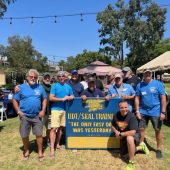
I'm Larry Fowler, a Navy veteran and BUD/S Class 89 graduate. In 10 Common Everyday Civilian Jobs That No Navy SEAL Could Ever Do, I'll use that background to look at the gaps between SEAL training and each role.
From my experience and what I've seen with teammates, Navy SEALs are trained to eliminate threats, embrace risks, and solve life-threatening tactical problems instantly. They also eliminate anything that gets in the way of their mission. In the corporate sector, aggressive assertiveness can be perceived as confrontational or hostile.
Must-know 10 Common Everyday Civilian Jobs That No Navy SEAL Could Ever Do terms:
To be clear, SEALs know the operational parameters and trust their teammates to execute their roles flawlessly. In fact, to perfection. The standard pipeline detailed in U.S. Navy SEAL Careers instills an aggressive bias toward action, rapid problem-solving, and complete mission commitment.
When transitioning to the corporate world, this high-velocity mindset often runs headfirst into ambiguity, workplace politics, and slow decision-making.
| Operational Factor | Special Warfare Environment | Standard Civilian Workplace |
|---|---|---|
| Mission Objective | Clear, measurable, life-or-death priority | Broad, shifting, profit- or service-driven |
| Chain of Command | Direct, structured, absolute accountability | Matrixed, lateral, open to office politics |
| Pace of Action | Immediate tactical execution | Deliberate, committee-based, bureaucratic |
| Conflict Resolution | Candid, direct, mission-focused debriefs | Diplomatic, human-resources-guided de-escalation |
| Workplace Monotony | Intense bursts of high-stakes physical action | Repetitive, low-adrenaline, sedentary tasks |

10 Common Everyday Civilian Jobs That No Navy SEAL Could Ever Do
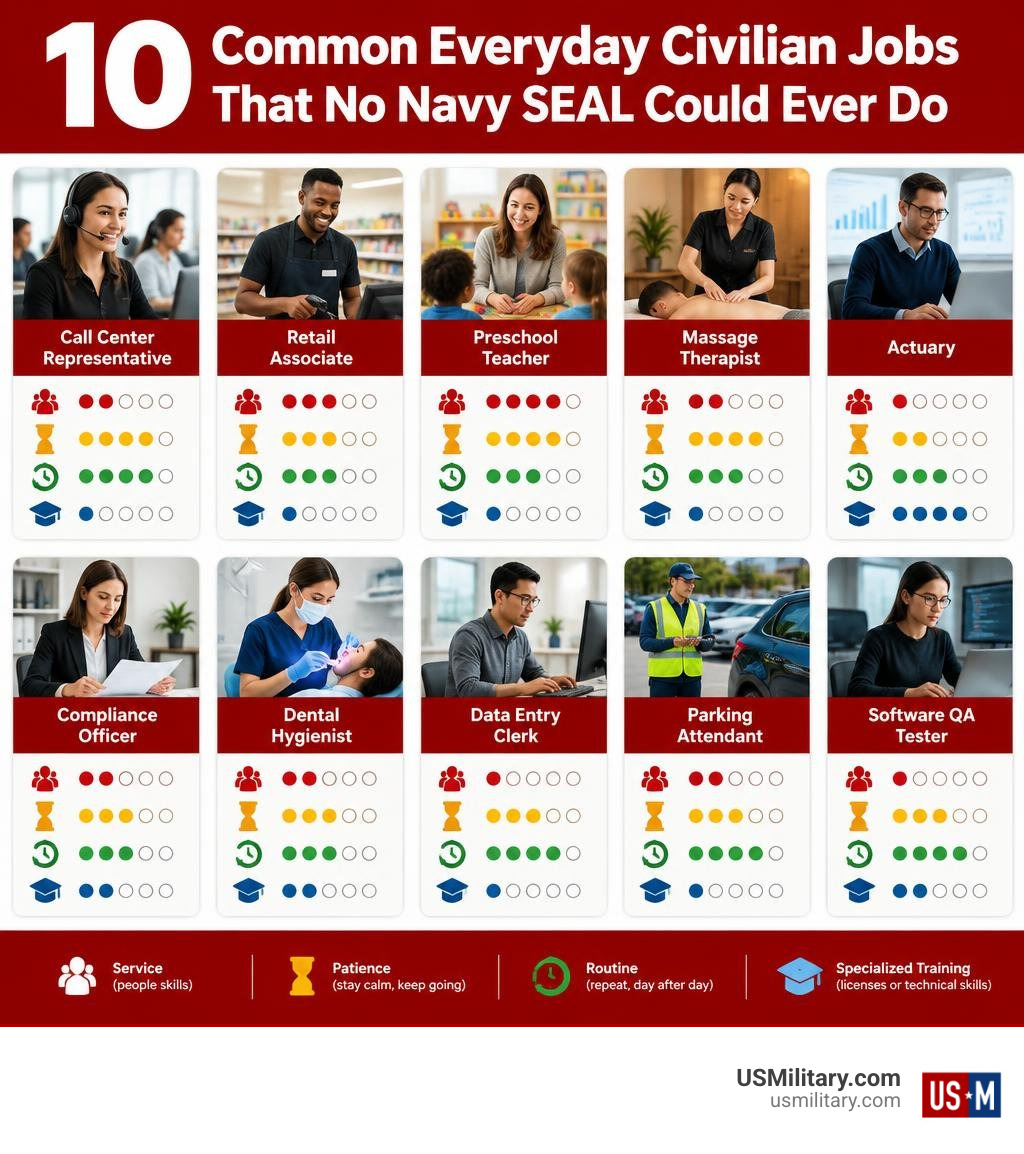
While special operators have elite physical conditioning and grit, many everyday jobs require tolerance for sitting and the patience of a customer service representative answering duplicate questions dozens of times per day or simple tasks like selling shoes. Without a miracle, here are ten careers that pose major hurdles for an action-oriented elite SEAL operator.
Customer Service and Emotional Labor: 10 Common Everyday Civilian Jobs That No Navy SEAL Could Ever Do
- Call Center Representative: Forget the cold-water chills of Hell Week; this role requires sitting in a comfortable, warm cubicle for eight hours while absorbing verbal complaints from angry callers over minor billing discrepancies. For someone trained to solve high-stakes crises, enduring low-stakes complaints while strictly adhering to a rigid customer service script is a fast track to cognitive exhaustion.
- Retail Sales Associate / Cashier: Handling routine transactions and dealing with unreasonable store visitors requires constant smiling and emotional restraint. When you have faced extreme maritime environments, having someone yell at you over an expired coupon tests a completely different type of discipline.
- Preschool Teacher: A far cry from screaming and demanding BUD/S instructors (or Coronado gods), managing a room of twenty toddlers requires boundless patience, gentle tones, and constant emotional soothing. While SEALs are exceptional team leaders, tactical leadership does not translate easily to managing finger-painting chaos and naptime negotiations.
- Massage Therapist: Providing quiet, therapeutic touch in a dimly lit, serene environment requires a delicate touch and steady physical gentleness over long appointments. It stands in stark contrast to combat conditioning and explosive physical mechanics.
- Actuary: Calculating statistical probabilities of risk and mortality requires years of specialized mathematical study and passing grueling professional actuarial exams. Tactical risk assessment in combat is intuitive and dynamic; actuarial science is purely mathematical and sedentary.
- Corporate Compliance Officer: Navigating federal regulations, internal audits, and endless policy updates demands a high tolerance for bureaucratic red tape. A direct-action mindset struggles when every solution requires weeks of paperwork and multi-layered legal reviews.
- Dental Hygienist: This position requires years of clinical schooling to master fine motor control while scraping plaque in tiny, confined oral spaces. It offers a solid median wage, but the day-to-day work is solitary, hyper-detailed, and physically confined.
- Data Entry Clerk: Typing numbers into spreadsheets for eight hours a day with no physical movement or strategic input clashes fundamentally with an operator’s need for purposeful, team-driven action.
- Parking Lot Attendant: Standing in a booth or waving cars into spaces for entire shifts requires enduring low-stakes monotony with minimal mental stimulation or physical purpose.
- Software QA Tester: Finding subtle bugs in software code by clicking the same button hundreds of times in different sequences requires immense digital patience and specialized software development knowledge.
The Psychological Hurdle: Transitioning from High-Stakes Teams to Solitary Desks
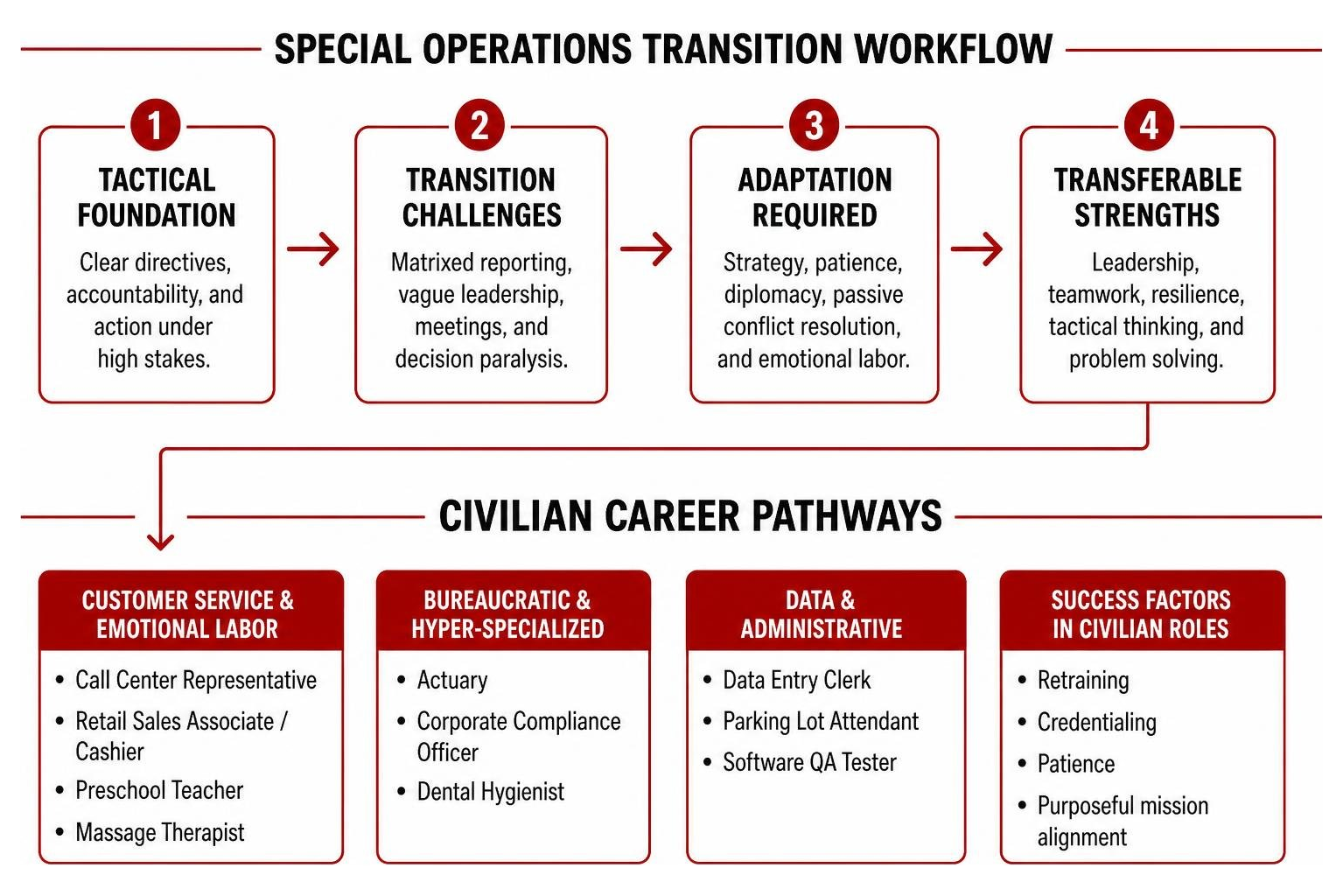
Transitioning out of active duty is rarely about physical capability; it is about psychological adaptation. In elite military units, service members experience intense brotherhood, shared hardship, and a profound sense of purpose. Former operators like David Goggins—who completed BUD/S three times, set world records for pull-ups, and ran over 100 miles on broken bones—demonstrate the superhuman capacity of the special operations mindset. All to say, SEALs are trained for high-energy, often risky, and highly challenging missions. Anything less can put a SEAL to sleep.
I dare say, moving from that intense fraternity to a quiet, solitary desk job can lead to severe adrenaline withdrawal and a feeling of purposeless routine. At USMilitary.com, we see how veterans must intentionally channel their drive into civilian fields that match their leadership strengths, tactical acumen, and need for clear missions.
Frequently Asked Questions About Navy SEALs and Civilian Careers
Why do Navy SEALs struggle with customer service roles?
Navy SEALs are trained to communicate directly, efficiently, and brutally honestly to achieve mission goals. Customer service roles demand passive conflict resolution, emotional diplomacy, and adherence to repetitive scripts during low-stakes disputes, which conflicts with direct-action military problem-solving.
What civilian careers naturally fit former Navy SEALs?
Former operators excel in roles that value decisive leadership under pressure, dynamic problem-solving, and team cohesion. Common successful transitions include private security consulting, corporate crisis management, entrepreneurship, emergency management, and tactical defense contracting.
How long does it take an operator to adjust to corporate culture?
Transition timelines vary, but most veterans take between six months and two years to fully adapt to civilian corporate environments. Veteran mentorship programs, targeted career counseling, and translating military logistics skills into business terminology can significantly accelerate success.
Conclusion
Navy SEALs represent the pinnacle of military grit, physical endurance, and tactical execution. Yet the modern civilian workforce relies on a diverse array of specialized technical skills, bureaucratic processes, and customer-facing emotional labor that combat training does not cover. Recognizing these operational differences helps transitioning veterans choose career tracks where their unique strengths shine brightest.
To learn more about special warfare pathways, training standards, and military benefits, read our comprehensive Navy SEAL guide, which covers everything from enlistment requirements to veteran career support.