The History of Navy SEALs Begins With World War II Frogmen
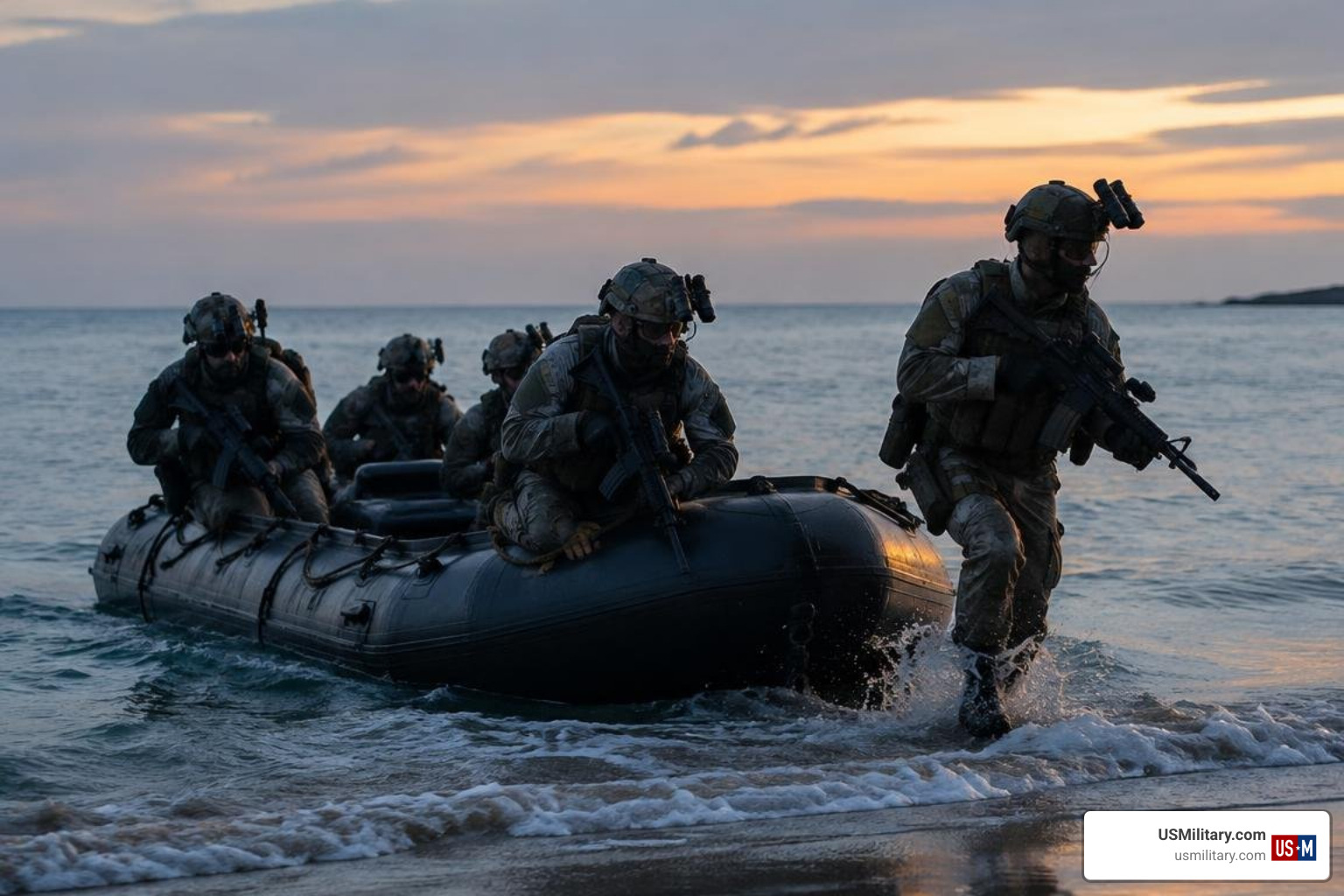
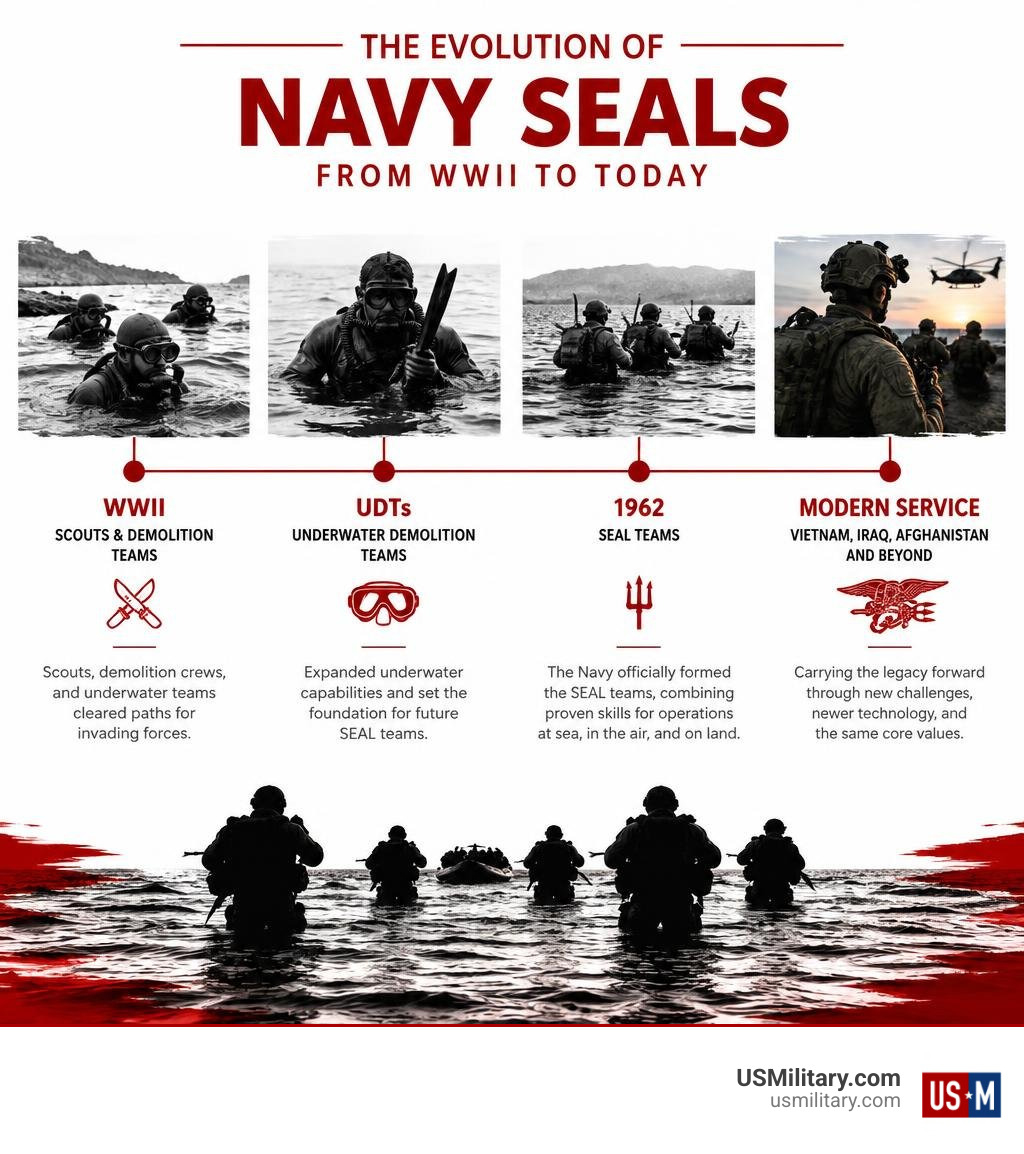
The history of Navy SEALs and the untold sacrifices they made begins with World War II scouts, demolition crews, and underwater teams that cleared paths for invading forces. The Navy formed the SEAL teams in 1962, building on those skills to operate at sea, in the air, and on land. From dangerous training to combat in Vietnam, Iraq, and Afghanistan, that legacy has cost lives and left lasting wounds that are less visible.
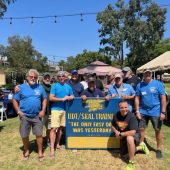
I'm Larry Fowler, a Navy veteran and graduate of BUD/S Class 89. In The History Of Navy SEALs And The Untold Sacrifices They Made, I'll draw on that training and my work publishing military resources to explain the people and costs behind the missions.
The History Of Navy SEALs And The Untold Sacrifices They Made word list:
- Navy SEALs Complete Guide
- Navy SEALs BUD/S Training Requirements
- The Definitive Guide to Navy SEAL Team 4
The History Of Navy SEALs And The Untold Sacrifices They Made: From WWII Frogmen to Modern Warriors
The roots of modern Naval Special Warfare were planted in the fires of World War II. When Allied amphibious assaults faced deadly natural reefs and fortified beach obstacles, the military realized standard infantry could not breach hostile coastlines alone. Specialized maritime demolition units emerged to clear the way under heavy enemy fire, establishing a tradition of extreme sacrifice. As detailed in the historical analysis of Draper Kauffman's Underwater Demolition Team, early combat swimmers operated with minimal equipment, facing devastating casualties to secure Allied landing zones.
Early Amphibious Pioneers: Scouts, Raiders, and NCDUs
Following the attack on Pearl Harbor, the Navy recognized an urgent need for covert beach reconnaissance. In August 1942, the Amphibious Scouts and Raiders were established at Amphibious Training Base Little Creek, Virginia. Pioneers like Phil H. Bucklew—a former professional football player often recognized as the "Father of Naval Special Warfare"—guided assault craft onto hostile shores during Operation Torch in North Africa. How global tensions and How Pearl Harbor helped create the Navy SEALs accelerated specialized maritime doctrine proved critical during Operation Overlord on June 6, 1944. During the Normandy landings, Naval Combat Demolition Units (NCDUs) assaulted Omaha Beach to clear mined obstacles, suffering a 52% casualty rate (31 killed and 60 wounded) on one of the bloodiest days in combat demolition history.
Draper Kauffman and the Birth of Underwater Demolition Teams
Lieutenant Commander Draper L. Kauffman established the Naval Combat Demolition Unit training school at Fort Pierce, Florida, in 1943. Kauffman instituted an intense selection phase known as "Hell Week," enduring every physical trial alongside his men. Following the tragic losses at Tarawa, where hidden coral reefs stranded landing craft, the Navy established formal Underwater Demolition Teams (UDTs). Operating in Pacific island-hopping campaigns—including Saipan, Tinian, and Iwo Jima—these "Naked Warriors" wore only swim trunks, dive masks, and combat knives while securing beachheads under sustained enemy bombardment.
| Unit Type | Founded | Core Missions | Operational Environment | Casualty Risk Factors |
|---|---|---|---|---|
| Scouts and Raiders | 1942 | Covert coastal recon, boat navigation | Littoral surf zones, hostile shorelines | Direct shore fire, surf swamping |
| NCDUs | 1943 | Explosive clearance of beach obstacles | Cold-water landing zones, tidal flats | High-density artillery, crossfire (52% on D-Day) |
| UDTs (Frogmen) | 1943 | Hydrographic survey, coral reef blasting | Tropical open ocean, heavily fortified reefs | Machine gun nests, snipers, marine predators |
| Modern Navy SEALs | 1962 | Sea, air, and land direct action, CT | Global multi-domain, urban, desert, maritime | Heavy enemy contact, IEDs, aviation shootdowns |
The OSS Maritime Unit and Covert Infiltration Tactics
Operating alongside military units, the Office of Strategic Services (OSS) Maritime Unit pioneered covert sea infiltration. This clandestine group included a dentist, an archaeologist, California surfers, Hollywood figures, and European refugees who had survived concentration camps. The OSS Maritime Unit developed early closed-circuit breathing apparatuses (which released no telltale surface bubbles), limpet mines, and combat submersibles. Their tactics proved that small, highly trained maritime units could strike strategic targets behind enemy lines, laying the philosophical and technical foundations of modern SEAL capabilities.

Cold War Crucible: The Formal Creation and the Vietnam War
In response to global communist insurgencies, President John F. Kennedy delivered a landmark address to Congress in 1961 calling for expanded unconventional warfare capabilities. On January 1, 1962, the U.S. Navy officially established SEAL Team ONE (Pacific Fleet) and SEAL Team TWO (Atlantic Fleet), drawing personnel directly from the UDTs. The comprehensive evolution of these operators is documented in SEAL History: The Story of Naval Special Warfare, which traces how maritime commandos adapted their training to conquer land and aerial operational environments.
The History of Navy SEALs and the Untold Sacrifices They Made in the Mekong Delta
In the dense waterways of the Mekong Delta and the treacherous mangrove swamps of the Rung Sat Special Zone, SEALs operated in small squads to disrupt enemy supply lines. The Viet Cong called them "the men with green faces" due to their distinctive camouflage paint and stealthy ambushes. As noted in historical accounts of America's Guerilla Warriors: U.S. Navy SEALs in Vietnam, operators lived in harsh conditions, enduring jungle pathogens, venomous wildlife, and severe ambushes.
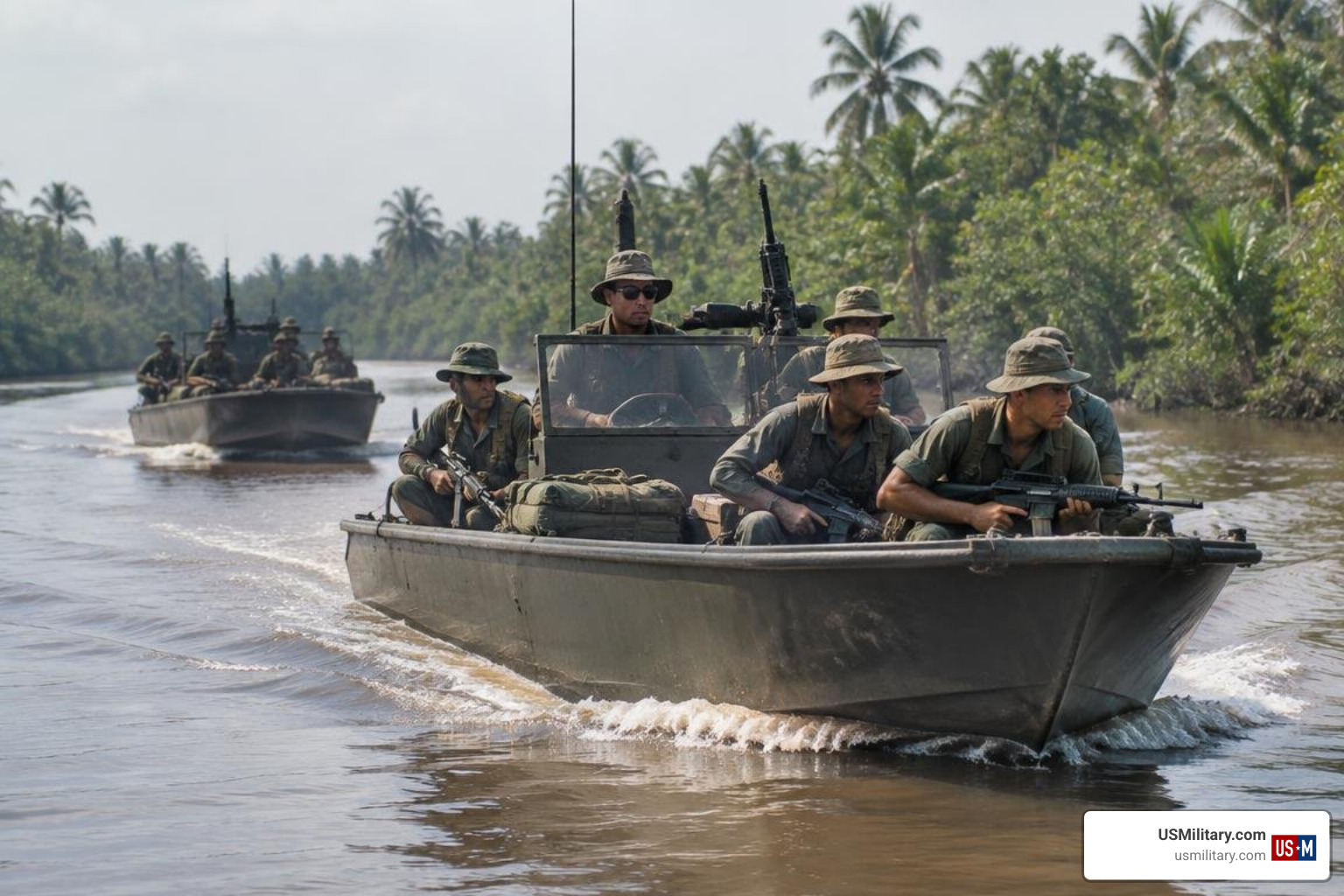
By the end of the conflict, 48 SEALs had been killed in action. For readers seeking deeper analysis, our comprehensive guide to the US Navy SEALs outlines the strategic doctrine developed during these riverine deployments.
Post-Vietnam Reorganization and the Rise of DEVGRU
Following the disastrous 1980 Operation Eagle Claw rescue mission in Iran, the Department of Defense recognized the need for a dedicated maritime counter-terrorism unit. Commander Richard Marcinko formed SEAL Team Six (later renamed the Naval Special Warfare Development Group, or DEVGRU). The 1980s saw SEALs taking part in high-risk direct actions during Operation Urgent Fury in Grenada and Operation Just Cause in Panama, testing specialized insertion techniques under heavy fire and reinforcing the need for continuous joint interoperability.
Global War on Terror: High-Stakes Direct Action and Extreme Human Cost
The attacks of September 11, 2001, placed Naval Special Warfare at the forefront of sustained ground combat in Iraq and Afghanistan. Operating under Joint Special Operations Command (JSOC), SEALs completed relentless combat rotations. National reporting in Navy SEALs: America’s Top Soldiers Take Down Bin Laden highlighted how small commando units shouldered major strategic responsibilities throughout the Global War on Terror. The broader historical lineage of these frontline operators is detailed in our overview of 15 historic Navy SEAL heroes.
The History of Navy SEALs and the Untold Sacrifices They Made in Afghanistan and Iraq
In the Hindu Kush mountains on June 28, 2005, Operation Red Wings resulted in the deaths of three team members—Lieutenant Michael P. Murphy, Danny Dietz, and Matthew Axelson—along with 16 special operators on a downed MH-47 rescue helicopter. Lieutenant Murphy was posthumously awarded the Medal of Honor for exposing himself to enemy fire to transmit an emergency distress call.
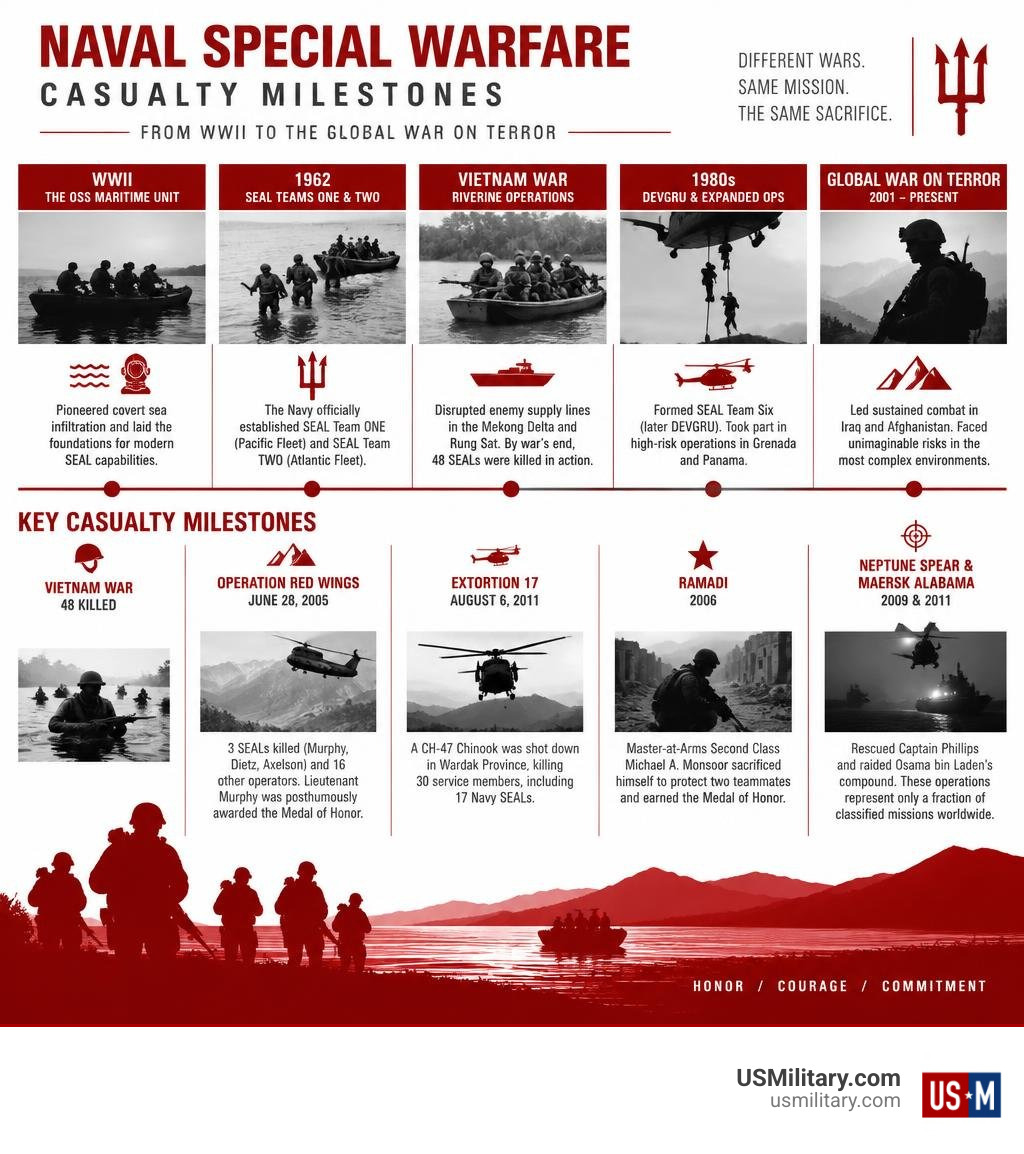
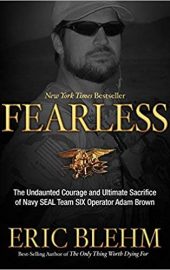
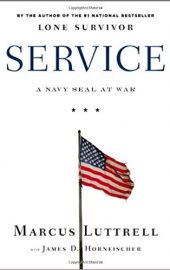
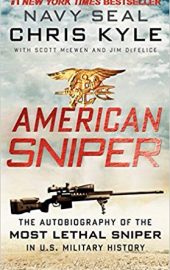
On August 6, 2011, tragedy struck again when a CH-47 Chinook helicopter (callsign Extortion 17) was shot down in Wardak Province, killing 30 American service members, including 17 Navy SEALs. In the urban battlespace of Ramadi in 2006, Master-at-Arms Second Class Michael A. Monsoor threw himself onto an enemy grenade to shield two teammates, sacrificing his life and earning the Medal of Honor. Combat veterans have documented these fierce engagements in detail; readers can explore these accounts in our curated list of 15 essential Navy SEAL books.
Clandestine Raids: Neptune Spear and the Maersk Alabama Rescue
In April 2009, SEAL Team Six snipers perched on the fantail of the USS Bainbridge eliminated three Somali pirates simultaneously in heavy seas to rescue hostage Captain Richard Phillips. In May 2011, DEVGRU executed Operation Neptune Spear, infiltrating Pakistani airspace via modified stealth helicopters to raid the compound of Osama bin Laden in Abbottabad. While these operations earned widespread acclaim, they represent only a fraction of the classified, high-consequence missions conducted worldwide.
The Human Cost: BUD/S Training Rigor, Mental Trauma, and Modern Challenges
The path to wearing the Special Warfare insignia (the Trident) involves intense physical and psychological vetting. Basic Underwater Demolition/SEAL (BUD/S) training in Coronado, California, has an attrition rate averaging 80%.
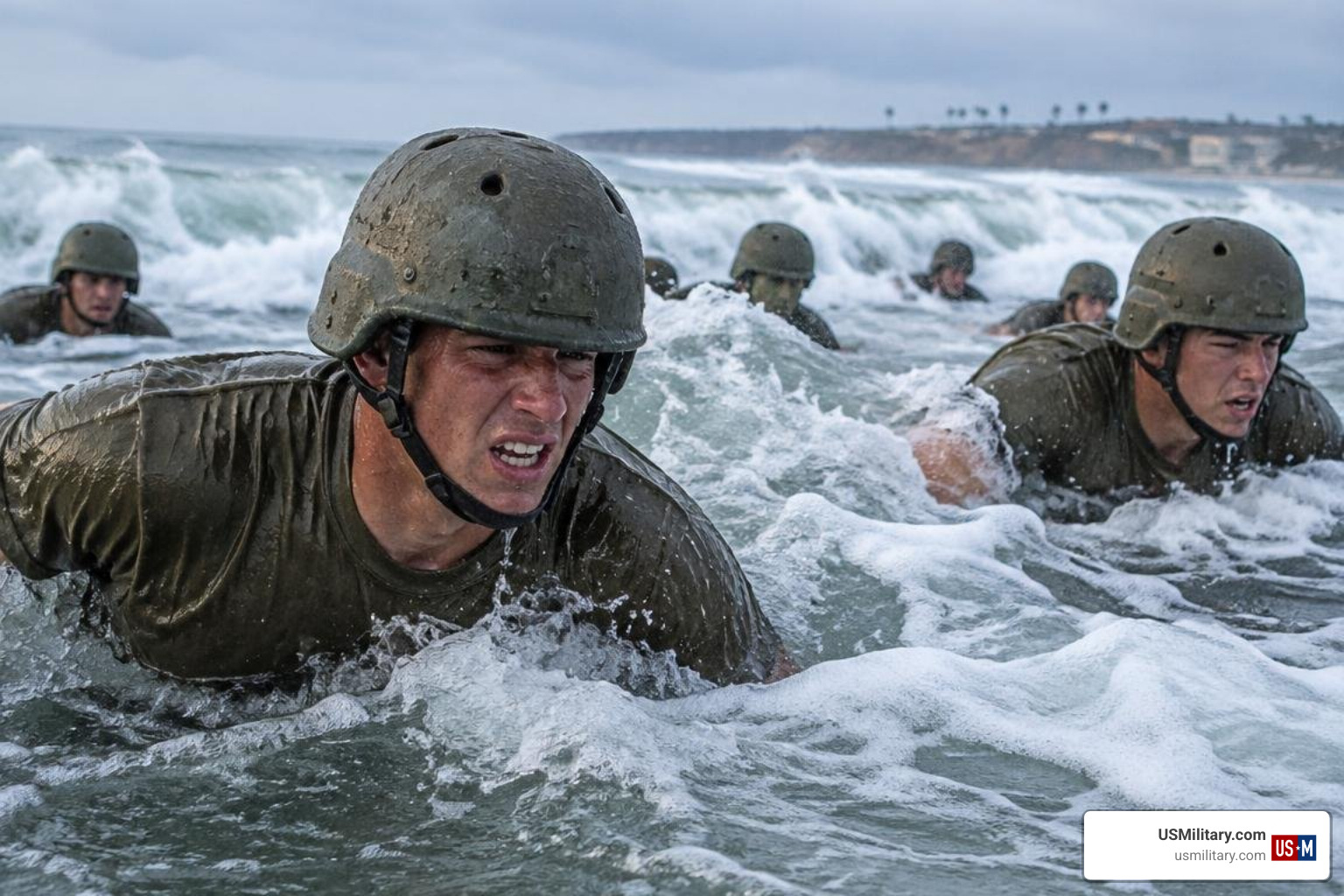
Aspiring candidates must meet rigorous physical standards before selection, as outlined in our review of understanding Navy SEAL BUD/S training requirements.
The Grinding Crucible of Basic Underwater Demolition/SEAL Selection
The selection pipeline tests absolute mental endurance and stress management across three stages:
- First Phase (Physical Conditioning): Seven weeks of continuous boat physical training, long-distance ocean swims, log PT, and "Hell Week"—five and a half days of continuous motion with under four hours of sleep.
- Second Phase (Combat Diving): Focuses on open-circuit and closed-circuit diving, underwater navigation, and drown-proofing.
- Third Phase (Land Warfare): Concentrates on weapons handling, demolitions, small-unit tactics, land navigation, and fast-rope insertions.
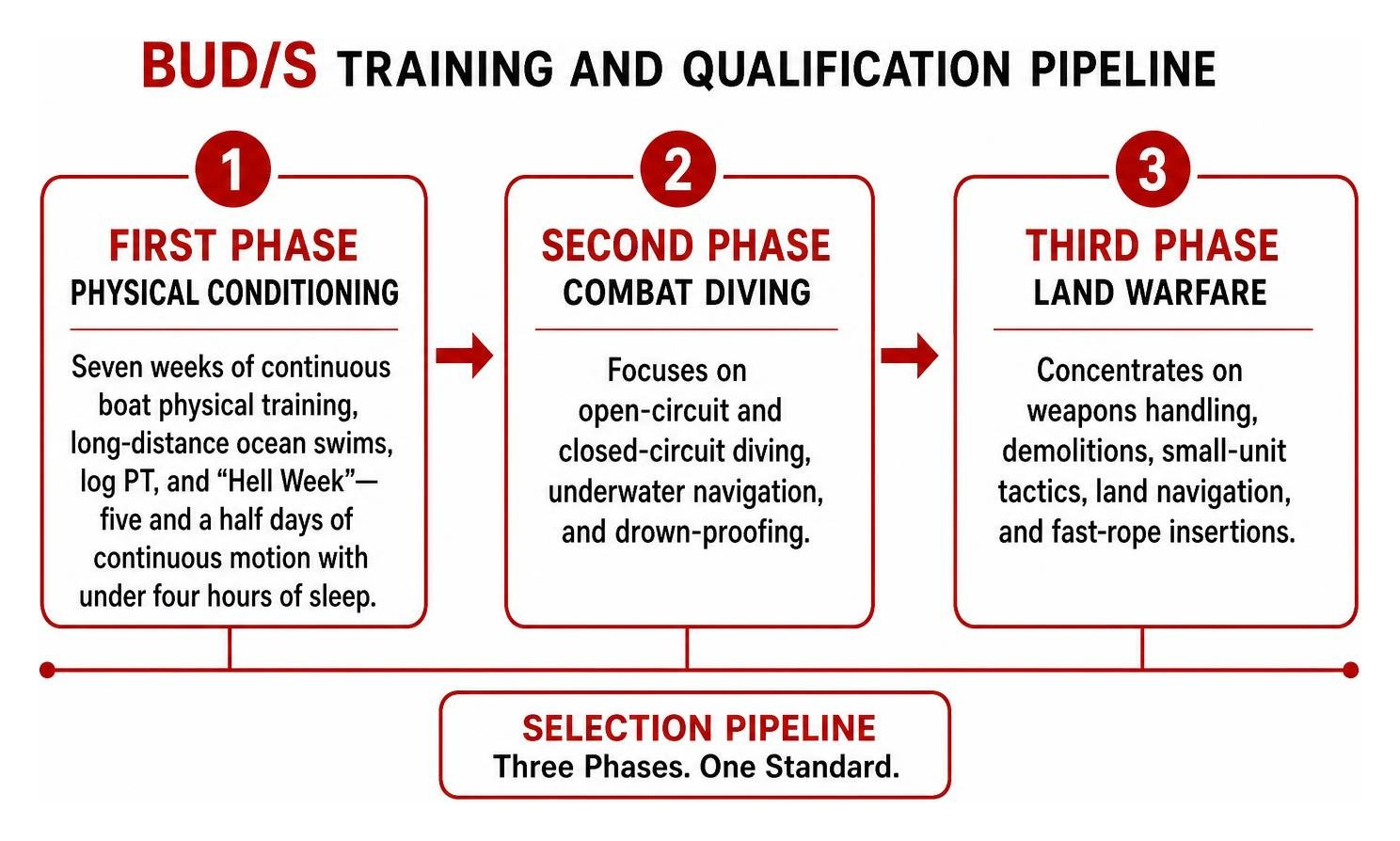
A comprehensive analysis of these phases is available in our breakdown of the 3 training phases.
Mental Health, Misconduct Inquiries, and the Strategic Pivot to Maritime Ops
Decades of continuous combat deployments have created significant physical and psychological burdens. Operators frequently sustain repeated blast exposures, traumatic brain injuries (TBI), and post-traumatic stress. High operational tempos also prompted command leadership reviews regarding operational discipline and professional standards.
As the national defense strategy shifts toward great power competition in the Indo-Pacific, Naval Special Warfare is pivoting from landlocked counter-insurgency back to its maritime roots, prioritizing submarine lock-out operations, underwater sabotage, and littoral reconnaissance. These complex missions require skilled operators compensated under modern military pay structures, such as the enlisted Navy SEAL salary and compensation in 2026.
Preserving the Legacy: Memorials, Traditions, and Honoring the Fallen
The sacrifices of Naval Special Warfare personnel are preserved at the National Navy UDT-SEAL Museum in Fort Pierce, Florida. As highlighted in the Navy Museum in Fort Pierce guide, the museum stands on the historic training grounds where the first combat demolition teams prepared for World War II.
The museum's Memorial Wall honors fallen operators who gave their lives in training and combat. When a SEAL falls in the line of duty, teammates gather at the gravesite to firmly drive their gold Tridents into the wooden casket—a solemn tradition honoring their service. Community initiatives and philanthropic foundations continue to support Gold Star families, as detailed in Honoring the Service and Sacrifice of the Navy SEALs.
Frequently Asked Questions About Navy SEAL History and Sacrifices
How did WWII demolition units lead to the modern Navy SEALs?
Modern SEAL teams trace their operational roots directly to the Amphibious Scouts and Raiders, Naval Combat Demolition Units (NCDUs), and Underwater Demolition Teams (UDTs) formed during World War II. In 1962, President John F. Kennedy officially established SEAL Teams ONE and TWO by drawing experienced combat swimmers directly from existing UDT rosters to create a dedicated sea, air, and land unconventional warfare capability.
What was the single deadliest day in Navy SEAL history?
The single deadliest incident occurred on August 6, 2011, when a CH-47 Chinook helicopter carrying the callsign Extortion 17 was shot down by an insurgent rocket-propelled grenade in Afghanistan's Wardak Province. The crash resulted in the loss of 30 American military personnel, including 17 Navy SEALs.
What key Medals of Honor highlight the sacrifices of Navy SEAL operators?
SEAL operators have received the Medal of Honor across multiple conflicts, including Vietnam veterans Joseph R. Kerrey, Thomas R. Norris, and Michael E. Thornton. During the Global War on Terror, recipients included Lieutenant Michael P. Murphy (posthumous, Afghanistan), Master-at-Arms Second Class Michael A. Monsoor (posthumous, Iraq), Senior Chief Britt Slabinski (Afghanistan), and Master Chief Edward Byers (Afghanistan).
Conclusion
The history of the Navy SEALs is defined by operational innovation, mental resolve, and profound personal sacrifice. From the obstacle-strewn shallows of Normandy to the mountain valleys of the Hindu Kush, these operators have undertaken our nation's most dangerous missions.
At USMilitary.com, we are committed to supporting our active service members, veterans, and military families. Whether navigating VA disability ratings, evaluating military benefits, or learning about our nation's military heritage, we provide the resources you need. To discover more about the training, missions, and culture of Naval Special Warfare, we invite you to explore the complete Navy SEAL guide.