

Are Navy SEALs On The Ground In Iran Today is one of the most pressing questions as the US military conducts active combat operations against Iran under Operation Epic Fury.
Quick answer:
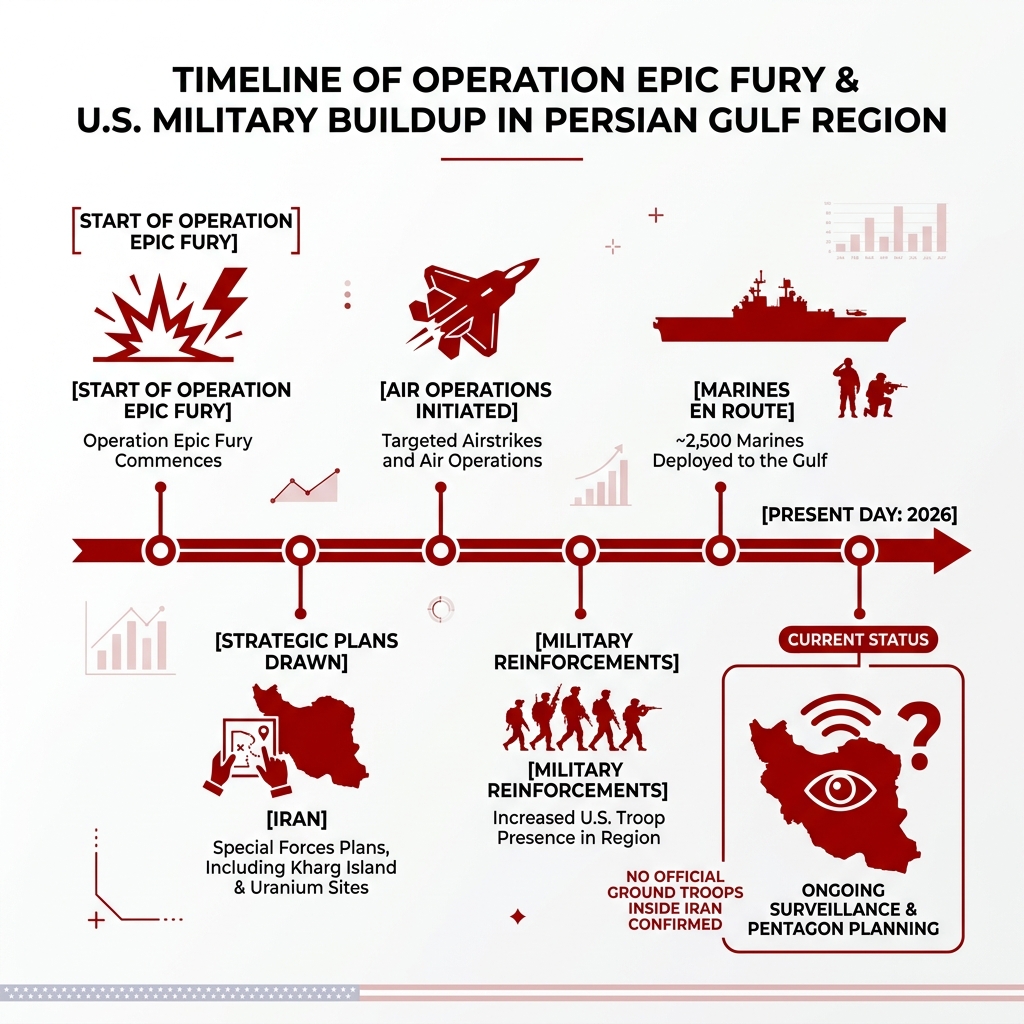
- No official confirmation exists of Navy SEALs or any US ground troops inside Iran
- Defense Secretary Pete Hegseth stated there are no American boots on the ground inside Iran
- However, the Pentagon has drawn up plans for special forces missions, including seizing enriched uranium and potentially Kharg Island
- Military experts say covert SEAL operations are plausible without public knowledge, given the classified nature of Tier One missions
- President Trump has said he would do "whatever is necessary" — stopping short of ruling out ground forces entirely
The situation is fluid. Over 2,500 US Marines are currently en route to the Gulf, and multiple senior officials describe Operation Epic Fury as "just the beginning." That gap between official denials and visible military buildup is exactly why so many people are asking this question right now.
I'm Larry Fowler, publisher of USMilitary.com, and I've spent nearly two decades covering US military operations, special forces capabilities, and veteran affairs — including the evolving question of are Navy SEALs on the ground in Iran today. Let's break down everything the evidence actually shows.
Related content about Are Navy SEALs On The Ground In Iran Today:
- navy seals
- seal team six
- Does Iran Have Sleeper Cells in America
Current US Military Posture: Are Navy SEALs On The Ground In Iran Today?

When we look at the current landscape of the Middle East, the tension is thick enough to cut with a combat knife. Officially, the Pentagon has been very clear: we are not in the business of a ground invasion. Defense Secretary Pete Hegseth has repeatedly pushed back against comparisons to the 2003 Iraq War, stating that this is not about nation-building or "endless war."
However, "no boots on the ground" is a phrase that often comes with a very specific, legalistic asterisk. In military parlance, this usually refers to large-scale conventional forces—infantry divisions and armored brigades. It rarely accounts for the "quiet professionals" who operate in the shadows.
Reports have surfaced that the US considers the idea of special operation to seize Iran’s uranium, suggesting that while a full-scale invasion is off the table, surgical strikes by elite units are very much a part of the planning process. For more context on the broader strategy, you can find more info about US military attack on Iran coming on our platform.
Official US Stance and Deployment Reports
The official word from CENTCOM is that Operation Epic Fury is a coordinated air, maritime, and cyber campaign. The goal is to dismantle Iran's offensive capabilities—specifically their missile launchers, command and control nodes, and manufacturing sites.
To date, over 1,000 targets were struck in the first 24 hours alone. While the Pentagon maintains that naval-special-warfare units are supporting the fleet, they have not confirmed any missions inside Iranian borders. The narrative remains focused on "force protection" and "regional air defense integration." But as any veteran will tell you, the military doesn't always advertise its most sensitive moves until the mission is over—and sometimes not even then.
Could Navy SEALs be on the ground in Iran today without public knowledge?
The short answer? Absolutely. Navy SEALs, particularly those in Tier One units like SEAL Team Six (DEVGRU), specialize in clandestine insertion. Their job is to go where they aren't supposed to be, do what needs to be done, and leave without leaving a footprint.
History is full of examples where special operations were only revealed years later or after a high-profile success (or tragedy). The nature of "plausible deniability" allows the government to maintain diplomatic leverage while still achieving tactical objectives. Given the current houthi-us-war dynamics and Iran's role in regional instability, the need for "eyes on the ground" to verify strike damage or track mobile missile launchers is higher than ever. If there are SEALs in Iran today, they are likely operating in small, 4-to-6 man teams, staying far away from civilian centers.
Operation Epic Fury and Strategic Targets in Iran
Operation Epic Fury isn't just a catchy name; it represents a massive shift in how we engage with the Iranian regime. CENTCOM reports indicate that we have already achieved 70-80% destruction of known Iranian missile systems. This includes the "planetary mixers" used for solid-fuel rockets and various storage sites.
But airpower has its limits. You can't seize a nuclear stockpile from 30,000 feet, and you can't hold a strategic island with a drone. This is where the discussion of ground forces becomes unavoidable. We are seeing reports that British Special Forces are ready to help US ground attacks, with the Special Boat Service (SBS) specifically mentioned for their familiarity with the Gulf's underwater and littoral terrain.
Seizing Kharg Island and Nuclear Infrastructure
Kharg Island is the "golden goose" of the Iranian economy. Located about 16 miles off the coast, it handles roughly 90% of Iran’s oil exports. Capturing it wouldn't just be a military victory; it would be an economic checkmate, as oil revenue accounts for nearly 40% of Iran's national budget.
Then there is the nuclear problem. Intelligence suggests Iran has a stockpile of approximately 450 kg (1,000 pounds) of 60% highly enriched uranium. This material is reportedly hidden deep within sites like Pickaxe Mountain or facilities in Isfahan and Natanz.
| Target | Estimated Force Required | Primary Objective |
|---|---|---|
| Kharg Island | 800 - 1,000 (Battalion size) | Seize oil terminals; Economic leverage |
| Nuclear Sites | 1,000 - 4,000 (Brigade size) | Recover/Secure enriched uranium |
| Coastal Radars | 12 - 24 (SEAL Platoon) | Sabotage; Open air corridors |
What would trigger a decision to put Navy SEALs on the ground in Iran today?
The "red line" for the US has always been the weaponization of nuclear material. If intelligence confirms that Iran is moving its enriched uranium to a location where it can be fitted onto a warhead, the "yips" about boots on the ground will likely vanish.
Another trigger would be the total closure of the Strait of Hormuz. While we have sunk at least 70 Iranian warships, their mine-laying capabilities remain a threat. SEALs and SWCC (Special Warfare Combatant-craft Crewmen) would be essential for clearing these waterways and conducting "visit, board, search, and seizure" (VBSS) operations on suspected rogue vessels. We often get asked how-many-navy-seals-are-there, and while the number is small (around 2,500 active duty), they are the exact force needed for these high-stakes triggers.
Capabilities and Risks of Special Operations Missions
Navy SEALs aren't just "tough guys"; they are precision instruments. In a conflict with Iran, their capabilities go far beyond kicking in doors. They provide "escalation dominance." This means they give the President options other than "do nothing" or "drop a nuclear bomb."
Whether it’s using HK416 rifles to clear a command center or Barrett .50 caliber snipers to disable radar dishes from a mile away, their gear is designed for the specific challenges of the Iranian theater. However, the geography of Iran—specifically the rugged Zagros Mountains—presents a nightmare for logistics and extraction.
High-Risk Insertion and Extraction Challenges
Iran is not a flat desert. It is a fortress of mountains and sophisticated air defenses like the S-300 and the domestic Bavar-373. Inserting a team requires "electronic warfare blankets" provided by EA-18G Growlers to blind Iranian sensors.
The biggest risk is the "Extortion 17" scenario. In 2011, a Chinook carrying SEAL Team 6 members was shot down in Afghanistan, marking the largest single loss of life in the unit's history. In Iran, where the density of MANPADS (Man-Portable Air-Defense Systems) is high, the extraction phase of any mission is the most dangerous. This is why navy-seal-qualifications emphasize not just getting in, but the meticulous planning required to get out. You can read more about the grueling navy-seal-training that prepares them for these exact life-and-death stakes.
Allied Support and Joint Force Integration
We aren't doing this alone. The British SBS is reportedly on standby, and Saudi commandos have been discussed as part of a combined force to take Kharg Island. This joint environment is critical. While SEALs might be the "tip of the spear," they rely on the Marine Expeditionary Units (MEUs) for the "hammer" that follows.
The 31st MEU, currently aboard the USS Tripoli, provides the heavy lifting—tanks, artillery, and the hundreds of Marines needed to hold territory once the SEALs have cleared it. This synergy is why comparing ranger-school-vs-navy-seal-training is so interesting; both are elite, but they serve different roles in the "multi-domain symphony" of modern war.
Frequently Asked Questions about Navy SEALs in Iran
Has the Pentagon confirmed Navy SEALs are in Iran?
No. As of today, there is zero official confirmation of Navy SEALs operating inside Iranian territory. Defense Secretary Pete Hegseth has explicitly denied that "boots on the ground" are currently part of the mission. However, military analysts suggest that clandestine reconnaissance or sabotage missions would likely remain classified and unconfirmed even if they were occurring.
What is the role of SEAL Team 6 in Operation Epic Fury?
While their exact role is classified, SEAL Team 6 (DEVGRU) is typically reserved for the highest-value targets. This includes "decapitation strikes" against regime leadership, sensitive site exploitation (SSE) at nuclear facilities to gather intelligence, or the recovery of American hostages/personnel. They act as the "connective tissue" between high-level intelligence and physical reality on the ground.
How many US Marines are currently in the Gulf region?
There are approximately 2,500 Marines en route or currently positioned in the Gulf as part of Marine Expeditionary Units (MEUs). These forces are stationed aboard amphibious assault ships like the USS Boxer and USS Tripoli, providing the US with a flexible "offshore" option for rapid response, evacuations, or limited ground operations.
Conclusion
The question of Are Navy SEALs On The Ground In Iran Today remains shrouded in the "strategic ambiguity" that defines elite special operations. While the official line is a firm "no," the reality of Operation Epic Fury—with its massive carrier groups, thousands of Marines, and the urgent need to secure nuclear materials—suggests that our most elite warriors are, at the very least, leaning forward in their saddles.
At USMilitary.com, we believe in providing you with the facts and the expert analysis you need to understand the risks our service members face. Whether it’s the impact on global oil markets or the safety of our troops in the Zagros Mountains, the stakes couldn't be higher. For those who want to dive deeper into these elite operators, we encourage you to check out our Navy SEALs: Complete Guide.
Stay informed, stay vigilant, and remember: in special operations, the loudest moves are often the ones you never hear.