Can Faith in Something Greater Than Yourself Help You Graduate BUD/S?
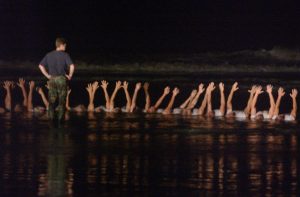
Faith in something greater than yourself can help Navy SEAL trainees endure BUD/S by giving them a reason to keep going when personal ambition isn't enough. That reason may be religious faith, service, or a commitment to teammates. It is a source of purpose, not a proven guarantee of graduation.
A study of 380 BUD/S candidates found that 151 eventually completed training, many after moving to a later class. It tracked changes in resilience and stress markers but didn't test whether faith made candidates more likely to graduate. That distinction matters when trying to understand what helps someone persevere.
I'm Larry Fowler, a Navy veteran and BUD/S Class 89 graduate. I bring that experience to this guide on "Having Faith in Something Greater Than Self-Help Navy SEAL Trainees Graduate BUD/S?" Looking back long after BUD/S and as I've matured in life, I now see God's fingerprint on my success in Coronado. And I'm sure that I'm not alone.
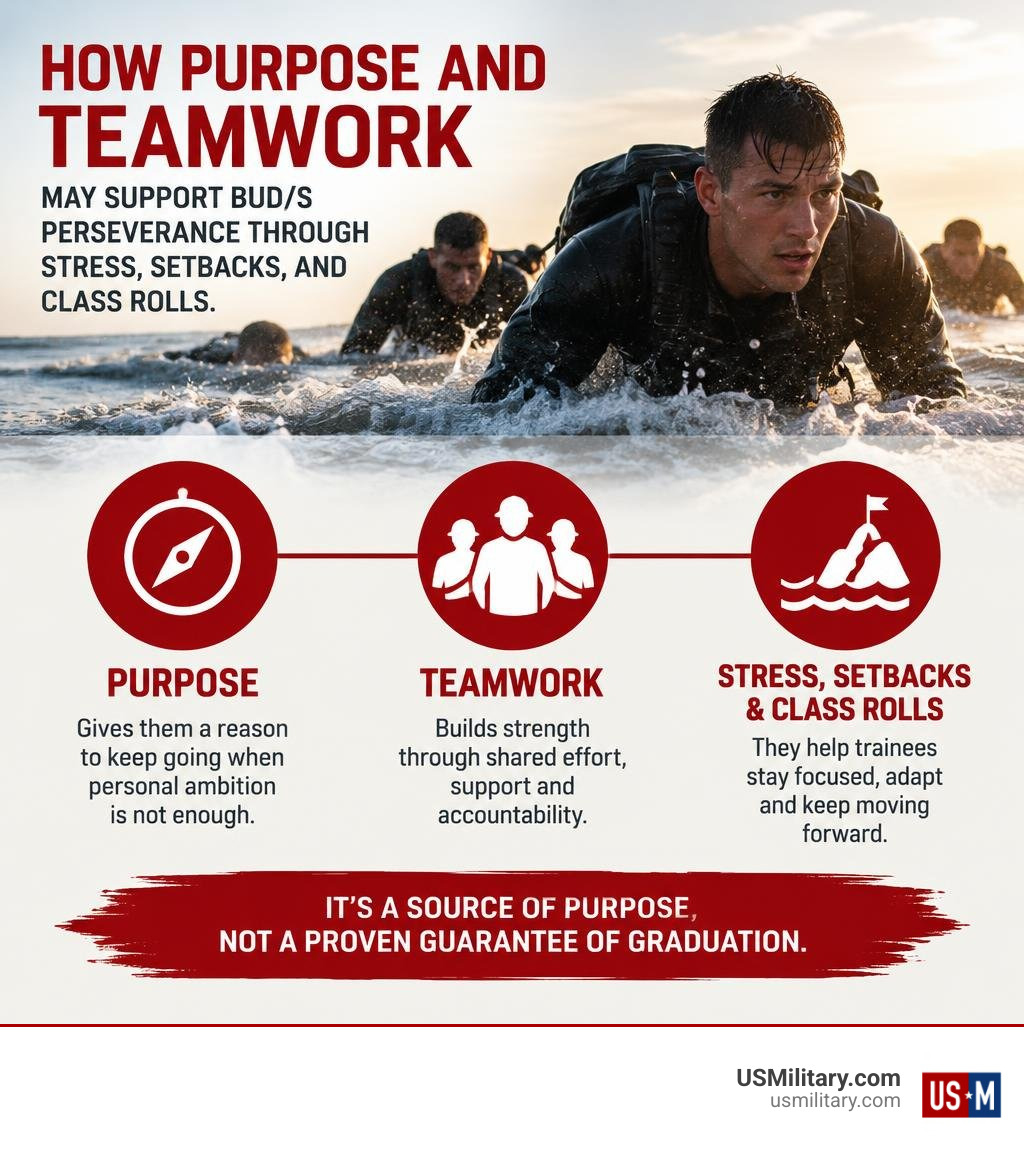
Key terms for Having Faith in Something Greater Than Self-Help Navy SEAL Trainees Graduate BUD/S?:
- What Navy SEAL BUD/S Training Taught Me About Self-Confidence, Courage, & Faith
- Are Christians Become Navy Special Warfare Operators?
- What Navy SEAL BUD/S Training Taught Me About Myself
Does Having Faith in Something Greater Than Self Help Navy SEAL Trainees Graduate BUD/S?
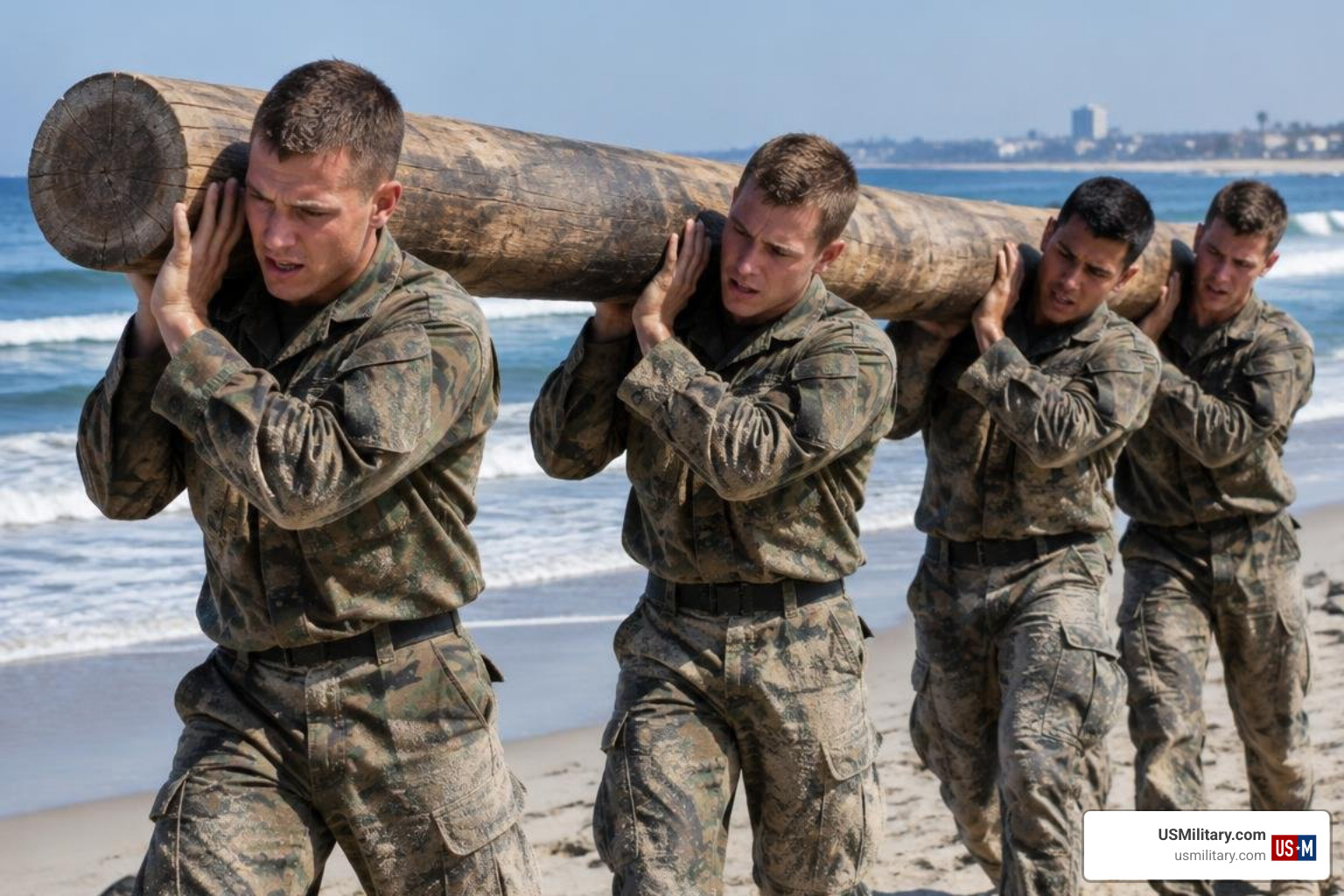
Basic Underwater Demolition/SEAL (BUD/S) selection at Coronado Island is famous for its punishing nature. Historically, between 70% and 85% of first-time candidates drop out. While millions focus on bench presses and sprint intervals when preparing for United States Navy SEAL selection and training, the physical toll eventually strips away raw conditioning. When you are hypothermic, sleep-deprived, and aching in places you did not know existed, self-centered ambition often dissolves.
In an extensive longitudinal analysis tracking 380 candidates (Ledford et al., 2022), 151 ultimately completed the pipeline. However, success was rarely linear:
- 54 candidates (36%) graduated with their original starting class.
- 68 candidates (45%) completed the program after being rolled into a second class.
- 22 candidates (15%) persevered through three classes.
- 6 candidates (4%) endured four separate classes.
- 1 candidate (<1%) required five class attempts before earning the Trident.
The data show that physical dominance alone does not prevent setbacks. Instead, intrinsic drive, spiritual endurance, and an external purpose beyond individual glory sustain trainees through repeated injury and class rolls. When self-preservation begs a student to quit, a transcendent anchor keeps their hands on the log.
Why Having Faith in Something Greater Than Oneself Helps Navy SEAL Trainees Graduate BUD/S Under Extreme Stress
During Hell Week—a 5.5-day ordeal with less than four hours of total sleep—the human mind routinely sends out cognitive quit signals. Trainees often encounter what performance experts call the 40 percent rule: when your brain screams that your tank is empty, your body has tapped into only about 40% of its reserve capacity.
Meeting the rigorous Navy SEAL BUD/S training requirements requires psychological and spiritual strategies that override those panic signals:
- Prayer and Scripture Reflection: Anchoring internal dialogue to timeless verses or meditative stillness provides peace amid the freezing surf.
- Chaplaincy and Spiritual Mentorship: Speaking with Navy chaplains gives candidates an objective, grounded perspective that resets their moral and mental compass.
- Team-Centric Dedication: Reframing personal pain as a necessary sacrifice for boat crew teammates transforms suffering into an act of love.
- Chunking Time via Higher Purpose: Focusing entirely on reaching the next evolution or meal while trusting God with the final outcome.
These coping practices shift focus away from personal misery toward transcendent dedication, turning relentless stress into meaningful endurance.
Psychological Resilience vs. Transcendent Belief: Bridging the Overconfidence Gap
Many candidates arrive in Coronado overestimating their psychological readiness. Empirical testing shows the average SEAL candidate starts BUD/S with a resilience baseline score of 53.7, which immediately drops by 1.78 units when real adversity hits (Ledford et al., 2022). Only as training progresses does resilience rebound, growing by roughly 0.59 units per phase. Similarly, hardiness starts at 34.5 and increases by 0.44 units per phase, while grit remains relatively stable throughout training (a non-significant slope of 0.12) (Ledford et al., 2022).
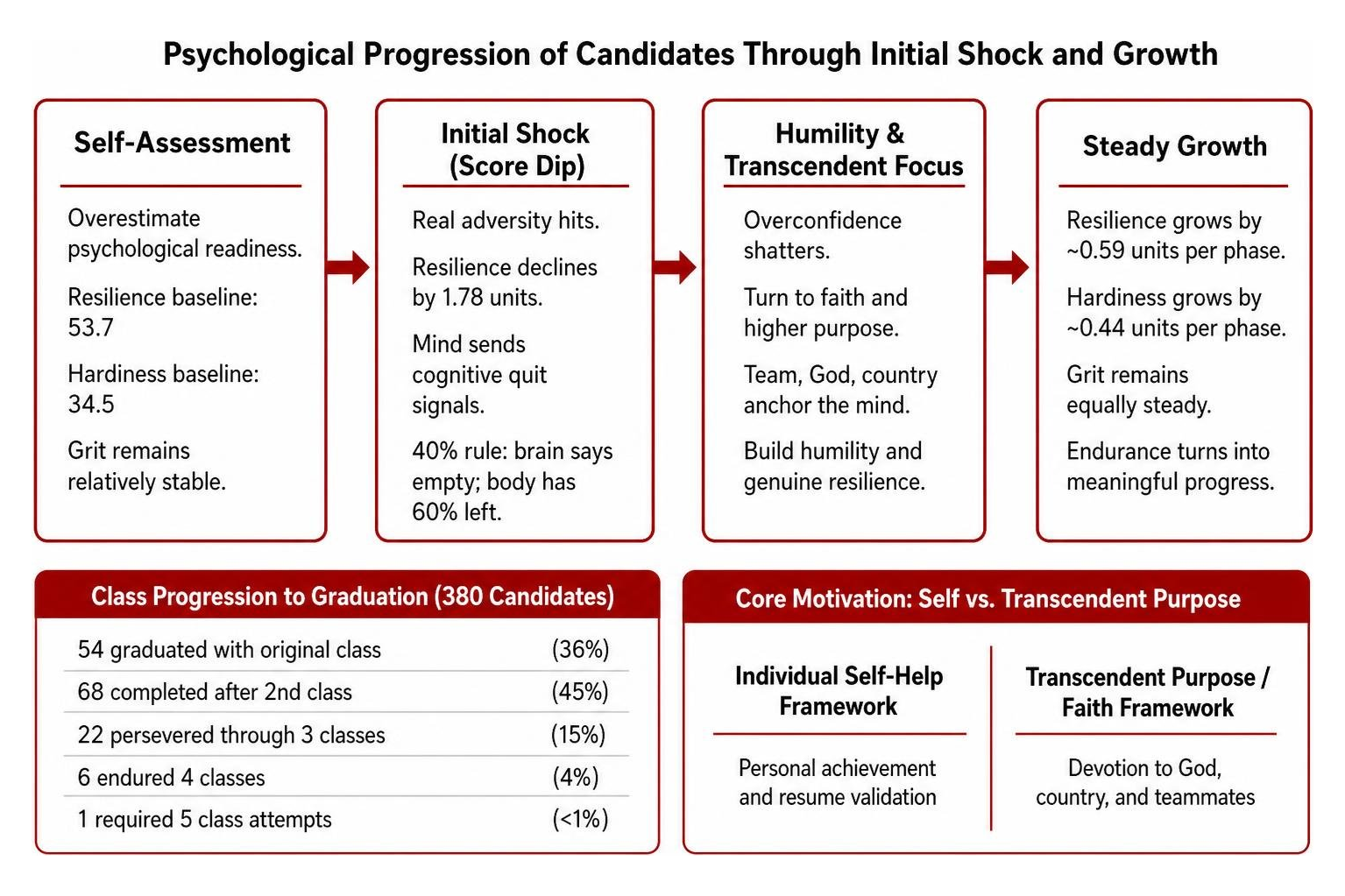
When candidates discover their initial overconfidence, pure self-reliance shatters. Transcendent belief fills this gap by cultivating genuine humility and drawing on proven strategies to build mental toughness.
| Psychological Dimension | Individual Self-Help Framework | Transcendent Purpose / Faith Framework |
|---|---|---|
| Core Motivation | Personal achievement and resume validation | Devotion to God, country, and teammates |
| Response to Failure | Ego crisis and self-doubt | Humble acceptance and rededication |
| Endurance Source | Willpower and stubbornness | Unwavering trust in a sovereign calling |
| Perspective on Team | Competitors for class ranking | Brothers to protect and serve |
Physiological Adaptations: How Faith and Mission Buffer Neuroendocrine Stress Responses
The extreme environment of BUD/S triggers measurable neuroendocrine changes. Research shows that successful candidates experience significant increases in dehydroepiandrosterone (DHEA) across training (coefficient = 2.32, p < .05), along with a rising DHEA-to-cortisol ratio (coefficient = 0.40, p < .001) (Ledford et al., 2022).
DHEA acts as an anabolic neurosteroid that shields the central nervous system against the catabolic, damaging effects of sustained cortisol. When trainees adopt a "stress-is-growth" mindset fueled by purpose, their physiology adapts more favorably to chronic fatigue, allowing them to remain clear-headed during complex underwater evolutions.
How Having Faith in Something Greater Than Self Helps Navy SEAL Trainees Graduate BUD/S Through Brotherhood and Teamwork
Instructors (or as I call them, the 'Coronado gods') frequently evaluate how students behave when cold, wet, and miserable. Those who focus solely on personal survival often fail peer reviews or quit. Conversely, the most dependable students frequently embody the "Gray Man" archetype: humble operators who consistently meet standards without seeking the spotlight, pouring their energy into their boat crew. Meaning, they focus on others, which is important for those of Christian faith.
As candidates progress through the three training phases, shared suffering reinforces the core tenet of the SEAL Ethos: putting the mission and your team ahead of yourself. This servant-hearted dynamic proves that having faith in something greater than oneself helps Navy SEAL trainees graduate BUD/S far more reliably than self-centered ego ever could.
The Enduring Impact of Transcendent Purpose for SEAL Operators and Veterans
The spiritual anchors forged during selection continue to support operators long after leaving active duty. Whether transitioning into civilian leadership, starting families, or answering a new calling, faith provides stability.
Understanding why faith matters in military service equips warfighters with the moral resilience to process intense operational experiences and prevent deep-seated moral injury.
Developing Transcendent Faith and Purpose Beyond Military Selection
You do not have to be freezing in the Pacific surf to build vertical development across physical, mental, emotional, and spiritual domains. Practical habits can cultivate this mindset anywhere:
- Practice Intentional Stillness: Utilize daily box breathing and prayer to manage sympathetic nervous system arousal.
- Embrace Uncomfortable Service: Regularly volunteer for demanding tasks that support others without expecting recognition.
- Establish Daily Disciplines: Build small habits of excellence, starting with making your bed every morning to reinforce integrity.
At NavySeal.com and USMilitary.com, we provide comprehensive guidance across all branches, helping service members and veterans access VA benefits, career comparisons, and transition resources. To explore Special Warfare pathways further, check out our comprehensive guide to the Navy SEALs and find your deeper purpose today.
Finally, as a BUD/S graduate, faith and focusing on something greater than self gave me more courage and confidence to move forward. In other words, being a strong team guy offers great benefits not just for self, but for your team.

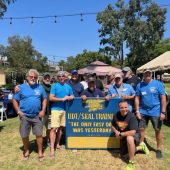
Larry, the amazing and Honor Man Doug Young and awesome Scott Rawding with the BUD/S Class 89 Plaque Still Displayed in BUD/S Compound.
References
Ledford AK, Beckner ME, Conkright WR, Raver C, Dixon DP, Miles P, Martin B, Nindl BC, Lynch SM. "Psychological and physiological changes during basic, underwater, demolition/SEAL training." Physiology & Behavior, 2022. PMCID PMC10284119.