

Aid and Attendance Benefits Not Always Claimed By Navy SEAL Families
Veteran Aid and Attendance is a monthly, tax-free cash payment from the Department of Veterans Affairs that helps wartime veterans and their surviving spouses pay for personal care — whether at home, in assisted living, or in a nursing facility.
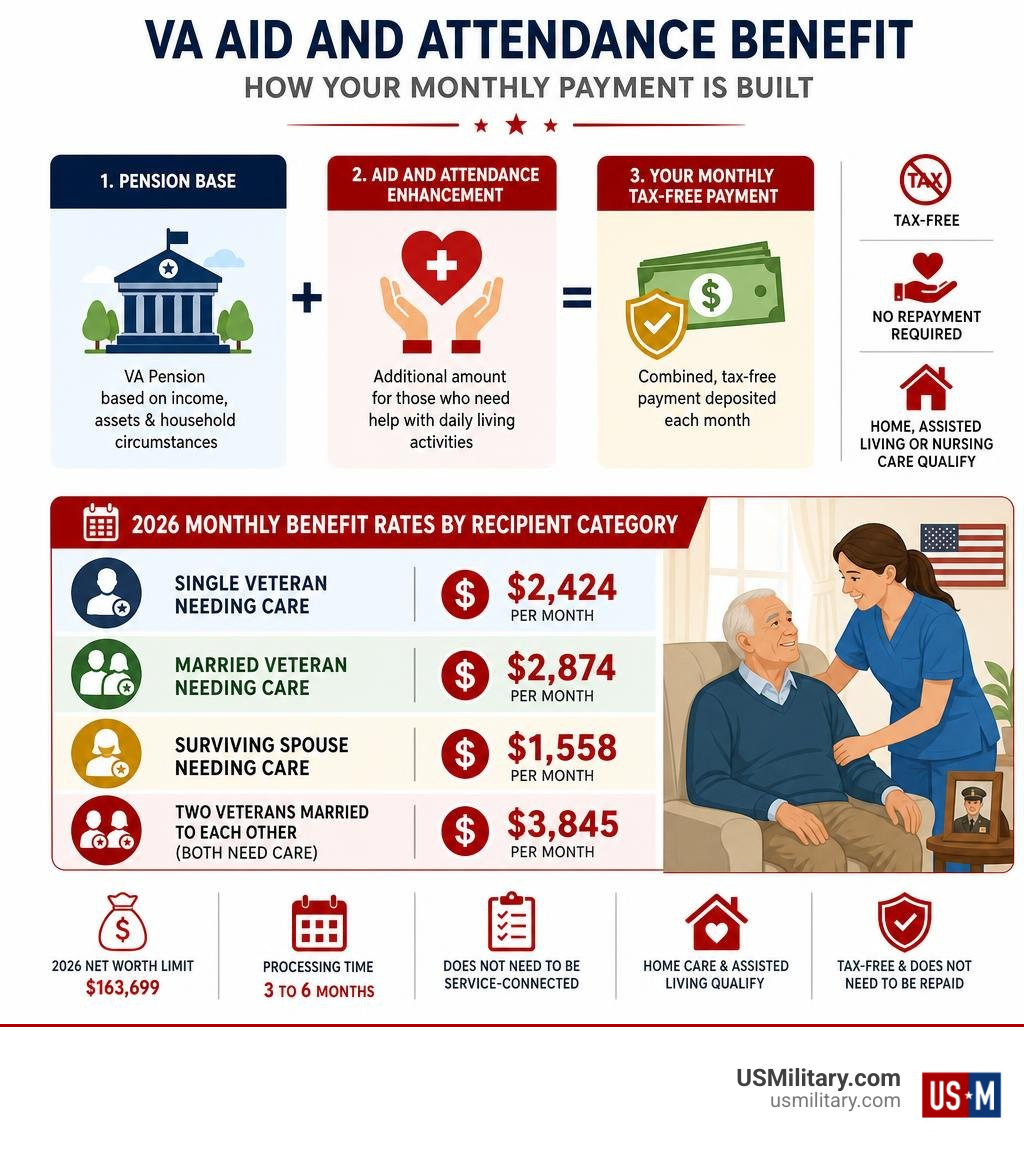
Here's a quick snapshot of what it pays in 2026:
| Who Receives the Benefit | Monthly Payment | Annual Payment |
|---|---|---|
| Single veteran needing care | $2,424 | $29,093 |
| Married veteran needing care | $2,874 | $34,488 |
| Surviving spouse needing care | $1,558 | $18,697 |
| Two veterans married to each other (both need care) | $3,845 | $46,143 |
Key facts at a glance:
- The benefit is tax-free and does not need to be repaid
- It is not limited to nursing homes — home care and assisted living qualify
- The condition does not need to be service-connected
- The 2026 net worth limit to qualify is $163,699
- Processing typically takes 3 to 6 months
Despite these numbers, it remains one of the most underused VA benefits available. Many eligible veterans and surviving spouses simply don't know it exists — and every month they wait is money left on the table.
I'm Larry Fowler, BUD/S class 89 and publisher of NavySeal.com and the USMilitary.com network. In this guide, I'll walk you through exactly who qualifies, how much you can receive, and how to apply without costly mistakes.
Veteran aid and attendance word list:
- VA claims back pay
- 7 Critical Steps You Must Take To Successfully Increase Your VA Disability Rating
- What To Do If The VA Lowers Your VA Disability Rating
Understanding the Veteran Aid and Attendance Benefit
To truly understand Veteran Aid and Attendance, we first have to clear up a very common point of confusion: it is not a standalone benefit. Instead, it is an "enhanced" or "improved" tier of the basic VA pension.
The VA offers three tiers of pension benefits for wartime veterans:
- Basic Pension: Designed for low-income wartime veterans who are either over 65 or permanently and totally disabled.
- Housebound Allowance: An increased pension amount for veterans who are substantially confined to their immediate premises due to a permanent disability.
- Aid and Attendance: The highest tier, designed for those with a documented clinical need for regular personal assistance.
Because it is a pension enhancement, you must first meet the foundational requirements for the basic VA pension. However, you don't need to be receiving a basic pension to apply. You can apply for both the basic pension and the Aid and Attendance enhancement at the exact same time.

The beauty of this benefit is its flexibility. Because the VA pays this benefit as direct cash, it follows the veteran rather than the facility. Whether you live in your own home, stay in an assisted living facility, or reside in a skilled nursing home, you can use this tax-free cash to cover your care. For a deeper dive into how this fits into the broader landscape of veteran support, check out The Ultimate Guide to Veterans Aid and Attendance and review the Official VA Aid and Attendance Benefits page.
Eligibility Requirements for 2026

Qualifying for Veteran Aid and Attendance requires meeting three distinct pillars: military service, clinical medical need, and financial limits. Let's break down each category so you can see exactly where you or your loved one stands.
Wartime Service and Discharge Status
The first gate to pass is your military service record. To qualify for the pension pathway, the veteran must have served on active duty for at least 90 days, with at least one of those days occurring during a congressionally defined wartime period. If the veteran entered active duty after September 7, 1980, they must generally have served at least 24 months (or the full period for which they were called to active duty), with at least one day during a wartime period.
The designated wartime periods include:
- World War II: December 7, 1941, to December 31, 1946
- Korean Conflict: June 27, 1950, to January 31, 1955
- Vietnam Era: November 1, 1955, to May 7, 1975, for veterans who served in the Republic of Vietnam; or August 5, 1964, to May 7, 1975, for those who served anywhere else.
- Gulf War: August 2, 1990, through a date yet to be prescribed by Presidential proclamation or law (which covers all active duty service up to the present day).
Additionally, the veteran’s discharge status must be anything other than dishonorable (such as honorable or general under honorable conditions). Combat service is not required; a veteran who served stateside or in a non-combat zone during these dates still meets the wartime service criteria. You can read more about these service baselines in our VA Aid and Attendance Complete Guide.
Medical and Functional Criteria for Veteran Aid and Attendance
Once wartime service is established, the applicant must demonstrate a clinical necessity for regular assistance. We look at Activities of Daily Living (ADLs) and cognitive safety. To qualify, you must meet at least one of the following conditions:
- ADL Assistance: You require the physical assistance of another person to perform at least two daily activities, such as bathing, dressing, toileting, transferring (getting in and out of bed or a chair), or eating.
- Bedridden Status: Your disability requires that you remain in bed apart from any prescribed course of treatment.
- Nursing Home Residency: You are a patient in a nursing home due to physical or mental incapacity.
- Severe Vision Impairment: Your corrected visual acuity is 5/200 or less in both eyes, or your visual field is contracted to 5 degrees or less.
- Cognitive Decline: You require a protected environment because cognitive impairment (such as Alzheimer's or dementia) makes you unsafe in your daily environment.
The primary document used to prove this need is VA Form 21-2680 (Examination for Housebound Status or Permanent Need for Regular Aid and Attendance), which a licensed physician, physician assistant, or nurse practitioner must complete in detail. If you are applying from a nursing home, you must also submit VA Form 21-0779. For step-by-step instructions on managing these medical requirements, see our VA Aid and Attendance Form Complete Guide.
Financial Limits and the 2026 Net Worth Cap
Because the VA pension is a needs-based program, the VA enforces strict financial limits. For the 2026 benefit year (running from December 1, 2025, to November 30, 2026), the net worth limit is $163,699.
What exactly goes into this net worth calculation? The VA combines your annual countable income with your liquid assets:
- Assets: This includes cash, savings accounts, checking accounts, individual retirement accounts (IRAs), stocks, bonds, and mutual funds.
- Exclusions: Fortunately, the VA does not count your primary residence (including reasonable surrounding land), your primary vehicle, or ordinary personal household items toward your net worth.
If your initial net worth seems to hover near or above this limit, do not lose hope. The VA lets you deduct recurring, unreimbursed medical expenses from your income, which can dramatically lower your countable income and bring you back under the threshold. We keep track of these evolving financial rules on our page covering VA Aid and Attendance 2026 Changes.
2026 Payment Rates and Financial Calculations
How much cash you receive from the VA depends on your Maximum Annual Pension Rate (MAPR) and your calculated "income for VA purposes" (IVAP).
Maximum Annual Pension Rates (MAPR) for 2026
The VA sets a maximum cap on the annual pension payout based on your family structure and care needs. The table below outlines the MAPR limits for the Aid and Attendance tier in 2026:
| Beneficiary Category | 2026 Max Annual Rate (MAPR) | 2026 Max Monthly Payout |
|---|---|---|
| Single Veteran | $29,093 | $2,424 |
| Veteran with One Dependent (Spouse/Child) | $34,488 | $2,874 |
| Surviving Spouse (No Dependents) | $18,697 | $1,558 |
| Two Married Veterans (Both Qualify) | $46,143 | $3,845 |
Your actual monthly payment is calculated by subtracting your annual countable income from your MAPR, then dividing the remainder by 12. If your countable income is reduced to $0, you will receive the absolute maximum monthly payout shown above. For a complete breakdown of these payment brackets, consult the Aid and Attendance Pay Chart 2026.
How Unreimbursed Medical Expenses (UMEs) Reduce Countable Income
Many families look at the income limits and assume they make too much money to qualify. However, the VA calculates your income after deducting your Unreimbursed Medical Expenses (UMEs).
These deductible expenses include:
- Assisted living facility fees (room, board, and care)
- Fees paid to in-home care agencies or private caregivers
- Health insurance premiums (including Medicare)
- Prescription medications and medical supplies
The VA applies a 5% rule to these deductions. Only medical expenses that exceed 5% of your applicable MAPR are deductible. For 2026, the 5% threshold is $872 for a single veteran and $1,141 for a veteran with one dependent.
Let’s look at a quick real-world example:
A married veteran has a gross household income of $45,000 a year from Social Security and a pension. This is well above the $34,488 MAPR limit. However, the veteran lives in an assisted living facility that costs $4,000 a month ($48,000 a year).
After subtracting the 5% threshold ($1,141) from the $48,000 care costs, the veteran has $46,859 in deductible medical expenses. Subtracting this from their $45,000 gross income brings their "income for VA purposes" to -$1,859 (which the VA rounds to $0). Because their countable income is now $0, they qualify for the full married veteran benefit of $2,874 per month.
To keep up with how these medical calculations affect your filing strategy, check out our guide on Everything You Need to Know About Aid and Attendance 2026 Changes.
Key Rules: Asset Transfers, Look-Back Periods, and Other Benefits
Before you start rearranging your finances to meet the net worth limits, you must understand the strict regulatory guardrails the VA has established.
The 3-Year Look-Back Period and Asset Penalties
To prevent applicants from simply giving away their money to family members to qualify for a needs-based pension, the VA enforces a 36-month look-back period (which applies to all asset transfers made after October 18, 2018).
When you submit your application, the VA will review your financial transactions over the previous three years. If they find that you transferred assets for less than fair market value (such as gifting cash to children or moving funds into an irrevocable trust) and those transfers dropped your net worth below the eligibility limit, they will assess a penalty.
The penalty period is calculated by dividing the amount transferred (that exceeded the net worth limit) by the maximum monthly pension rate for a married veteran ($2,874 in 2026). The resulting number is the number of months you will be blocked from receiving benefits, up to a maximum penalty of 5 years. For details on protecting your assets legally, read Aid and Attendance Payouts 2026.
Interaction with VA Disability Compensation and Medicaid
Another common question is whether you can receive both Aid and Attendance and VA disability compensation at the same time. Generally, the answer is no. The VA will not pay you both a pension and disability compensation at the same time; it will pay whichever benefit is higher.
However, an exception applies if your disability is service-connected. If you are rated at 100% disability (or TDIU) and require personal care, you may qualify for Special Monthly Compensation (SMC-L). SMC-L is the disability compensation equivalent of Aid and Attendance, paying significantly higher monthly amounts (approximately $4,901/month for a single veteran in 2026) and with no income or asset limits.
Also, be careful when coordinating with Medicaid. If you are in a nursing home and receive Medicaid, the VA will reduce your pension benefit to a maximum of $90 per month to prevent dual-dipping into government funds.
How to Apply and Avoid Common Denials

Applying for Aid and Attendance requires meticulous documentation. One missing signature or vague medical description can delay your approval by months.
Step-by-Step Application Process for Veteran Aid and Attendance
To get started on your application, follow these sequential steps:
- Gather Service Records: Locate the veteran's DD-214 or discharge papers. If you do not have them, request them immediately from the National Archives.
- Obtain Medical Evidence: Schedule an appointment with your primary care physician to complete VA Form 21-2680. Ensure they write detailed narrative descriptions of your physical or cognitive limitations rather than just checking boxes.
- Compile Financial Records: Gather bank statements, income tax returns, Social Security award letters, and proof of all recurring medical expenses (such as home care contracts or assisted living invoices).
- Complete the Correct Pension Form:
- Veterans must file VA Form 21P-527EZ (Application for Veterans Pension).
- Surviving spouses must file VA Form 21P-534EZ (Application for DIC, Survivors Pension, and/or Accrued Benefits).
- Submit Your Claim: You can submit your completed packet online via the VA’s QuickSubmit portal, mail it to the Pension Management Center in Janesville, Wisconsin, or apply in person at your local regional VA office.
For a detailed walkthrough, see our guide on How to Complete the Aid and Attendance Form in 5 Simple Steps.
Common Reasons for Claim Denials and How to Avoid Them
The VA processes thousands of pension claims monthly, and it quickly sets aside incomplete submissions. Avoid these four common pitfalls to keep your claim moving:
- Vague Medical Documentation: If your doctor simply writes "patient is old and weak" on Form 21-2680, the VA will likely deny the claim. The doctor must explicitly state how your medical conditions prevent you from performing specific ADLs (e.g., "Severe osteoarthritis prevents the claimant from bending or reaching, requiring daily physical assistance to dress and bathe safely").
- Failing to Document the Need for Cognitive Protection: For dementia patients who are physically capable of walking and eating, you must check the box and write details regarding their need for "protection from the hazards of their daily environment."
- Unreported Asset Transfers: Do not attempt to hide asset transfers within the 3-year look-back window. Be transparent, and consult a VA-accredited professional if you have concerns about assets.
- Missing Caregiver Lay Statements: If you are using home care, submit a detailed statement from your caregiver outlining the daily tasks they perform for you.
Learn more about securing a clean, fast approval on our page about How to Get Aid and Attendance Approval Without Delay.
Frequently Asked Questions about Aid and Attendance
Can Aid and Attendance pay a family member as a caregiver?
Yes. Because the VA pays this benefit as a direct cash pension to the beneficiary, you can use those funds to pay a family member (such as an adult child or grandchild) to provide your care. However, document the caregiver arrangement with a formal, written care agreement, and ensure payments reflect fair market value for caregiving services.
Alternatively, veterans can explore the Veteran-Directed Care program, managed through local VA Medical Centers, which provides a flexible budget to hire caregivers, sometimes including spouses.
What is the difference between Aid and Attendance and Housebound benefits?
The core difference lies in the level of care needed. Housebound benefits are designed for veterans who are permanently and substantially confined to their home or immediate premises because of a disability. You do not need to show that you require help with daily activities (ADLs) to qualify for Housebound benefits.
Aid and Attendance, on the other hand, requires a hands-on clinical need for personal assistance with daily tasks, regardless of whether you are physically confined to your home. Because Aid and Attendance care requirements are higher, it pays a much higher monthly rate. You cannot receive both benefits at the same time.
Can you use the benefit for assisted living facilities?
Absolutely. This is one of the most common and effective uses of the benefit. While the basic VA pension doesn't specifically target assisted living, the rooms, board, and care costs of an assisted living facility can count as deductible medical expenses if you receive custodial care there. This deduction often brings your countable income down to $0, allowing you to secure the maximum monthly benefit to offset your monthly facility bill. Read our analysis, Does VA Pay for Assisted Living for Veterans Like Aid and Attendance, for more information.
Conclusion
The Veteran Aid and Attendance benefit represents a life-changing financial resource for wartime veterans and their families. Whether you need to hire an in-home health aide, move into a supportive assisted living community, or secure skilled nursing care, this tax-free monthly benefit can significantly ease the financial burden.
At USMilitary.com, we help you navigate the complex world of military and veteran benefits. From tracking annual pension rate increases to providing guidance on disability ratings and long-term care planning, we serve as your trusted central resource. Don't leave the benefits you earned on the table—start gathering your service and medical records today. For more guidance, visit The Ultimate Guide to Veterans Aid and Attendance.