
Would a Democratic Congress Cut Special Forces Funding?

Not automatically. If Democrats win control of Congress in the 2026 midterm elections, they could challenge President Trump’s proposed $1.5 trillion defense budget and seek to reduce spending on overseas operations. And this is where it gets dicey.
The UDT/SEAL teams experienced severe budget cuts after the Vietnam War, which had a dramatic effect on the teams. During the Cold War, the U.S. Navy shifted its primary focus to nuclear submarines and blue-water naval conflicts against the Soviet Union, making special operations seem like an unnecessary extravagance.
But legislative research identifies no Democratic proposal to cut all military special operations funding. Any eventual fiscal change would depend entirely on the specific appropriation bills Congress passes and whether the president signs them into law.
For active service members, defense planners, and military veterans, the fundamental distinction lies between blocking a proposed top-line increase and cutting money already allocated to existing programs. Congress has the constitutional authority to do either, but approving a smaller overall Pentagon budget topline alone would not determine what happens to operational special operations units.
I’m Larry Fowler, a Navy veteran, BUD/S Class 89 graduate, and publisher of USMilitary.com. That operational background and defense policy analysis help me assess the question: Will the Budgets for Military Special Forces Be Cut If Democrats Take Control of Congress in the Midterm Elections?
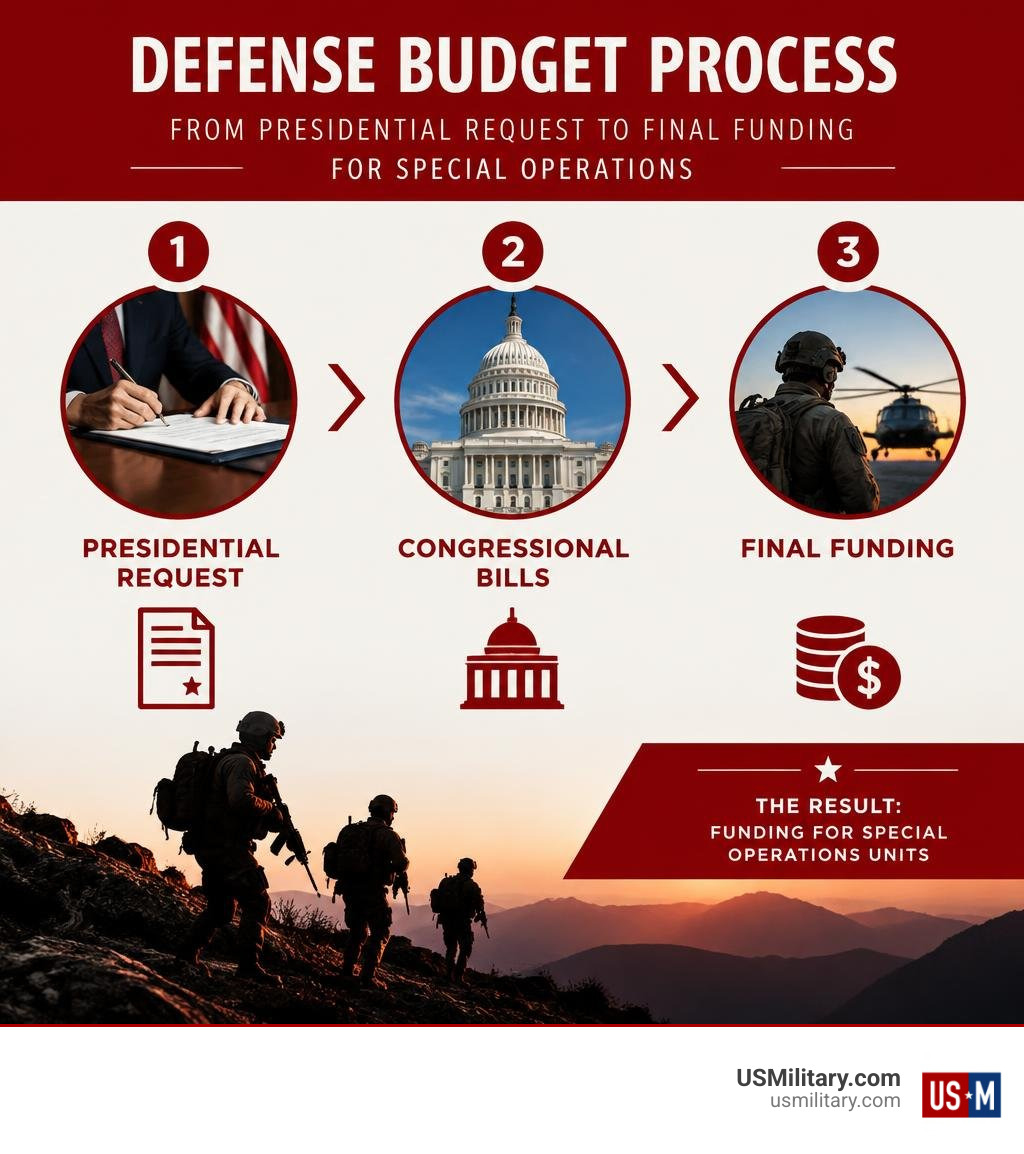
Important: Will the Budgets for Military Special Forces Be Cut If Democrats Take Control of Congress in the Midterm Elections:
Will The Budgets For Military Special Forces Be Cut If Democrats Take Control Of Congress in the Midterm Elections?
General Military Drawdown Facts: After the Vietnam War ended, overall U.S. defense spending dropped, and special forces units experienced widespread downsizing and budget tightening.
The 77-member Congressional Progressive Caucus has advocated trimming top-line Pentagon spending. Both parties acknowledge the indispensability of rapid-reaction capabilities during emerging international crises. The central question remains: Will Democrats cut military special-forces budgets if they take control of Congress in the midterm elections? The answer depends on how appropriations committees balance strategic priorities against fiscal constraints.
| Defense Budget Priority | Republican Approach | Democratic Approach |
|---|---|---|
| Top-Line Defense Spending | Push for historic expansions up to $1.5 trillion using reconciliation | Enforce discretionary caps; balance defense with domestic investments |
| Special Operations Posture | Maximize direct action, counter-narcotics, and regional strike assets | Prioritize oversight, partner-force training, and intelligence integration |
| Overseas Conflicts | Unilateral rapid response, border security, and executive operations | Strong War Powers enforcement, statutory authorization, allied coalition aid |
| Force Modernization | Procurement surges, nuclear deterrence, conventional hardware | High-tech R&D, cyber warfare, personnel sustainment, precision unmanned systems |
Will Democrats cut military special forces budgets if they take control of Congress in the midterm elections through NDAA oversight?
Leadership on the House and Senate Armed Services Committees plays a dominant role in military funding outcomes. Key figures like Representative Adam Smith and Senator Jack Reed champion rigorous legislative oversight, operational efficiency, and enforcement of the constitutional War Powers.
Under Title 10, Section 167 of the U.S. Code, USSOCOM maintains unique budgetary authority (Major Force Program 11) to develop, acquire, and field equipment tailored specifically to special operations requirements. Learning about the special operations community reveals how this specialized funding stream protects essential command capabilities against arbitrary cuts.
Rather than gutting SOF accounts, a Democratic-controlled committee structure is far more likely to curtail unauthorized conflicts or demand formal statutory justifications before deploying units abroad.
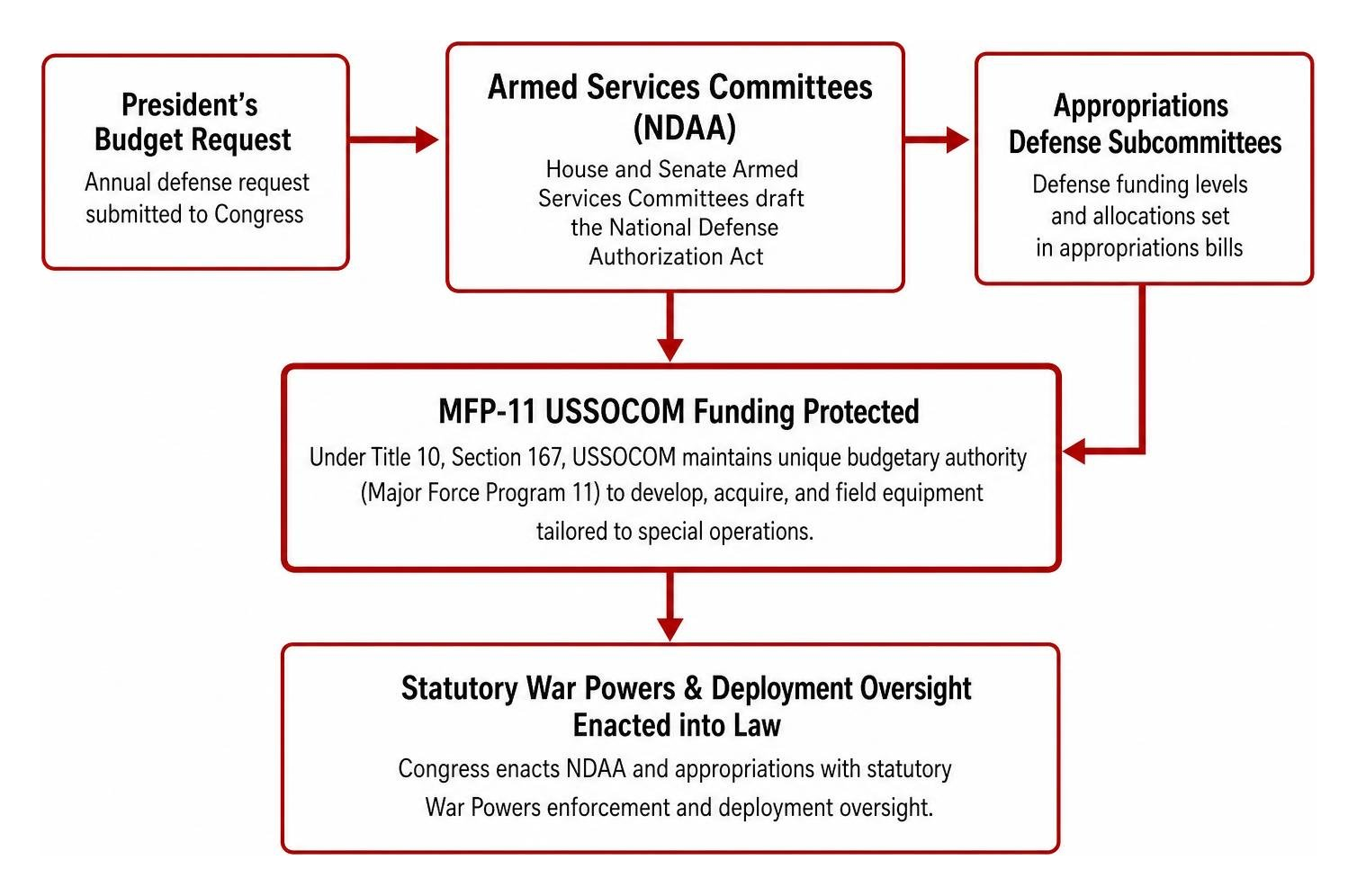
Reconciliation, Continuing Resolutions, and Pentagon Power of the Purse
The budget battles between 2025 and 2026 established unprecedented fiscal maneuvers across Capitol Hill. In 2025, lawmakers utilized the "One Big Beautiful Bill Act" (OBBB) to allocate $150 billion in defense spending via budget reconciliation, bypassing the traditional 60-vote Senate filibuster threshold. The FY26 request relied on $113 billion in reconciliation funding while keeping base discretionary spending relatively flat.
The Shift from Counterterrorism to Great Power Competition and SOF Force Structure
After two decades of intensive counterinsurgency and counterterrorism operations across multiple theaters, the Department of Defense has shifted toward great-power competition, prioritizing deterrence against peer adversaries in the Indo-Pacific and Eastern Europe. Understanding elite military training underscores why modern commandos must continuously balance counterterrorism skills with advanced electronic warfare, distributed maritime reconnaissance, cyber integration, and contested-logistics tactics.
The 10% Army SOF Force Reduction Debate
The Army's Total Army Analysis has explored various restructuring options, including a potential 10% reduction to certain Army Special Operations Command (USASOC) support billets. These proposed adjustments primarily target enablers—such as logistics elements, specialized administrative staff, and intelligence support units—to free up authorized end-strength for conventional armored formations and long-range precision fires units.
Lawmakers on both sides of the aisle have heavily scrutinized these trims during defense authorization hearings. When you compare special operations career and combat roles, the details show that combat enablers remain essential to keeping small detachment teams agile, self-sufficient, and lethal in contested theaters.
Conflict Priorities: Iran War, Ukraine Aid, and Caribbean Interdictions
Foreign policy disagreements heavily shape military resourcing and deployment authorizations. House Democrats introduced articles of impeachment against Defense Secretary Pete Hegseth, highlighting deep congressional tensions over unauthorized military strikes on drug-trafficking vessels in the Caribbean and kinetic strikes involving Iran conducted without formal declarations of war.
Concurrently, a Democratic Congress would likely accelerate military aid deliveries through established multilateral frameworks like NATO's Prioritized Ukraine Requirements List (PURL), converting months-long acquisition backlogs into rapid logistics flows. Under this strategic framework, SOF elements would see increased operational demand for advising, intelligence sharing, and foreign internal defense missions alongside strategic partners.
Bipartisan Realities: Historical Precedent and Future SOF Defense Spending
Historical defense data underscores that major spending shifts rarely follow clean partisan divides. The $716 billion FY2019 defense authorization bill received overwhelming bipartisan support, passing with affirmative votes from nearly three-fourths of House Democrats. As the INCONSISTENT CONGRESS report details, statutory spending caps like those established under the Fiscal Responsibility Act often apply fiscal pressure across the entire defense enterprise, yet specialized operational accounts remain remarkably resilient.
Key Factors Determining If Military Special Forces Budgets Will Be Cut If Democrats Take Control of Congress in the Midterm Elections
Several fundamental realities safeguard special operations funding regardless of midterm election outcomes:
- The Annual NDAA Consensus: The National Defense Authorization Act has passed with broad bipartisan majorities for more than six consecutive decades, reflecting enduring institutional support.
- Cost-Effective Return on Investment: Elite units represent less than 2% of the total defense budget while executing high-impact strategic tasks, deterrence missions, and crisis responses across the globe.
- Recruiting and Retention Pressures: All military branches face ongoing recruiting headwinds, making well-funded elite pipelines, specialized retention bonuses, and quality-of-life programs critical for long-term national readiness.
Staying informed on broader congressional defense policy shifts helps service members anticipate how legislative realignments affect everyday operations, training schedules, and deployment tempos.
Impact on Readiness, Modernization, and Procurement
Modernization across USSOCOM focuses heavily on next-generation emerging technology:
- Research, Development, Test & Evaluation (RDT&E): Advanced night-vision optics, secure tactical communications, resilient battlefield networks, and edge artificial intelligence.
- Unmanned Systems: Collaborative Combat Aircraft, loitering munitions, and precise-mass autonomous reconnaissance drones.
- Lifecycle Sustainment: Ensuring rapid hardware acquisitions are fully supported by long-term Operations and Maintenance (O&M) funding.
Frequently Asked Questions About Special Forces Budgets and Congressional Elections
What is the current funding status for USSOCOM under the Trump administration?
USSOCOM maintains robust baseline funding, supported directly by Major Force Program 11. While the administration requested an expansive top-line defense budget of $1.5 trillion for FY27—including $350 billion in proposed second-tranche reconciliation funding—special operations programs continue to receive dedicated appropriations across air, ground, and maritime components to preserve rapid crisis response.
Can Democrats unilaterally defund special operations if they win the House?
No. The constitutional legislative process requires agreement between both chambers of Congress and the White House. Even with a House majority, passing binding appropriations bills requires negotiation with the Senate and must overcome presidential veto power, ensuring core national defense priorities retain bipartisan support.
How do Pete Hegseth's Pentagon reforms impact special forces funding?
Defense Secretary Pete Hegseth ordered comprehensive internal efficiency reviews aiming to reduce administrative overhead by up to 8% while safeguarding 17 high-priority modernization areas. These structural initiatives prioritize border security, nuclear modernization, and direct combat units, minimizing adverse impacts on front-line commando forces and critical readiness programs.
Conclusion: Navigating the Future of Special Operations Funding
A change in congressional leadership after the 2026 midterms would renew scrutiny of unilateral foreign engagements, top-line reconciliation requests, and defense cabinet leadership. However, unlike the political events following the Vietnam War, we hope the foundational budget for U.S. Special Operations Command remains structurally sound, highly insulated from broad cuts, and backed by enduring bipartisan consensus.
At USMilitary.com, we provide active-duty personnel, veterans, and military families with transparent guidance on defense policies, VA benefits, and career paths. To understand how different elite units train and operate within these budgets, compare Army Delta Force vs. Navy SEALs to explore their distinct missions, histories, and training pipelines.