What Sets a Navy SEAL Career Apart?
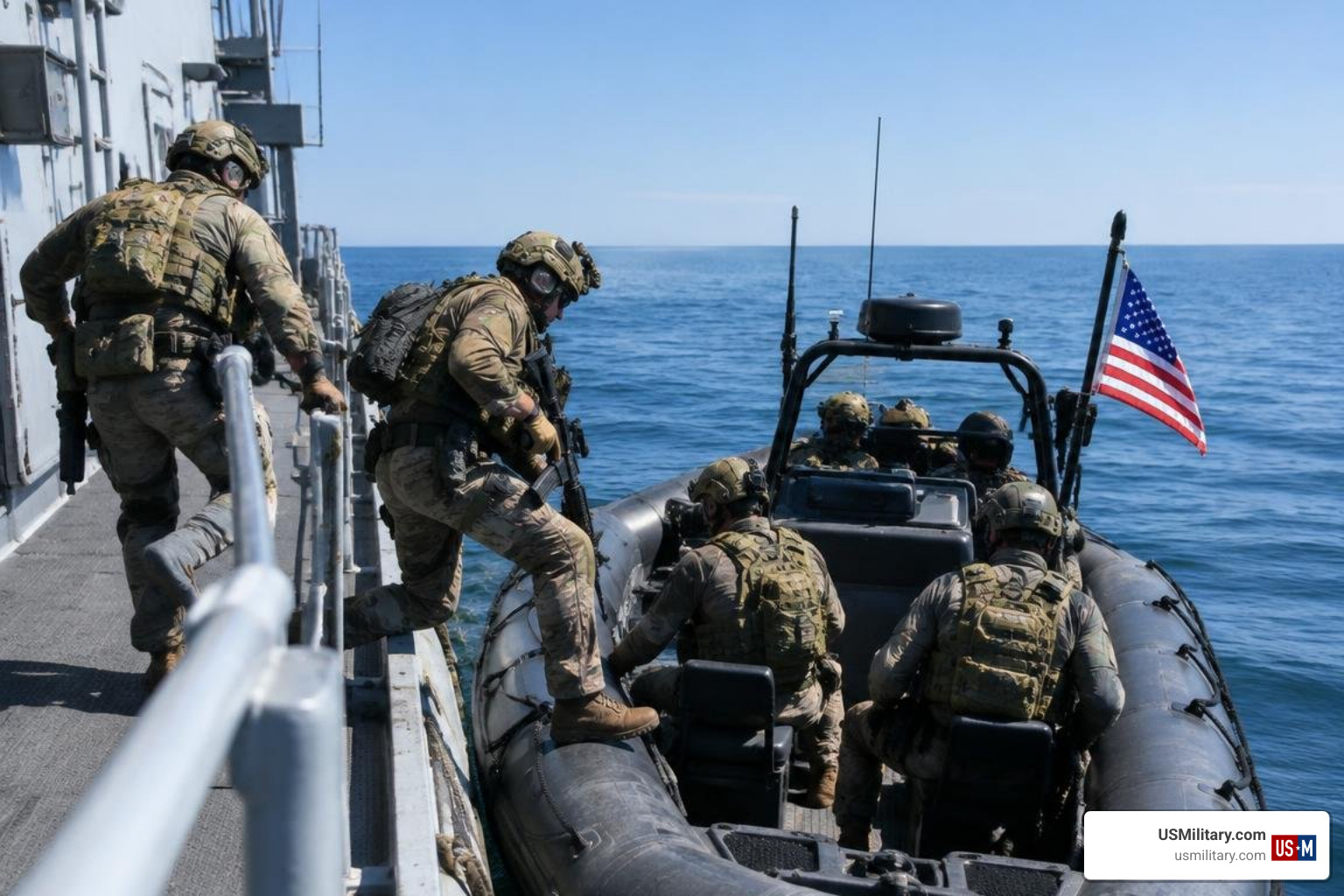
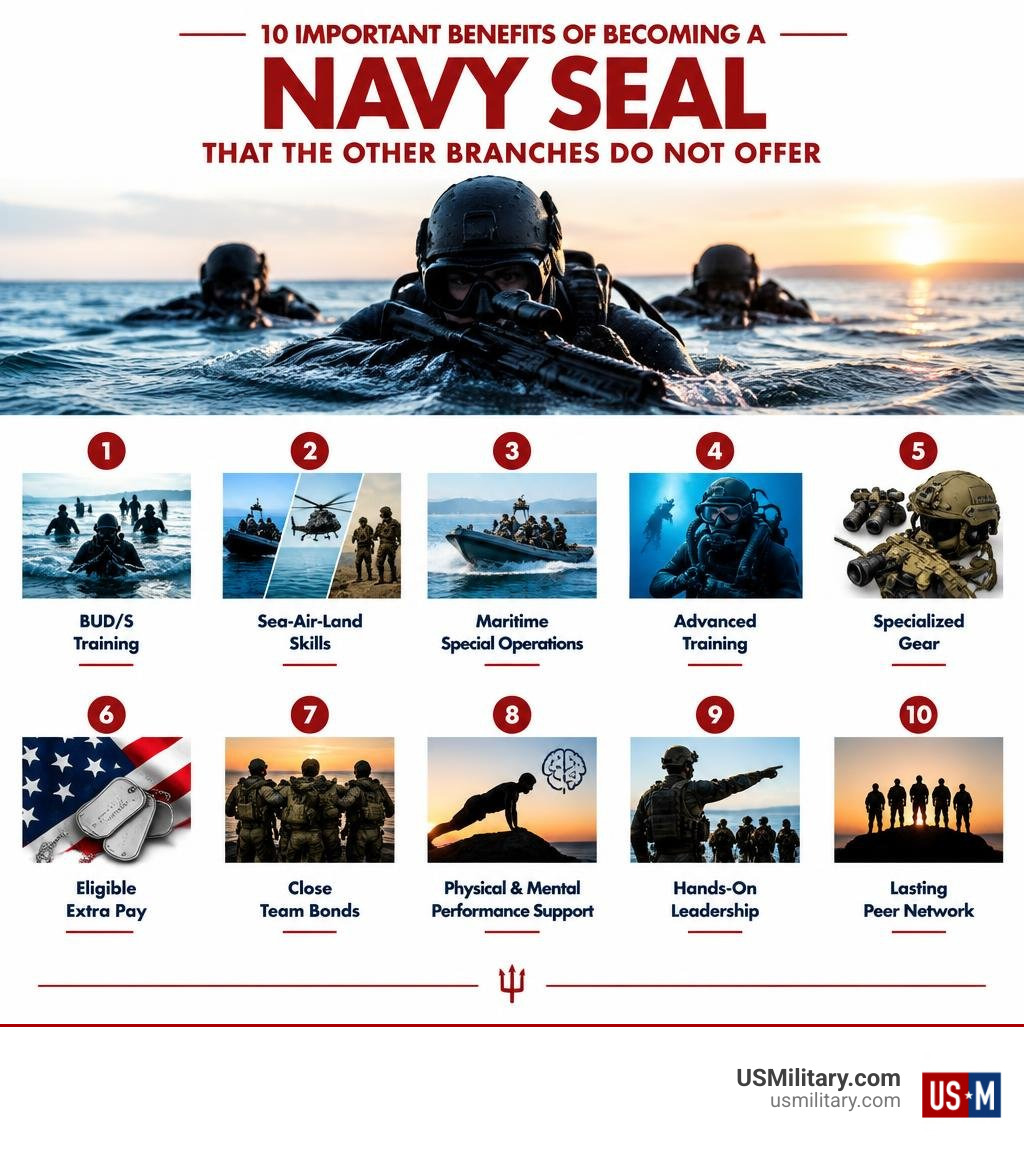
A Navy SEAL career stands apart through BUD/S training, sea-air-land skills, and a focus on maritime special operations. Other draws include advanced courses, specialized gear, eligible extra pay, strong team bonds, physical and mental performance support, hands-on leadership, and a lasting peer network.
The distinction matters: Other special operations forces offer demanding training, close teams, and some of the same extra pay. Standard military and VA benefits are not exclusive to SEALs.
I’m Larry Fowler, a Navy veteran and BUD/S Class 89 graduate. I bring that experience to this look at what truly sets this path apart.
Explore these essential guides on Naval Special Warfare careers and requirements:
- How Much Do Navy SEALs Make Per Year
- Navy SEALs BUD/S Training Requirements
- What is Navy SEAL Training 3 Phases And Why is it so tough
10 Important Benefits Of Becoming a Navy SEAL That The Other Branches Do Not Offer
Serving in the United States military offers tremendous pride, but Naval Special Warfare operates in an entirely different operational category. Conventional military paths often place service members into rigid, single-domain roles with highly centralized command structures. In contrast, becoming a Navy SEAL unlocks unparalleled multi-domain freedom, unmatched tactical autonomy, and elite personal development. Exploring 10 key benefits of becoming a Navy SEAL that other branches don't offer reveals advantages ranging from tri-domain combat supremacy to a lifelong alumni network.
To help illustrate the differences between Naval Special Warfare and conventional branch assignments, review this side-by-side comparison:
| Operational Feature | Conventional Military Branches | U.S. Navy SEAL Teams |
|---|---|---|
| Operational Domain | Single domain focus (Ground, Air, or Surface Fleet) | Tri-Domain mastery (Sea, Air, and Land) |
| Command Structure | Traditional, hierarchical top-down execution | Decentralized command and extreme ownership |
| Attrition & Selectivity | Standard entry qualifications | 70% to 80% selection attrition rate |
| Mission Autonomy | Broad formation support | Small-unit tactical autonomy and direct action |
| Specialized Training | Fixed occupational specialty training | Continuous high-tier tactical qualification pipelines |
To learn the official requirements and administrative standards, prospective candidates often consult the Navy Special Warfare community guidelines to understand what it takes to join this elite brotherhood.
1. Tri-Domain Combat Supremacy Across Sea, Air, and Land
Most service branches specialize in a single battle space: the Army focuses primarily on ground combat, the Air Force dominates the skies, and the conventional Navy manages surface and subsurface fleet assets. Navy SEALs (SEa, Air, Land) are explicitly organized, trained, and equipped to operate across all three environments seamlessly.
Whether conducting subsurface combat diving with closed-circuit rebreathers, jumping from high altitudes under cover of night, or conducting direct-action ground assaults, SEALs transition across environments without operational handoffs. For a deeper look into how these multi-environment missions operate in the real world, explore our comprehensive Navy SEAL operational overview.
2. Extreme Mental Inoculation and Psychological Resilience
The psychological transformation undergone during Basic Underwater Demolition/SEAL (BUD/S) training builds unmatched mental resilience. Dropout rates during BUD/S hover around 70%, with some winter classes seeing attrition reach 85%. During Hell Week, candidates run over 200 miles and engage in intense physical training for more than 20 hours a day while surviving on roughly four total hours of sleep across five and a half days.
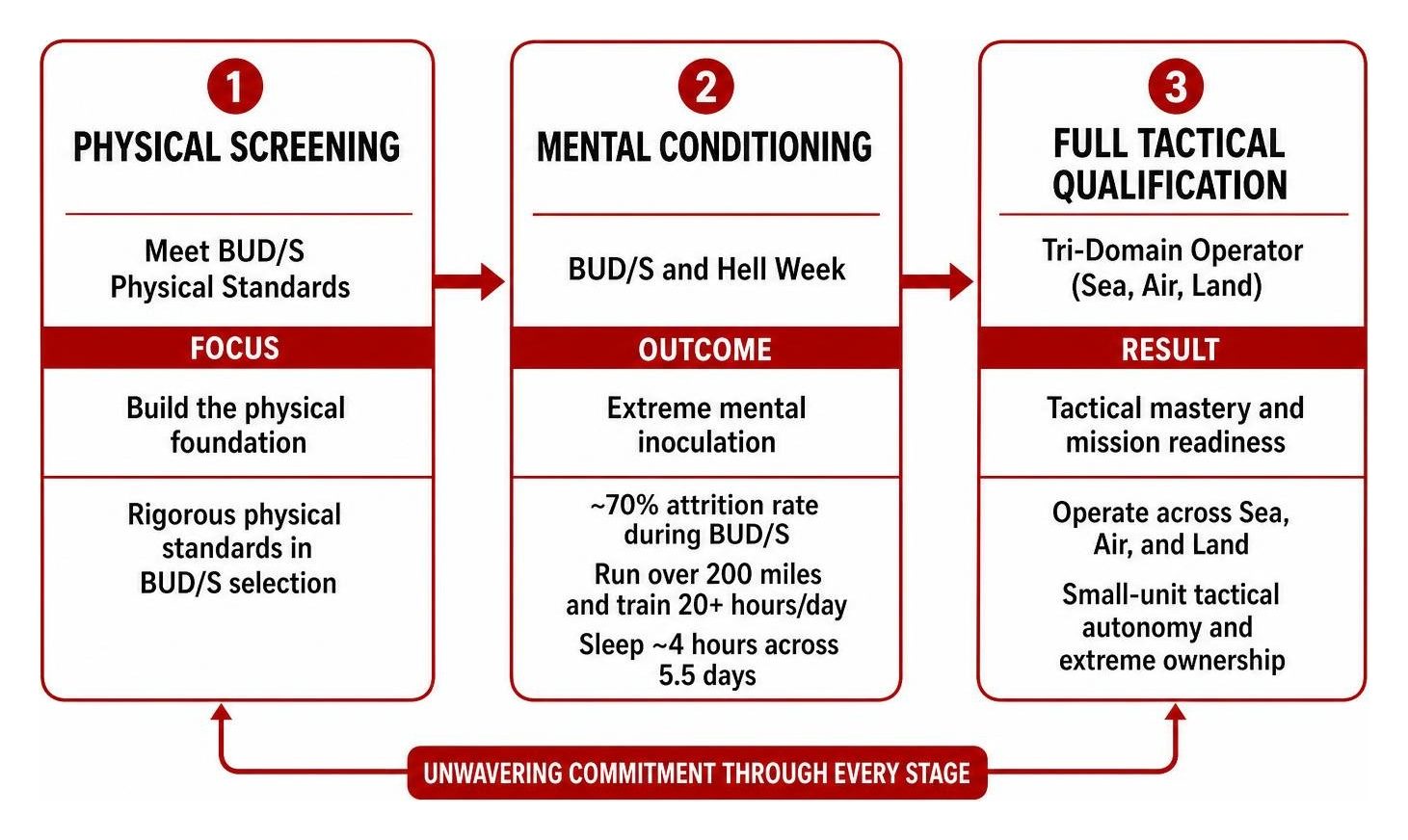
This crucible produces a distinct psychological profile. Psychological profiling data reveals that successful operators score significantly lower in Neuroticism than the average adult male, displaying profound emotional stability and low anxiety. They also register exceptionally high in Conscientiousness, indicating methodical organization and unwavering commitment. Candidates internalize concepts like the "40% Rule"—the understanding that when your mind tells you that you are physically spent, you have only tapped into 40% of your actual capability. Meeting the rigorous physical standards in BUD/S selection builds mental toughness that lasts a lifetime.
3. Flat Hierarchy and Decentralized Extreme Ownership
Conventional military structures rely on rigid, top-down chains of command where junior personnel rarely make real-time tactical decisions. Naval Special Warfare flips this model through decentralized command and extreme ownership.
In a SEAL platoon, leadership is fluid. While officers retain ultimate responsibility, operational planning and execution require every operator—regardless of rank—to take complete ownership of their role. If a mission descends into chaos, junior enlisted operators step up instantly and make strategic decisions. This environment of absolute mutual trust and "Cover and Move" communication fosters leadership capabilities rarely cultivated so early in other military branches.
4. Direct Global Action and Unconventional Warfare
While large conventional forces focus on broad-area defense and sustained logistical maneuvers, SEALs specialize in small-unit direct action raids, counter-terrorism, and interdiction of high-value targets. Operating in tight 16-man platoons, SEAL elements execute sensitive national security priorities with minimal footprints.
These high-stakes deployments require exceptional strategic trust from top military commanders. To understand how individual operational units are structured to manage these direct-action taskings, read our breakdown of Navy SEAL Team 4's organizational structure.

5. Specialized Advanced Tactical Pipelines and High-Tier Equipment
Earning the Trident is simply the beginning of an operator's technical education. Once assigned to a team, SEALs have access to world-class tactical pipelines that far surpass standard military occupational specialties.
Operators regularly complete advanced schools, including:
- Special Operations Combat Medic (SOCM) courses
- Naval Special Warfare Sniper School
- High-altitude Military Freefall (MFF) and Jumpmaster qualifications
- Advanced Combat Diving and Dive Supervisor certifications
- Technical surveillance and intelligence analysis
- Advanced tactical mobility and military performance driving
In addition to elite training schools, SEALs receive priority access to state-of-the-art weapons systems, advanced night-vision optics, specialized maritime craft, and custom gear.
Long-Term Career, Financial, and Alumni Advantages of the Trident
6. Premier Special Duty Incentive Pay and Enlistment Bonuses
While base military pay is standardized across all Department of Defense branches by rank and years of service, Navy SEALs maximize compensation through extensive special duty incentive pays. Starting pay for an operator can reach up to $60,000 annually when factoring in specialized allowances.
Qualified operators stack multiple monthly incentive pays on top of basic pay and tax-free housing allowances, including:
- Demolition Duty Pay
- Special Duty Assignment Pay (SDAP)
- Military Freefall and Parachute Jump Pay
- Hazardous Duty and Combat Diving Pay
- High-demand foreign language proficiency pay
Review our guide to enlisted Navy SEAL compensation standards in 2026, along with our comprehensive breakdown of Navy SEAL salary structures, to see how these bonuses and allowances accumulate over a 20-year career.
7. The Swim-Buddy Culture and Lifelong Mastermind Network
In BUD/S, candidates are assigned a "swim buddy"—a partner from whom they cannot be separated by more than arm's length. If one fails, both pay the price. This builds an extraordinary culture of mutual accountability that extends throughout an operator's life.
When SEALs leave active duty, they join an elite, tightly knit alumni network. This community acts like an executive mastermind group where veterans support one another in launching ventures, securing leadership roles, and navigating personal transitions. Seeing how BUD/S training accelerates personal growth provides perspective on why these lifelong relationships remain unbreakable.
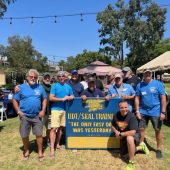
After graduating BUD/S class 89 almost 50 years ago, I'm still in contact with my swimbuddy, the amazing one-and-only Guy Cortise.

The Only Easy Day Was Yesterday: BUD/S Class 89
8. Holistic Human Performance, Longevity, and Conditioning
Naval Special Warfare treats operators as tactical athletes. Rather than relying solely on traditional calisthenics, modern SEAL conditioning integrates physical therapists, strength coaches, sports psychologists, and nutrition experts.
This holistic approach focuses on sustainable performance, mobility, cognitive processing under fatigue, and proactive injury prevention. Operators gain a deep, lifelong understanding of their own physiology, giving them physical and mental vitality that lasts well beyond their service years.
9. Global Prestige and Superior Post-Military Executive Opportunities
The Navy SEAL Trident is internationally recognized as a hallmark of discipline, grit, and executive potential. Corporate recruiters and venture capital firms actively seek out former operators because they know these individuals thrive under uncertainty, make decisive choices under pressure, and manage complex risks.
Studies show that BUD/S graduates score significantly higher in adjustment, likability, and managerial potential than those who drop out. With high extraversion and emotional stability, former SEALs transition into senior leadership roles in business, technology, consulting, and entrepreneurship with exceptional track records.
10. Cultivated Humor Under Extreme Stress and Lifelong Confidence
One of the least-talked-about, but most powerful, benefits of SEAL training is cultivating humor under extreme stress. When you are shivering in freezing surf at 3:00 AM after four days without sleep, shared laughter becomes a vital psychological survival tool.
This cognitive reframing teaches operators to defuse tension and stay grounded during high-pressure crises. Coupled with earned competence, it develops an unshakeable, quiet confidence. SEALs do not need to project bravado; their internal self-assurance allows them to approach personal and professional challenges with calm poise.
Comparing Naval Special Warfare to Other Military Branch Pipelines
While every branch of the U.S. Armed Forces features elite specialized units—such as Army Special Forces, Air Force Pararescue, and Marine Raiders—Naval Special Warfare maintains distinct differences in mission focus, team size, and maritime doctrine.
Across the approximately 2,900 active-duty Navy SEALs serving worldwide, the training pipeline remains uniquely rigorous. Understanding the three rigorous phases of Navy SEAL training helps prospective candidates evaluate how selection differs from other special operations pipelines across the military.
Frequently Asked Questions About Navy SEAL Benefits
What makes Navy SEAL compensation higher than standard military branch pay?
Navy SEALs earn higher total compensation than standard service members because they qualify for multiple concurrent special duty incentive pays, including dive pay, jump pay, demolition pay, and special assignment pay, alongside substantial enlistment and retention bonuses.
How does Navy SEAL mental conditioning differ from other special operations forces?
Naval Special Warfare selection centers heavily on continuous water immersion, hypothermic stress conditioning, and prolonged sleep deprivation during Hell Week. This process selects candidates with exceptionally low neuroticism, high conscientiousness, and strong emotional regulation.
What civilian career advantages do former Navy SEALs have over other veterans?
Former SEALs carry immediate brand recognition for elite leadership, crisis management, and adaptability. Their deep alumni network and decentralized-command training make them top candidates for executive leadership, venture-backed startups, and consulting careers.
Conclusion
The journey to earning the Navy SEAL Trident demands extreme sacrifice, but the unique advantages—from tri-domain operational capabilities and premier incentive pay to lifelong leadership resilience—are unmatched across the armed services.
At NavySeal.com and USMilitary.com, we provide comprehensive guidance on military career pathways, VA benefits, and veteran transition resources. To explore every step of the selection pipeline, requirements, and heritage of Naval Special Warfare, read our complete Navy SEAL career and training guide and begin your journey toward elite service.